Loading...
Claude Auchinleck vs K. M. Cariappa
K. M. Cariappa leads by 1.6 pts · 2 figures compared
…
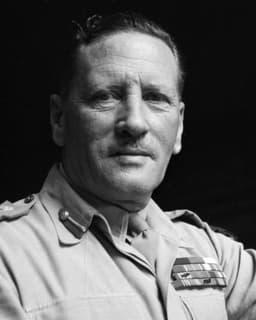
Claude Auchinleck
General · Modern
55.2Total

K. M. Cariappa
General · Modern
56.8Total
Basic Information
Born
1884
1899
Died
1981
1993
Era
Modern
Modern
Nationality
United Kingdom
India
Occupation
General
General
Civilization
Western
Indian
Score Comparison
Military (10%)
72.5
38.3
Political (20%)
39.4
68.0
Influence (20%)
61.0
55.0
Legacy (20%)
50.0
50.0
Leadership (15%)
54.2
70.0
Strategy (15%)
61.2
60.0
TOTAL
55.2
56.8
Claude Auchinleck — Complete Timeline
1941 AD
Appointed Commander-in-Chief of India CommandOther◆ Major
Auchinleck was appointed Commander-in-Chief of the Indian Army in January 1941. He oversaw the expansion and training of Indian forces for service in the Middle East, East Africa, and Southeast Asia, building a multi-ethnic army that grew to over two million men.
World War IIIndia
Impact: national
Appointed Commander-in-Chief of Middle East CommandOther◆ Major
Auchinleck replaced Archibald Wavell as Commander-in-Chief of Middle East Command in July 1941. He assumed command of British forces in North Africa, Iraq, and Persia during a critical period when German forces under Rommel were threatening Egypt and the Suez Canal.
World War IINorth Africa
Impact: national
Launched Operation CrusaderOther◆ Major
Auchinleck launched Operation Crusader on November 18, 1941, an offensive to relieve the besieged garrison at Tobruk. After heavy tank battles at Sidi Rezegh, British forces relieved Tobruk on December 10, forcing Rommel to retreat to El Agheila and lifting the 242-day siege.
World War IINorth AfricaVictory
Impact: nationalconstructive
1942 AD
Defeated at the First Battle of El AlameinOther◆ Major
Auchinleck personally took command of the Eighth Army in June 1942 after the fall of Tobruk. He halted Rommel's advance at the First Battle of El Alamein in July 1942, preventing the Axis from reaching Alexandria and the Suez Canal, but failed to destroy the German forces.
World War IINorth AfricaStalemate
Impact: national
Relieved of Command and Replaced by MontgomeryOther◆ Major
Auchinleck was relieved of command in August 1942 by Prime Minister Churchill, who lost confidence in his leadership. He was replaced by General Harold Alexander as Commander-in-Chief and Bernard Montgomery as commander of the Eighth Army, a decision that remains controversial among historians.
World War IINorth AfricaDismissal
Impact: nationaldestructive
1943 AD
Appointed Commander-in-Chief of India Command (Second Term)Other◆ Major
Auchinleck returned as Commander-in-Chief of the Indian Army in June 1943, a position he held until 1947. He oversaw the Burma Campaign, the defense against the Japanese invasion of India, and the post-war demobilization and partition of the Indian Army between India and Pakistan.
World War IIIndiaPartition
Impact: national
K. M. Cariappa — Complete Timeline
1945 AD
Awarded Order of the British Empire (OBE)Cultural
Cariappa was awarded the Order of the British Empire (OBE) for his services during World War II. He served in the Burma Campaign and other theaters, commanding troops.
AwardWorld War IIMilitary
Impact: national
1947 AD
Led Indian Forces in the 1947-48 Kashmir WarWar◆ Major
As a senior commander, Cariappa played a key role in the military operations during the first Indo-Pakistani war over Kashmir. He coordinated Indian forces to repel tribal invaders and secure the state's accession to India.
Kashmir WarMilitary Operations1947
Impact: regional
1949 AD
Appointed First Indian Commander-in-Chief of Indian ArmyPolitical Action◆ Major
K. M. Cariappa was appointed as the first Indian Commander-in-Chief of the Indian Army, succeeding General Sir Roy Bucher. This marked the Indianization of the army's top leadership after independence.
ArmyIndianizationLeadership
Impact: nationalconstructive
1953 AD
Served as High Commissioner to AustraliaPolitical Action
After retiring from the army, Cariappa served as India's High Commissioner to Australia. He focused on diplomatic relations and trade, representing India in the Commonwealth.
DiplomacyHigh CommissionerAustralia
Impact: national
Expert Analysis
Origins
Claude Auchinleck was born on June 21, 1884, in Aldershot, England, into a military family. His father was a colonel in the Royal Artillery. Auchinleck attended Wellington College and the Royal Military College, Sandhurst, graduating in 1904. He was commissioned into the Indian Army, serving in the 62nd Punjabis. This early exposure to India shaped his career.
K. M. Cariappa was born on January 28, 1899, in Shanivarsante, Coorg, India, into a farming family. He was educated at Central High School in Bangalore and later at Presidency College, Madras. In 1919, he joined the Indian Army as a temporary officer, receiving training at the Daly Cadet College in Indore. He was commissioned into the 2/88th Carnatic Infantry.
Rise to Power
Auchinleck rose through the Indian Army, serving in World War I in Mesopotamia. By 1930, he was a brigadier. In 1941, he was appointed Commander-in-Chief of India Command (scored 72.5 in military), overseeing the expansion of Indian forces. His biggest break came in July 1941 when he replaced Archibald Wavell as Commander-in-Chief of Middle East Command, taking charge of the North African campaign.
Cariappa's rise was slower due to colonial barriers. He served in World War II in Burma, earning the Order of the British Empire. After independence, he was appointed Deputy Chief of the Indian Army. In 1949, he became the first Indian Commander-in-Chief of the Indian Army, succeeding General Sir Roy Bucher. This was a pivotal moment for Indian military independence (scored 68.0 in political).
Leadership & Governance
Auchinleck's leadership was marked by careful planning but poor communication with superiors. He launched Operation Crusader in November 1941, relieving Tobruk. However, his cautious approach frustrated Churchill. At the First Battle of El Alamein in July 1942, he halted Rommel's advance but failed to counterattack decisively. His governance style was methodical but lacked the aggressive drive Churchill wanted.
Cariappa's leadership emphasized integration and professionalism. He oversaw the Indianization of the army's officer corps, ensuring smooth transition from British control. He led Indian forces in the 1947-48 Kashmir War, coordinating operations to secure the state. His political score of 68.0 reflects his diplomatic skills, including his later role as High Commissioner to Australia. He focused on morale and unity, scoring 70.0 in leadership.
Triumph & Tragedy
Auchinleck's greatest triumph was halting Rommel at El Alamein in July 1942, saving Egypt. His Operation Crusader also succeeded in relieving Tobruk. However, his tragedy was his relief in August 1942 by Churchill, who replaced him with Montgomery. Auchinleck never held a major field command again. His strategic score of 61.2 reflects competence but not brilliance.
Cariappa's triumph was becoming the first Indian Commander-in-Chief, a symbol of national pride. He also helped secure Kashmir in 1948. His tragedy was that his military role was largely administrative; he did not command in a major war. His military score of 38.3 is low because his combat experience was limited compared to Auchinleck.
Character & Destiny
Auchinleck was reserved and intellectual, earning the nickname "The Auk." He was a good organizer but lacked the charisma to inspire Churchill's confidence. His destiny was to be overshadowed by Montgomery, though historians now recognize his contributions. His total score of 55.2 reflects a solid but not exceptional career.
Cariappa was known for his integrity and dedication to nation-building. He was a unifying figure in a newly independent India. His destiny was to be a symbol of Indian military independence rather than a battlefield hero. His total score of 56.8 edges out Auchinleck due to his political and leadership scores.
Legacy
Auchinleck's legacy is mixed: he is remembered as a competent commander who was unfairly sacked. His reforms to the Indian Army, including expansion and training, had lasting impact. However, his name is often forgotten in popular histories. His influence score of 61.0 reflects moderate recognition.
Cariappa's legacy is profound in India: he is celebrated as the first Indian Commander-in-Chief. His role in Indianizing the army paved the way for future leaders. The K. M. Cariappa Award is given for military excellence. His influence score of 55.0 is lower globally but high in India.
Conclusion
K. M. Cariappa had greater impact on his nation's military history than Auchinleck. While Auchinleck's military score (72.5) far exceeds Cariappa's (38.3), Cariappa's political (68.0) and leadership (70.0) scores reflect his crucial role in transitioning the Indian Army to independent control. Auchinleck's contributions were significant but ultimately temporary; he was replaced. Cariappa's legacy as the first Indian commander-in-chief endures as a foundational event for modern India. Therefore, Cariappa edges out Auchinleck with a total score of 56.8 vs 55.2.
Rankings
🥇
K. M. CariappaLeader
Mil: 38.3Pol: 68.0Inf: 55.0
56.8
🥈
Claude Auchinleck
Mil: 72.5Pol: 39.4Inf: 61.0
55.2
+1.6 behind
How This Comparison Works
Algorithm
Each figure is scored on 6 dimensions (0—100 scale) based on structured historical data: Military (10%), Political (20%), Influence (20%), Legacy (20%), Leadership (15%), Strategy (15%). The weighted total produces the final ranking.
Data Sources
Scores are computed from structured sub-indicators in the database. Scale factors adjust for era (Ancient ×0.85, Modern ×1.0) and civilization size (Eastern ×1.05, Other ×0.80) to account for differences in population and military scale.
Maximum 3 Figures
Comparisons are limited to 2—3 figures to ensure readability and statistical meaningfulness.
Error Margins
±5 points per dimension — Sub-scores are derived from historical records with inherent uncertainty. Two figures within 5 points on a dimension should be considered roughly equivalent in that area.
Total Score Accuracy
±3 points overall — The weighted combination of 6 dimensions produces a total score with approximately ±3 points of uncertainty. Differences of less than 3 points are not statistically significant— the figures are effectively tied.
Known Limitations
- Historical records are incomplete and uneven across civilizations
- Figures from oral-tradition societies may be underrepresented
- Occupation labels can misclassify multi-role figures
- Scores measure capability and impact, not moral character
- Quantitative scoring is a comparison tool, not absolute truth
Capability Radar
Military (10%) — Battles & Warfare
Battles
65
30
Win Rate
55
40
Expansion
50
20
Political (20%) — Governance & Reform
Reform
20
50
Diplomacy
40
50
Economy
15
30
Influence (20%) — Cultural & Global Reach
Cultural
30
40
Global
45
45
Legacy (20%) — Historical Impact
Historical
55
55
Longevity
40
40
Leadership (15%) — Power & Stability
Tenure
30
55
Stability
25
60
Strategy (15%) — Tactics & Innovation
Strategy
75
40
Tactics
70
35
Reform
60
60
Similar Comparisons
Comments & Discussion
No comments yet. Be the first to share your thoughts!