Loading...
This comparison has not been analyzed yet.
One-time AI generation (~1 minute). Scores and timeline are already available below.
Cato the Elder vs Pharnabazus II
Cato the Elder leads by 8.6 pts · 2 figures compared
…
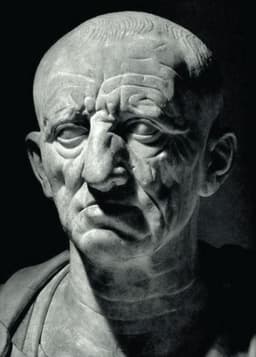
Cato the Elder
Politician · Ancient
63.0Total

Pharnabazus II
Politician · Ancient
54.4Total
Basic Information
Born
-234
-450
Died
-149
-370
Era
Ancient
Ancient
Nationality
Roman Republic
Achaemenid Empire
Occupation
Politician
Politician
Civilization
Western
Middle Eastern
Score Comparison
Military (10%)
45.0
38.3
Political (20%)
55.0
68.0
Influence (20%)
68.0
54.9
Legacy (20%)
68.0
48.3
Leadership (15%)
72.0
68.0
Strategy (15%)
54.3
43.3
TOTAL
63.0
54.4
Cato the Elder — Complete Timeline
195 BC
Consulship and Campaign in SpainWar
Cato served as consul and led a campaign in Hispania Citerior, suppressing a rebellion. He used harsh tactics, including mass executions, to pacify the region, and later boasted of his victories in his writings.
Military campaignSpanish wars
Impact: regionaldestructive
184 BC
Censorship and Moral ReformsReform◆ Major
Cato the Elder served as censor, implementing strict moral reforms to combat luxury and corruption. He expelled senators for immorality, taxed luxury goods, and promoted traditional Roman values, earning the nickname 'Censorius'.
CensorshipMoral reform
Impact: nationalconstructive
168 BC
Publication of 'Origines'Cultural◆ Major
Cato wrote 'Origines', the first history of Rome in Latin. The work covered the founding of Rome and the early Republic, emphasizing Roman virtues and the importance of agriculture, and influenced later Roman historiography.
LiteratureHistoriography
Impact: nationalconstructive
155 BC
Opposition to HellenizationPolitical Action
Cato opposed the influence of Greek culture on Rome, arguing it undermined Roman values. He led a campaign to expel Greek philosophers from Rome and promoted traditional Roman education and customs.
Cultural conflictConservatism
Impact: national
153 BC
Campaign for the Destruction of CarthagePolitical Action◆ Major
Cato ended every speech in the Senate with 'Carthago delenda est' (Carthage must be destroyed). His persistent advocacy for war against Carthage influenced Roman policy and contributed to the outbreak of the Third Punic War.
Foreign policyImperialism
Impact: globaldestructive
Pharnabazus II — Complete Timeline
430 BC
Appointed Satrap of DascyliumPolitical Action◆ Major
Pharnabazus II succeeded his father as satrap of Dascylium (Hellespontine Phrygia). He governed this strategic region during the Peloponnesian War, using its resources to influence Greek affairs.
AppointmentSatrapyPeloponnesian War
Impact: regional
412 BC
Alliance with SpartaPolitical Action◆ Major
Pharnabazus II allied with Sparta during the Peloponnesian War, providing financial and naval support to the Spartans against Athens. This alliance helped Sparta build a fleet that challenged Athenian naval dominance.
AlliancePeloponnesian WarSparta
Impact: regionalconstructive
410 BC
Conflict with AthensWar
Pharnabazus II fought against Athenian forces in the Hellespont region, including the Battle of Cyzicus in 410 BC where the Athenian fleet defeated the Spartan-Persian fleet. This setback weakened Persian influence temporarily.
BattlePeloponnesian WarAthens
Impact: regionaldestructive
404 BC
Played Athens and Sparta Against Each OtherPolitical Action◆ Major
After the Peloponnesian War, Pharnabazus II shifted Persian policy, supporting Athens against Sparta to prevent Spartan hegemony. He provided funds to the Athenian general Conon, helping rebuild the Athenian fleet.
DiplomacyBalance of PowerConon
Impact: regionalconstructive
This comparison has not been analyzed yet.
One-time AI generation (~1 minute). Scores and timeline are already available below.
Rankings
🥇
Cato the ElderLeader
Mil: 45.0Pol: 55.0Inf: 68.0
63.0
🥈
Pharnabazus II
Mil: 38.3Pol: 68.0Inf: 54.9
54.4
+8.6 behind
How This Comparison Works
Algorithm
Each figure is scored on 6 dimensions (0—100 scale) based on structured historical data: Military (10%), Political (20%), Influence (20%), Legacy (20%), Leadership (15%), Strategy (15%). The weighted total produces the final ranking.
Data Sources
Scores are computed from structured sub-indicators in the database. Scale factors adjust for era (Ancient ×0.85, Modern ×1.0) and civilization size (Eastern ×1.05, Other ×0.80) to account for differences in population and military scale.
Maximum 3 Figures
Comparisons are limited to 2—3 figures to ensure readability and statistical meaningfulness.
Error Margins
±5 points per dimension — Sub-scores are derived from historical records with inherent uncertainty. Two figures within 5 points on a dimension should be considered roughly equivalent in that area.
Total Score Accuracy
±3 points overall — The weighted combination of 6 dimensions produces a total score with approximately ±3 points of uncertainty. Differences of less than 3 points are not statistically significant— the figures are effectively tied.
Known Limitations
- Historical records are incomplete and uneven across civilizations
- Figures from oral-tradition societies may be underrepresented
- Occupation labels can misclassify multi-role figures
- Scores measure capability and impact, not moral character
- Quantitative scoring is a comparison tool, not absolute truth
Capability Radar
Military (10%) — Battles & Warfare
Battles
10
45
Win Rate
10
40
Expansion
10
35
Political (20%) — Governance & Reform
Reform
70
30
Diplomacy
60
75
Economy
70
50
Influence (20%) — Cultural & Global Reach
Cultural
70
30
Global
60
30
Legacy (20%) — Historical Impact
Historical
70
45
Longevity
70
35
Leadership (15%) — Power & Stability
Tenure
60
60
Stability
60
45
Strategy (15%) — Tactics & Innovation
Strategy
10
60
Tactics
10
55
Reform
10
20
Similar Comparisons
Comments & Discussion
No comments yet. Be the first to share your thoughts!