Loading...
Chan Santokhi vs Mahmoud Abbas
Mahmoud Abbas leads by 0.5 pts · 2 figures compared
…
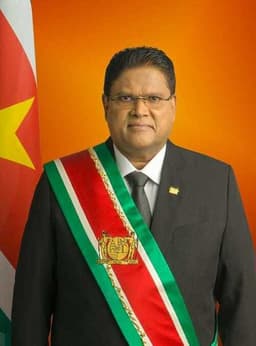
Chan Santokhi
Politician · Modern
49.0Total

Mahmoud Abbas
Politician · Modern
49.5Total
Basic Information
Born
1959
1935
Died
—
—
Era
Modern
Modern
Nationality
Suriname
Palestine
Occupation
Politician
Politician
Civilization
Other
Middle Eastern
Score Comparison
Military (10%)
50.0
47.1
Political (20%)
45.0
42.3
Influence (20%)
50.2
54.1
Legacy (20%)
40.8
45.0
Leadership (15%)
68.0
64.0
Strategy (15%)
42.9
40.7
TOTAL
49.0
49.5
Chan Santokhi — Complete Timeline
1991 AD
Appointed Police CommissionerPolitical Action
Santokhi was appointed Commissioner of the Suriname Police Force, a position he held until 2005. His tenure was noted for efforts to professionalize the force and combat crime, though it also coincided with periods of political tension.
PoliceLaw EnforcementCareer
Impact: national
2000 AD
Led investigation into December MurdersPolitical Action◆ Major
As Police Commissioner, Santokhi oversaw the investigation into the 1982 December Murders, in which 15 political opponents of the military regime were executed. This investigation eventually led to the trial and conviction of former President Desi Bouterse.
Human RightsJusticeDecember Murders
Impact: nationalconstructive
2005 AD
Elected to National AssemblyPolitical Action
Santokhi was elected to the National Assembly of Suriname as a member of the Progressive Reform Party (VHP). This marked his transition from police leadership to formal politics.
ParliamentPolitical CareerVHP
Impact: national
Appointed Minister of Justice and PolicePolitical Action
Santokhi served as Minister of Justice and Police under President Ronald Venetiaan. He continued efforts to reform the justice system and pursue accountability for past human rights abuses.
CabinetJustice ReformVenetiaan
Impact: nationalconstructive
2020 AD
Elected President of SurinamePolitical Action◆ Major
Chan Santokhi was elected President of Suriname by the National Assembly, succeeding Desi Bouterse. His election marked a shift in Suriname's political landscape after a period of economic difficulty and the previous administration's legal troubles.
ElectionPresidencySuriname
Impact: nationalconstructive
Mahmoud Abbas — Complete Timeline
1993 AD
Signed Oslo Accords as NegotiatorPolitical Action
As a key PLO negotiator, Abbas was instrumental in the secret talks that led to the Oslo Accords. He signed the Declaration of Principles on behalf of the PLO, establishing the Palestinian Authority and a framework for Israeli-Palestinian peace.
Oslo AccordsPeace ProcessPLO
Impact: globalconstructive
2004 AD
Elected Chairman of the Palestine Liberation OrganizationPolitical Action◆ Major
Following Yasser Arafat's death, Abbas was elected Chairman of the PLO. This position made him the central figure in Palestinian leadership, responsible for negotiations with Israel and internal Palestinian governance.
Palestinian LeadershipPLOSuccession
Impact: regional
2005 AD
Elected President of the Palestinian AuthorityPolitical Action◆ Major
Abbas won the Palestinian presidential election with 62% of the vote. His election followed Arafat's death and was seen as a mandate for peace negotiations with Israel, though his term expired in 2009 without new elections.
Palestinian AuthorityElectionPeace Process
Impact: regional
2007 AD
Hamas Takeover of GazaPolitical Action◆ Major
After winning the 2006 Palestinian legislative election, Hamas forcibly seized control of the Gaza Strip from Fatah forces loyal to Abbas. This split the Palestinian territories into two rival governments: Fatah in the West Bank and Hamas in Gaza.
Palestinian SplitHamasFatahCivil Conflict
Impact: regionaldestructive
2011 AD
Submitted Palestinian UN Membership BidPolitical Action◆ Major
Abbas formally submitted an application to the United Nations seeking full membership for the State of Palestine. The bid was not approved by the Security Council but led to Palestine being granted non-member observer state status in 2012.
United NationsStatehoodDiplomacy
Impact: global
Expert Analysis
Origins
Chan Santokhi was born on February 3, 1959, in Lelydorp, Suriname, to a family of Indian descent. He studied at the Police Academy and later earned a law degree from the Anton de Kom University. Santokhi began his career as a police officer, rising through the ranks. Mahmoud Abbas was born on November 15, 1935, in Safed, Palestine (now Israel). His family fled during the 1948 Arab-Israeli war. Abbas studied law in Damascus and later earned a PhD in history from the Patrice Lumumba University in Moscow. He joined the Fatah movement early on.
Rise to Power
Santokhi's rise came through his role as Police Commissioner, appointed in 1991. He gained prominence by leading the investigation into the December Murders (1982), where 15 political opponents were executed. This investigation targeted former dictator Desi Bouterse, making Santokhi a symbol of accountability. In 2005, he entered politics, winning a seat in the National Assembly and serving as Minister of Justice and Police. In 2020, he was elected President by the National Assembly, defeating Bouterse's coalition. Abbas rose through the PLO bureaucracy. He was a key negotiator in the Oslo Accords, signing the Declaration of Principles in 1993. After Yasser Arafat's death in 2004, Abbas was elected PLO Chairman and then President of the Palestinian Authority in 2005 with 62% of the vote.
Leadership & Governance
Santokhi's leadership focused on anti-corruption and economic reform. He inherited a country in crisis, with high debt and inflation. His government implemented austerity measures and sought IMF assistance. He also pursued legal action against Bouterse for the December Murders, leading to a conviction in 2023. Abbas's governance is marked by authoritarianism and stagnation. He has ruled the Palestinian Authority without elections since 2005, and his security coordination with Israel is controversial. He has failed to unify Palestinian factions, with Hamas controlling Gaza since 2007. His leadership score of 64.0 reflects his longevity but limited effectiveness.
Triumph & Tragedy
Santokhi's greatest success is the conviction of Bouterse for the December Murders, a historic step for justice. He also stabilized Suriname's economy after the pandemic. His failure includes the slow pace of economic recovery and ongoing political polarization. Abbas's triumph is the Oslo Accords, which established the Palestinian Authority and created a framework for peace. He also gained UN observer state status for Palestine in 2012. However, his tragedy is the loss of Gaza to Hamas and the failure to achieve statehood. His legacy score of 45.0 is below Santokhi's 40.8, but both are limited.
Character & Destiny
Santokhi is methodical and principled, shaped by his police background. He is seen as incorruptible but cautious. His destiny was to confront Bouterse's legacy. Abbas is pragmatic and diplomatic, but often indecisive. His character led him to prioritize negotiation over resistance, but his inability to adapt to changing realities left him marginalized. Both men's scores reflect their constrained environments: Santokhi's total is 49.0, Abbas's 49.5.
Legacy
Santokhi's legacy will be defined by his anti-corruption stance and the December Murders trial. He has set a precedent for accountability in Suriname. Abbas's legacy is mixed: he kept the Palestinian cause alive diplomatically but failed to achieve tangible progress. His security coordination with Israel is criticized. In the long term, Santokhi's impact on Suriname's governance may be more concrete, while Abbas's influence on Palestinian strategy is fading.
Conclusion
Mahmoud Abbas scores marginally higher overall (49.5 vs 49.0), but Chan Santokhi has had a more direct impact on his country's trajectory. Santokhi's leadership score (68.0) exceeds Abbas's (64.0), reflecting his decisive actions. However, Abbas's influence on the global stage (54.1 vs 50.2) gives him a broader reach. Given the stagnation of the Palestinian cause under Abbas and the tangible reforms under Santokhi, Santokhi's impact is more substantial for his nation. Abbas's legacy is tied to a failed peace process, while Santokhi has advanced justice and stability in Suriname.
Rankings
🥇
Mahmoud AbbasLeader
Mil: 47.1Pol: 42.3Inf: 54.1
49.5
🥈
Chan Santokhi
Mil: 50.0Pol: 45.0Inf: 50.2
49.0
+0.5 behind
How This Comparison Works
Algorithm
Each figure is scored on 6 dimensions (0—100 scale) based on structured historical data: Military (10%), Political (20%), Influence (20%), Legacy (20%), Leadership (15%), Strategy (15%). The weighted total produces the final ranking.
Data Sources
Scores are computed from structured sub-indicators in the database. Scale factors adjust for era (Ancient ×0.85, Modern ×1.0) and civilization size (Eastern ×1.05, Other ×0.80) to account for differences in population and military scale.
Maximum 3 Figures
Comparisons are limited to 2—3 figures to ensure readability and statistical meaningfulness.
Error Margins
±5 points per dimension — Sub-scores are derived from historical records with inherent uncertainty. Two figures within 5 points on a dimension should be considered roughly equivalent in that area.
Total Score Accuracy
±3 points overall — The weighted combination of 6 dimensions produces a total score with approximately ±3 points of uncertainty. Differences of less than 3 points are not statistically significant— the figures are effectively tied.
Known Limitations
- Historical records are incomplete and uneven across civilizations
- Figures from oral-tradition societies may be underrepresented
- Occupation labels can misclassify multi-role figures
- Scores measure capability and impact, not moral character
- Quantitative scoring is a comparison tool, not absolute truth
Capability Radar
Military (10%) — Battles & Warfare
Battles
23
22
Win Rate
27
26
Expansion
27
26
Political (20%) — Governance & Reform
Reform
60
25
Diplomacy
65
55
Economy
55
20
Influence (20%) — Cultural & Global Reach
Cultural
20
20
Global
20
45
Legacy (20%) — Historical Impact
Historical
25
40
Longevity
20
30
Leadership (15%) — Power & Stability
Tenure
55
60
Stability
50
15
Strategy (15%) — Tactics & Innovation
Strategy
28
29
Tactics
35
35
Reform
34
39
Similar Comparisons
Comments & Discussion
No comments yet. Be the first to share your thoughts!