Loading...
Chandragupta II vs Shalmaneser I
Chandragupta II leads by 15.2 pts · 2 figures compared
…
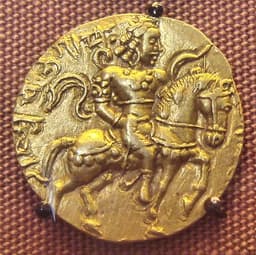
Chandragupta II
Emperor · Ancient
74.7Total

Shalmaneser I
Emperor · Ancient
59.5Total
Basic Information
Born
380
-1273
Died
415
-1244
Era
Ancient
Ancient
Nationality
India
Assyria
Occupation
Emperor
Emperor
Civilization
Indian
Middle Eastern
Score Comparison
Military (10%)
74.0
74.0
Political (20%)
78.0
68.0
Influence (20%)
88.0
54.1
Legacy (20%)
65.0
45.8
Leadership (15%)
72.0
72.0
Strategy (15%)
65.4
61.2
TOTAL
74.7
59.5
Chandragupta II — Complete Timeline
380 AD
Accession to the Gupta ThronePolitical Action
Chandragupta II succeeded his father Samudragupta as emperor of the Gupta Empire. He inherited a vast territory and continued the expansionist policies, further consolidating Gupta power in northern India.
Gupta EmpireSuccessionExpansion
Impact: regional
385 AD
Marriage Alliance with the VakatakasPolitical Action◆ Major
Chandragupta II married his daughter Prabhavatigupta to the Vakataka king Rudrasena II. After Rudrasena's death, Prabhavatigupta ruled as regent, effectively bringing the Vakataka kingdom under Gupta influence and securing the Deccan frontier.
VakatakaAllianceDeccan
Impact: regionalconstructive
395 AD
Conquest of the Western SatrapsWar◆ Major
Chandragupta II defeated the Western Kshatrapas (Saka rulers) in Gujarat and Malwa, annexing their territories. This conquest gave the Gupta Empire access to the Arabian Sea ports and control over lucrative trade routes with the Roman Empire.
Western SatrapsGujaratTrade
Impact: regional
400 AD
Patronage of the Golden Age of Gupta CultureCultural◆ Major
Chandragupta II's court included the poet Kalidasa, the astronomer Varahamihira, and other scholars. This period saw the flourishing of Sanskrit literature, art, and science, often considered the peak of classical Indian culture.
Golden AgeKalidasaSanskrit Literature
Impact: regionalconstructive
405 AD
Visit of the Chinese Pilgrim FaxianCultural
The Chinese Buddhist monk Faxian visited the Gupta Empire during Chandragupta II's reign. Faxian recorded the prosperity, religious tolerance, and efficient administration of the empire, providing valuable historical documentation.
FaxianChinese PilgrimBuddhism
Impact: regionalconstructive
Shalmaneser I — Complete Timeline
1270 BC
Campaign against UrartuWar◆ Major
Shalmaneser I led military campaigns against the kingdom of Urartu in the Armenian highlands. He defeated the Urartian forces and annexed territory, extending Assyrian control into the region.
Military CampaignUrartuExpansion
Impact: regional
1265 BC
Defeat of the MitanniWar◆ Major
Shalmaneser I defeated the remnants of the Mitanni kingdom, incorporating its lands into the Assyrian Empire. This victory eliminated a rival power and secured Assyrian dominance in northern Mesopotamia.
Military CampaignMitanniConquest
Impact: regional
1260 BC
Construction of KalhuCultural◆ Major
Shalmaneser I ordered the construction of a new capital city at Kalhu (Nimrud), relocating the administrative center from Ashur. The city became a major hub of Assyrian power and culture, featuring palaces, temples, and fortifications.
Urban PlanningCapital CityAssyrian Empire
Impact: regionalconstructive
Expert Analysis
Origins
Chandragupta II, also known as Vikramaditya, was born around 380 CE into the Gupta dynasty, which ruled over northern India. He was the son of Samudragupta, a powerful conqueror, and inherited a realm already vast. His early life was spent in Pataliputra, the Gupta capital, where he received training in statecraft and warfare. In contrast, Shalmaneser I ascended the throne of the Middle Assyrian Empire around 1274 BCE, succeeding his father Adad-nirari I. He was born into the royal lineage of Assyria, a militaristic society centered on the city of Ashur. His upbringing emphasized military discipline and administration, preparing him for the constant campaigns that defined Assyrian kingship.
Rise to Power
Chandragupta II succeeded his father Samudragupta around 375 CE, inheriting a stable and expansive empire. His rise was smooth, as he continued his father's policies of expansion and consolidation. The turning point came with his conquest of the Western Satraps (Saka rulers) in Gujarat and Malwa around 395 CE, which gave the Gupta Empire access to western trade routes. He also forged a crucial marriage alliance with the Vakataka kingdom by marrying his daughter Prabhavatigupta to Rudrasena II, effectively extending Gupta influence into the Deccan. Shalmaneser I rose to power after his father's death, but his reign was marked by early challenges. He faced the kingdom of Urartu in the north and the remnants of Mitanni in the west. His major victory came when he defeated the Mitanni, incorporating their lands into Assyria. He also launched campaigns against Urartu, securing the northern frontiers. Unlike Chandragupta II, Shalmaneser I's rise was defined by military conquest rather than diplomatic alliances.
Leadership & Governance
Chandragupta II's leadership style was characterized by cultural patronage and administrative efficiency. He is renowned for his court, which included the poet Kalidasa and astronomer Varahamihira, fostering what is called the Golden Age of Gupta India. He promoted religious tolerance, as noted by the Chinese pilgrim Faxian, who visited during his reign and recorded peace and prosperity. Administratively, the Gupta Empire under Chandragupta II was decentralized, with local governors enjoying autonomy. In contrast, Shalmaneser I governed through a centralized bureaucracy and military might. He built a new capital at Kalhu (Nimrud), relocating the administrative center from Ashur to project power. His governance focused on extracting tribute and maintaining control through garrisons. While Chandragupta II scored 78.0 in political leadership, Shalmaneser I scored 68.0, reflecting the former's superior statecraft.
Triumph & Tragedy
Chandragupta II's greatest triumph was the cultural flourishing of his empire. The Gupta period saw advances in science, literature, and art, with works like Kalidasa's "Shakuntala" and the development of the decimal system. His conquest of the Western Satraps brought economic prosperity through trade. However, his reign also saw the beginning of the Huna (Hephthalite) threats from the northwest, which would later weaken the empire. Shalmaneser I's triumphs include the defeat of Mitanni and the construction of Kalhu, which became a symbol of Assyrian power. He also expanded Assyrian territory into the Armenian highlands. Yet, his reign was marred by constant warfare, and his legacy is less enduring than Chandragupta II's. Shalmaneser I scored 45.8 in legacy, compared to Chandragupta II's 65.0.
Character & Destiny
Chandragupta II was known for his wisdom and patronage, earning the title Vikramaditya (Sun of Valor). His personality fostered a court of intellectuals, and his diplomatic marriage alliance showed strategic foresight. In contrast, Shalmaneser I was a warrior king, focused on expansion and consolidation. His character was shaped by the militaristic culture of Assyria, leading to a reign of campaigns. Historical assessments suggest Chandragupta II's character allowed for a stable, prosperous era, while Shalmaneser I's destiny was tied to the Assyrian empire's relentless expansion.
Legacy
Chandragupta II's legacy is immense: he is remembered as the epitome of India's classical age. The Gupta period set standards in art, literature, and science that influenced subsequent Indian civilization. His patronage of Sanskrit literature and the creation of the Navaratna (nine gems) court are celebrated. Shalmaneser I's legacy is more localized: Kalhu became a major Assyrian city, but his empire eventually declined. The Assyrian military model he advanced influenced later empires, but his personal impact is overshadowed by later Assyrian kings like Tiglath-Pileser III.
Conclusion
Chandragupta II had a greater impact on world history than Shalmaneser I. With a total score of 74.7 versus 59.5, Chandragupta II's contributions to culture, administration, and diplomacy outshine Shalmaneser I's military achievements. The Gupta Golden Age produced enduring intellectual and artistic legacies, while Shalmaneser I's empire, though powerful, left fewer lasting contributions to civilization.
Rankings
🥇
Chandragupta IILeader
Mil: 74.0Pol: 78.0Inf: 88.0
74.7
🥈
Shalmaneser I
Mil: 74.0Pol: 68.0Inf: 54.1
59.5
+15.2 behind
How This Comparison Works
Algorithm
Each figure is scored on 6 dimensions (0—100 scale) based on structured historical data: Military (10%), Political (20%), Influence (20%), Legacy (20%), Leadership (15%), Strategy (15%). The weighted total produces the final ranking.
Data Sources
Scores are computed from structured sub-indicators in the database. Scale factors adjust for era (Ancient ×0.85, Modern ×1.0) and civilization size (Eastern ×1.05, Other ×0.80) to account for differences in population and military scale.
Maximum 3 Figures
Comparisons are limited to 2—3 figures to ensure readability and statistical meaningfulness.
Error Margins
±5 points per dimension — Sub-scores are derived from historical records with inherent uncertainty. Two figures within 5 points on a dimension should be considered roughly equivalent in that area.
Total Score Accuracy
±3 points overall — The weighted combination of 6 dimensions produces a total score with approximately ±3 points of uncertainty. Differences of less than 3 points are not statistically significant— the figures are effectively tied.
Known Limitations
- Historical records are incomplete and uneven across civilizations
- Figures from oral-tradition societies may be underrepresented
- Occupation labels can misclassify multi-role figures
- Scores measure capability and impact, not moral character
- Quantitative scoring is a comparison tool, not absolute truth
Capability Radar
Military (10%) — Battles & Warfare
Battles
75
75
Win Rate
80
80
Expansion
80
80
Political (20%) — Governance & Reform
Reform
80
65
Diplomacy
75
60
Economy
90
55
Influence (20%) — Cultural & Global Reach
Cultural
95
50
Global
70
35
Legacy (20%) — Historical Impact
Historical
90
55
Longevity
85
40
Leadership (15%) — Power & Stability
Tenure
85
70
Stability
85
60
Strategy (15%) — Tactics & Innovation
Strategy
75
75
Tactics
70
70
Reform
65
60
Similar Comparisons
Comments & Discussion
No comments yet. Be the first to share your thoughts!