Loading...
Charles II of Spain vs Sultan Hasanuddin
Sultan Hasanuddin leads by 8.0 pts · 2 figures compared
…
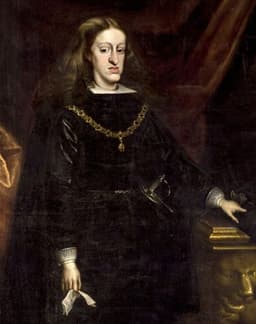
Charles II of Spain
Emperor · Modern
44.9Total

Sultan Hasanuddin
Emperor · Modern
52.9Total
Basic Information
Born
1661
1631
Died
1700
1670
Era
Modern
Modern
Nationality
Spain
Indonesia
Occupation
Emperor
Emperor
Civilization
Western
Eastern
Score Comparison
Military (10%)
15.0
50.0
Political (20%)
26.4
48.0
Influence (20%)
53.3
55.7
Legacy (20%)
52.0
44.2
Leadership (15%)
48.4
65.0
Strategy (15%)
58.4
60.0
TOTAL
44.9
52.9
Charles II of Spain — Complete Timeline
1661 AD
Suffered from Severe Physical and Mental DisabilitiesOther◆ Major
Charles II was born with numerous health problems due to Habsburg inbreeding, including a deformed jaw, epilepsy, and intellectual disabilities. He was unable to walk until age eight and was considered unfit to rule, leading to a regency throughout his life.
InbreedingDisabilityHabsburg Dynasty
Impact: nationaltragic
1665 AD
Became King of SpainPolitical Action
Charles II inherited the Spanish throne at age four upon the death of his father Philip IV. His reign was marked by severe physical and mental disabilities due to generations of inbreeding, leading to a regency government.
SuccessionHabsburg DynastyRegency
Impact: global
1697 AD
Signed the Treaty of RyswickPolitical Action
Charles II's government signed the Treaty of Ryswick, ending the Nine Years' War with France. Spain ceded territories in the Caribbean and Europe to France, but the treaty temporarily stabilized relations before the succession crisis.
TreatyNine Years' WarDiplomacy
Impact: regional
1700 AD
Death Without Heir Triggered War of Spanish SuccessionPolitical Action
Charles II died without an heir, leaving his throne to Philip of Anjou (grandson of Louis XIV) in his will. This sparked the War of Spanish Succession (1701-1714) as European powers contested the Bourbon succession to the Spanish throne.
Succession CrisisWar of Spanish SuccessionBourbon Dynasty
Impact: global
Sultan Hasanuddin — Complete Timeline
1650 AD
Expansion of Gowa's Maritime TradePolitical Action
Sultan Hasanuddin expanded Gowa's influence across eastern Indonesia through strategic alliances and naval power. He controlled key spice trade routes, making Makassar a major commercial hub that challenged Dutch monopolies in the region.
Trade ExpansionMaritime PowerGowa Kingdom
Impact: regionalconstructive
1666 AD
Battle of Makassar (1666-1669)War◆ Major
Sultan Hasanuddin led the Gowa-Tallo kingdom in a protracted war against the Dutch East India Company (VOC) and its local allies. Despite fierce resistance, Makassar fell in 1669, leading to the Bongaya Treaty which severely curtailed Gowa's sovereignty and trade.
Dutch Colonial WarMakassar WarResistance
Impact: regionaltragic
1667 AD
Signing of the Bongaya Treaty (1667)Political Action◆ Major
After military defeats, Sultan Hasanuddin signed the Bongaya Treaty with the VOC. The treaty forced Gowa to recognize VOC monopolies, cede territories, and dismantle fortifications, effectively ending Makassar's independence and opening the region to Dutch control.
TreatyColonial SubmissionLoss of Sovereignty
Impact: regionaltragic
Expert Analysis
Origins
Charles II of Spain (1661-1700) was born into the Habsburg dynasty, a family notorious for intermarriage. His parents were Philip IV of Spain and Mariana of Austria, who were uncle and niece. Charles's birth was the result of generations of inbreeding aimed at preserving Habsburg power. He was born with multiple physical deformities, including a pronounced Habsburg jaw, and suffered from epilepsy, intellectual disabilities, and a host of health issues that made him unable to rule effectively. His education was minimal, and he was often described as having the mental capacity of a child.
Sultan Hasanuddin (1631-1670) was born in Makassar, on the island of Sulawesi (modern-day Indonesia), into the royal family of the Gowa-Tallo kingdom. His father was Sultan Malikussaid, the ruler of Gowa. From a young age, Hasanuddin was trained in martial arts, Islamic scholarship, and statecraft. He gained a reputation as a fierce warrior and skilled naval commander, earning the nickname 'Chicken of the East' (Ayam Jantan dari Timur) for his bravery.
Rise to Power
Charles II became king at age four upon the death of his father Philip IV in 1665. His mother Mariana of Austria served as regent until he came of age. However, due to his severe disabilities, Charles never truly ruled. The Spanish monarchy was effectively controlled by a series of favorites and court factions, including the German Jesuit Juan Everardo Nithard, Fernando de Valenzuela, and later Charles's half-brother John of Austria. Charles's reign was marked by political instability and economic decline.
Sultan Hasanuddin ascended to the throne of Gowa in 1653 after the death of his father. He quickly consolidated power and expanded Gowa's influence across eastern Indonesia. He controlled key spice trade routes, particularly for cloves and nutmeg, which brought wealth and power. Hasanuddin formed alliances with other local kingdoms and resisted the encroachment of the Dutch East India Company (VOC), which sought to monopolize the spice trade.
Leadership & Governance
Charles II's leadership was nominal at best. He had no real authority, and his government was plagued by infighting among nobles and foreign powers. The Spanish economy was in shambles, with inflation and declining trade. Charles's only significant act was signing the Treaty of Ryswick in 1697, which ended the Nine Years' War with France but ceded territories in the Caribbean and Europe. His leadership score of 48.4 reflects his symbolic role rather than actual governance.
Sultan Hasanuddin was an active and decisive leader. He reformed the Gowa military, building a strong navy that could challenge the VOC. He promoted trade and diplomacy, forging alliances with other sultanates. His leadership score of 65.0 is supported by his ability to mobilize his people against a technologically superior enemy. However, his political score of 48.0 indicates that he struggled to maintain unity among his allies, some of whom were bribed or coerced by the Dutch.
Triumph & Tragedy
Charles II's greatest triumph was perhaps his survival to adulthood, given his frail health. His reign saw the signing of the Treaty of Ryswick, which temporarily preserved Spanish territories. However, his greatest failure was his inability to produce an heir, leading to the War of Spanish Succession (1701-1714), a devastating conflict that cost Spain its European possessions and marked the end of Habsburg rule. His military score of 15.0 reflects the complete lack of Spanish military success during his reign.
Sultan Hasanuddin's triumphs include his early victories against the VOC, notably the Battle of Makassar (1666-1669) where his forces inflicted heavy losses on the Dutch. He successfully expanded Gowa's maritime trade and influence. However, his tragedy came with the signing of the Bongaya Treaty in 1667, which forced Gowa to recognize VOC monopolies, cede territories, and dismantle its fortifications. Hasanuddin's resistance ultimately failed, and he died in 1670, likely from illness, with his kingdom reduced to a vassal state. His military score of 50.0 reflects his tactical competence but strategic defeat.
Character & Destiny
Charles II was a tragic figure, a victim of Habsburg inbreeding. His character was marked by passivity and dependency. He was known to be pious and gentle, but his disabilities prevented him from acting independently. His destiny was shaped by his genetics; his inability to father children sealed the fate of the Spanish Habsburgs. Historians often describe him as 'the Bewitched' (El Hechizado), reflecting the belief that his ailments were caused by witchcraft.
Sultan Hasanuddin was courageous, proud, and determined. He was a skilled military commander and a devout Muslim. His character drove him to resist Dutch imperialism despite overwhelming odds. His destiny was to be a symbol of anti-colonial resistance, though his kingdom fell. He is remembered as a national hero in Indonesia, with a university and several streets named after him.
Legacy
Charles II's legacy is largely negative. His death without an heir triggered the War of Spanish Succession, which reshaped European power balances. Spain lost its territories in Italy and the Netherlands, and the Bourbon dynasty replaced the Habsburgs. His reign is seen as the nadir of Spanish power. His influence score of 53.3 and legacy score of 52.0 reflect the unintended consequences of his reign.
Sultan Hasanuddin's legacy is more positive in Indonesia, where he is celebrated as a freedom fighter. His resistance against the VOC is a key part of Indonesian national identity. However, his military defeat meant that Gowa's independence was lost, and the VOC tightened its grip on the spice trade. His influence score of 55.7 and legacy score of 44.2 indicate a mixed impact: he is a symbol but did not achieve lasting political change.
Conclusion
While Sultan Hasanuddin scored higher overall (52.9 vs 44.9), his impact was largely localized and ultimately reversed. Charles II, despite his personal inadequacies, triggered a major European war that reshaped the continent's political landscape. In terms of global historical impact, Charles II's death had more far-reaching consequences than Hasanuddin's resistance. Therefore, Charles II had a greater impact on world history, even if his personal scores are lower.
Rankings
🥇
Sultan HasanuddinLeader
Mil: 50.0Pol: 48.0Inf: 55.7
52.9
🥈
Charles II of Spain
Mil: 15.0Pol: 26.4Inf: 53.3
44.9
+8.0 behind
How This Comparison Works
Algorithm
Each figure is scored on 6 dimensions (0—100 scale) based on structured historical data: Military (10%), Political (20%), Influence (20%), Legacy (20%), Leadership (15%), Strategy (15%). The weighted total produces the final ranking.
Data Sources
Scores are computed from structured sub-indicators in the database. Scale factors adjust for era (Ancient ×0.85, Modern ×1.0) and civilization size (Eastern ×1.05, Other ×0.80) to account for differences in population and military scale.
Maximum 3 Figures
Comparisons are limited to 2—3 figures to ensure readability and statistical meaningfulness.
Error Margins
±5 points per dimension — Sub-scores are derived from historical records with inherent uncertainty. Two figures within 5 points on a dimension should be considered roughly equivalent in that area.
Total Score Accuracy
±3 points overall — The weighted combination of 6 dimensions produces a total score with approximately ±3 points of uncertainty. Differences of less than 3 points are not statistically significant— the figures are effectively tied.
Known Limitations
- Historical records are incomplete and uneven across civilizations
- Figures from oral-tradition societies may be underrepresented
- Occupation labels can misclassify multi-role figures
- Scores measure capability and impact, not moral character
- Quantitative scoring is a comparison tool, not absolute truth
Capability Radar
Military (10%) — Battles & Warfare
Battles
37
55
Win Rate
41
45
Expansion
45
50
Political (20%) — Governance & Reform
Reform
5
40
Diplomacy
10
45
Economy
5
35
Influence (20%) — Cultural & Global Reach
Cultural
10
40
Global
40
35
Legacy (20%) — Historical Impact
Historical
60
45
Longevity
50
30
Leadership (15%) — Power & Stability
Tenure
35
50
Stability
5
30
Strategy (15%) — Tactics & Innovation
Strategy
45
55
Tactics
50
60
Reform
49
40
Similar Comparisons
Comments & Discussion
No comments yet. Be the first to share your thoughts!