Loading...
This comparison has not been analyzed yet.
One-time AI generation (~1 minute). Scores and timeline are already available below.
Charles VIII of France vs Illig Qaghan
Charles VIII of France leads by 5.7 pts · 2 figures compared
…
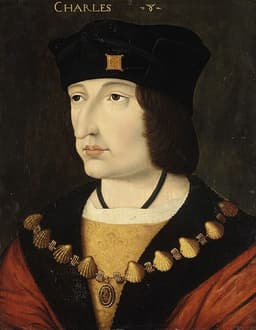
Charles VIII of France
Emperor · Medieval
45.9Total

Illig Qaghan
Emperor · Medieval
40.2Total
Basic Information
Born
1470
600
Died
1498
634
Era
Medieval
Medieval
Nationality
France
Eastern Turkic Khaganate
Occupation
Emperor
Emperor
Civilization
Western
Eastern
Score Comparison
Military (10%)
40.0
46.7
Political (20%)
30.8
26.4
Influence (20%)
54.9
49.4
Legacy (20%)
49.2
38.3
Leadership (15%)
45.0
34.6
Strategy (15%)
45.0
45.0
TOTAL
45.9
40.2
Charles VIII of France — Complete Timeline
1494 AD
Invasion of ItalyWar
Charles VIII led a French army into Italy to claim the Kingdom of Naples, beginning the Italian Wars. He marched through Italy unopposed, entered Florence and Rome, and conquered Naples in 1495, but was forced to retreat by the League of Venice.
Italian WarsInvasionCapetian
Impact: global
1495 AD
Battle of FornovoWar◆ Major
Charles VIII's French army fought the League of Venice at Fornovo. Though technically a French victory as they broke through the enemy lines, Charles VIII lost his baggage train and was forced to withdraw from Italy, ending his Neapolitan adventure.
Italian WarsBattleCapetian
Impact: regional
1498 AD
Death by AccidentOther◆ Major
Charles VIII died after striking his head on a low door lintel while walking to watch a tennis match at the Ch
Accidental DeathSuccessionCapetian
Impact: nationaltragic
Illig Qaghan — Complete Timeline
620 AD
Restoration of the Eastern Turkic KhaganatePolitical Action◆ Major
Illig Qaghan revived the Eastern Turkic Khaganate after its submission to the Sui dynasty. He united Turkic tribes and launched raids into Tang China, reasserting Turkic independence and power on the steppe.
RestorationTurkic KhaganateTang Dynasty
Impact: regionalconstructive
624 AD
Siege of TaiyuanWar◆ Major
Illig Qaghan led a major invasion of Tang China, besieging the city of Taiyuan. The Tang emperor Li Shimin (Taizong) personally led a relief force, forcing Illig to retreat after a stalemate.
InvasionTang DynastySiege
Impact: regionaldestructive
630 AD
Battle of YinshanWar
Illig Qaghan was decisively defeated by Tang forces under Li Jing at the Battle of Yinshan. The Tang army captured Illig's camp, and he fled, leading to the collapse of the Eastern Turkic Khaganate.
BattleTang DynastyDefeat
Impact: regionaldestructive
634 AD
Capture and deathPolitical Action◆ Major
Illig Qaghan was captured by Tang forces and taken to Chang'an, where he died in captivity. His defeat ended the Eastern Turkic Khaganate, which was annexed by Tang China, marking a major expansion of Tang power.
CaptureDeathTang Dynasty
Impact: regionaltragic
This comparison has not been analyzed yet.
One-time AI generation (~1 minute). Scores and timeline are already available below.
Rankings
🥇
Charles VIII of FranceLeader
Mil: 40.0Pol: 30.8Inf: 54.9
45.9
🥈
Illig Qaghan
Mil: 46.7Pol: 26.4Inf: 49.4
40.2
+5.7 behind
How This Comparison Works
Algorithm
Each figure is scored on 6 dimensions (0—100 scale) based on structured historical data: Military (10%), Political (20%), Influence (20%), Legacy (20%), Leadership (15%), Strategy (15%). The weighted total produces the final ranking.
Data Sources
Scores are computed from structured sub-indicators in the database. Scale factors adjust for era (Ancient ×0.85, Modern ×1.0) and civilization size (Eastern ×1.05, Other ×0.80) to account for differences in population and military scale.
Maximum 3 Figures
Comparisons are limited to 2—3 figures to ensure readability and statistical meaningfulness.
Error Margins
±5 points per dimension — Sub-scores are derived from historical records with inherent uncertainty. Two figures within 5 points on a dimension should be considered roughly equivalent in that area.
Total Score Accuracy
±3 points overall — The weighted combination of 6 dimensions produces a total score with approximately ±3 points of uncertainty. Differences of less than 3 points are not statistically significant— the figures are effectively tied.
Known Limitations
- Historical records are incomplete and uneven across civilizations
- Figures from oral-tradition societies may be underrepresented
- Occupation labels can misclassify multi-role figures
- Scores measure capability and impact, not moral character
- Quantitative scoring is a comparison tool, not absolute truth
Capability Radar
Military (10%) — Battles & Warfare
Battles
45
30
Win Rate
40
25
Expansion
50
40
Political (20%) — Governance & Reform
Reform
25
20
Diplomacy
30
20
Economy
20
20
Influence (20%) — Cultural & Global Reach
Cultural
25
15
Global
35
10
Legacy (20%) — Historical Impact
Historical
55
20
Longevity
30
10
Leadership (15%) — Power & Stability
Tenure
40
25
Stability
15
15
Strategy (15%) — Tactics & Innovation
Strategy
30
30
Tactics
35
35
Reform
20
20
Similar Comparisons
Comments & Discussion
No comments yet. Be the first to share your thoughts!