Loading...
This comparison has not been analyzed yet.
One-time AI generation (~1 minute). Scores and timeline are already available below.
Chea Sim vs Luis Echeverria
Chea Sim leads by 2.9 pts · 2 figures compared
…
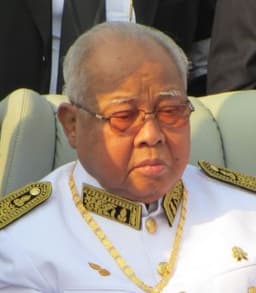
Chea Sim
Politician · Modern
52.1Total

Luis Echeverria
Politician · Modern
49.2Total
Basic Information
Born
1932
1922
Died
—
—
Era
Modern
Modern
Nationality
Cambodia
Mexico
Occupation
Politician
Politician
Civilization
Eastern
Western
Score Comparison
Military (10%)
24.1
50.0
Political (20%)
54.7
43.7
Influence (20%)
51.8
51.8
Legacy (20%)
49.2
41.7
Leadership (15%)
72.0
65.0
Strategy (15%)
54.1
45.6
TOTAL
52.1
49.2
Chea Sim — Complete Timeline
1991 AD
Appointed President of the Cambodian People's PartyPolitical Action◆ Major
Chea Sim became the President of the Cambodian People's Party (CPP), the ruling party. He was a key figure in the party's leadership, overseeing its transition from a communist to a more pragmatic political organization.
Political PartyCPPLeadership
Impact: national
1993 AD
Became President of the National Assembly of CambodiaPolitical Action◆ Major
Chea Sim was elected President of the National Assembly following the 1993 UN-supervised elections. He played a central role in drafting the new constitution and establishing the coalition government between FUNCINPEC and the CPP.
ParliamentConstitutionCambodia
Impact: nationalconstructive
Served as Acting Head of StatePolitical Action
In the interim period before the restoration of the monarchy, Chea Sim served as Acting Head of State of Cambodia. He oversaw the transition to the constitutional monarchy under King Norodom Sihanouk.
Head of StateTransitionCambodia
Impact: national
Luis Echeverria — Complete Timeline
1970 AD
Dirty War repressionPolitical Action
As president, Luis Echeverr
Dirty WarRepressionHuman Rights Abuses
Impact: nationaldestructive
1971 AD
Corpus Christi Massacre (El Halconazo)Political Action◆ Major
On June 10, 1971, a paramilitary group called Los Halcones, allegedly linked to the government, attacked student protesters in Mexico City. Dozens were killed. Echeverr
MassacreParamilitaryRepression
Impact: nationaltragic
1973 AD
Expansion of the Mexican welfare stateReform◆ Major
Echeverría implemented populist economic policies, including increased public spending on education, healthcare, and housing. He expanded the social security system and created the National Fund for Workers' Housing (INFONAVIT), but these policies also fueled inflation and debt.
WelfarePopulismSocial Policy
Impact: nationalconstructive
2006 AD
Exile and later prosecution for genocidePolitical Action◆ Major
In 2006, a Mexican judge issued an arrest warrant for Echeverr
JusticeHuman RightsAccountability
Impact: national
This comparison has not been analyzed yet.
One-time AI generation (~1 minute). Scores and timeline are already available below.
Rankings
🥇
Chea SimLeader
Mil: 24.1Pol: 54.7Inf: 51.8
52.1
🥈
Luis Echeverria
Mil: 50.0Pol: 43.7Inf: 51.8
49.2
+2.9 behind
How This Comparison Works
Algorithm
Each figure is scored on 6 dimensions (0—100 scale) based on structured historical data: Military (10%), Political (20%), Influence (20%), Legacy (20%), Leadership (15%), Strategy (15%). The weighted total produces the final ranking.
Data Sources
Scores are computed from structured sub-indicators in the database. Scale factors adjust for era (Ancient ×0.85, Modern ×1.0) and civilization size (Eastern ×1.05, Other ×0.80) to account for differences in population and military scale.
Maximum 3 Figures
Comparisons are limited to 2—3 figures to ensure readability and statistical meaningfulness.
Error Margins
±5 points per dimension — Sub-scores are derived from historical records with inherent uncertainty. Two figures within 5 points on a dimension should be considered roughly equivalent in that area.
Total Score Accuracy
±3 points overall — The weighted combination of 6 dimensions produces a total score with approximately ±3 points of uncertainty. Differences of less than 3 points are not statistically significant— the figures are effectively tied.
Known Limitations
- Historical records are incomplete and uneven across civilizations
- Figures from oral-tradition societies may be underrepresented
- Occupation labels can misclassify multi-role figures
- Scores measure capability and impact, not moral character
- Quantitative scoring is a comparison tool, not absolute truth
Capability Radar
Military (10%) — Battles & Warfare
Battles
50
28
Win Rate
55
30
Expansion
60
36
Political (20%) — Governance & Reform
Reform
40
30
Diplomacy
55
40
Economy
30
35
Influence (20%) — Cultural & Global Reach
Cultural
20
25
Global
30
25
Legacy (20%) — Historical Impact
Historical
50
30
Longevity
45
20
Leadership (15%) — Power & Stability
Tenure
75
60
Stability
45
20
Strategy (15%) — Tactics & Innovation
Strategy
62
38
Tactics
66
39
Reform
69
43
Similar Comparisons
Comments & Discussion
No comments yet. Be the first to share your thoughts!