Loading...
Chen Baxian vs Lars Porsena
Chen Baxian leads by 3.7 pts · 2 figures compared
…

Chen Baxian
Emperor · Ancient
47.4Total
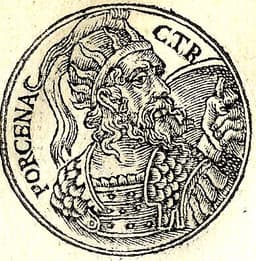
Lars Porsena
Emperor · Ancient
43.7Total
Basic Information
Born
-503
-520
Died
—
-480
Era
Ancient
Ancient
Nationality
China
Etruria
Occupation
Emperor
Emperor
Civilization
Eastern
Western
Score Comparison
Military (10%)
65.0
25.0
Political (20%)
40.8
37.9
Influence (20%)
50.2
48.6
Legacy (20%)
40.8
40.8
Leadership (15%)
45.0
58.8
Strategy (15%)
52.5
43.3
TOTAL
47.4
43.7
Chen Baxian — Complete Timeline
557 AD
Defeated the Northern Qi invasionWar◆ Major
Chen Baxian repelled a Northern Qi invasion of the Chen dynasty. His victory secured the southern border and stabilized the new dynasty.
BattleDefenseNorthern Qi
Impact: regionalconstructive
Founded the Chen dynastyPolitical Action◆ Major
Chen Baxian forced the abdication of the last Liang emperor and proclaimed himself emperor, founding the Chen dynasty. He established his capital at Jiankang (Nanjing) and began rebuilding after the Hou Jing rebellion.
Dynasty FoundingSouthern DynastiesRebuilding
Impact: regionalconstructive
559 AD
Death from illnessOther◆ Major
Chen Baxian died of illness after a short reign of two years. His death left the Chen dynasty in a precarious position, but it survived under his successors until 589.
DeathShort ReignDynastic Continuity
Impact: regionaltragic
Lars Porsena — Complete Timeline
508 BC
Siege of RomeWar◆ Major
Lars Porsena led an Etruscan army to besiege Rome in an attempt to restore the exiled king Tarquinius Superbus. The siege was marked by legendary acts of Roman heroism, such as Horatius Cocles defending the bridge, but Porsena eventually lifted the siege after negotiations.
SiegeEtruscan-Roman WarTarquin Restoration
Impact: regional
Peace Treaty with RomePolitical Action◆ Major
Lars Porsena made peace with the Roman Republic, agreeing to withdraw his forces in exchange for hostages and territory. The treaty ended the siege and recognized the Republic's independence, though Porsena failed to restore Tarquinius to the throne.
Peace TreatyDiplomacyRoman Independence
Impact: regional
Gift of Insignia to RomeOther
According to some accounts, Lars Porsena, impressed by Roman bravery, presented the Romans with his royal insignia, including the ivory chair and the fasces. These symbols were adopted by Roman magistrates and became enduring emblems of Roman authority.
Cultural ExchangeSymbols of PowerEtruscan Gift
Impact: nationalconstructive
500 BC
War with the Latin LeagueWar
Lars Porsena waged war against the Latin League, seeking to expand Etruscan influence. He defeated the Latins at the Battle of Aricia but was subsequently defeated by a coalition of Latin and Greek forces, ending his expansionist ambitions.
Etruscan ExpansionLatin WarBattle of Aricia
Impact: regional
Expert Analysis
Origins
Chen Baxian (503–559) was born into a minor official family in what is now Zhejiang, China. His early life was marked by the turbulence of the Southern Dynasties period, where military prowess offered a path to advancement. He rose through the ranks of the Liang dynasty army, gaining experience in suppressing rebellions and defending borders. Lars Porsena, an Etruscan king of Clusium (modern Chiusi, Italy), lived in the 6th century BCE. Details of his early life are scarce, but he belonged to the aristocratic elite of Etruria, a civilization that dominated central Italy before Rome's rise. His background was rooted in the Etruscan city-state system, where kings exercised both military and religious authority.
Rise to Power
Chen Baxian's rise began during the Hou Jing rebellion (548–552), which devastated the Liang dynasty. He distinguished himself by defeating rebel forces and was granted increasing authority. In 555, after the Liang emperor was killed, Chen became the de facto ruler of the south. He forced the abdication of the last Liang emperor in 557, proclaiming himself emperor of the Chen dynasty. His rise was a classic example of military strongman taking power during a period of fragmentation. Lars Porsena's rise to prominence came from his role as the king of Clusium, one of the most powerful Etruscan cities. Around 508 BCE, he was approached by the exiled Roman king Tarquinius Superbus to restore him to the throne. Porsena saw an opportunity to expand Etruscan influence and marched on Rome, initiating the siege that defined his legacy.
Leadership & Governance
Chen Baxian's leadership focused on consolidating the Chen dynasty's control over southern China. He centralized military command, reduced the power of regional warlords, and promoted agriculture to stabilize the economy. His rule was short—only two years—but he established a foundation that allowed the Chen dynasty to survive for 33 years. His governance style was pragmatic, relying on his military network. Lars Porsena, as an Etruscan king, led through personal authority and the support of other Etruscan cities. His siege of Rome demonstrated strategic patience, but his decision to withdraw after receiving hostages and territory showed a preference for diplomacy over total conquest. Some accounts suggest he was impressed by Roman bravery and granted them symbols of royal authority, indicating a respect for martial virtue.
Triumph & Tragedy
Chen Baxian's greatest triumph was founding the Chen dynasty and repelling a Northern Qi invasion in 558. This victory secured his borders and demonstrated his military skill (scoring 65.0 in military). His tragedy was his early death from illness after only two years on the throne, leaving his successors to face ongoing threats from the north. The dynasty never achieved the strength to reunify China. Lars Porsena's triumph was his successful siege of Rome, which forced the Romans to submit and surrender hostages. However, his failure to restore the Tarquins and his eventual withdrawal meant his victory was incomplete. His later defeat at the Battle of Aricia (c. 504 BCE) by the Latin League ended Etruscan expansion into Latium, marking a strategic setback.
Character & Destiny
Chen Baxian was a capable military commander but lacked the political acumen to fully secure his dynasty's long-term future. His score of 40.8 in political skills reflects his inability to transition from general to statesman. His death cut short his potential, but his decisive action in founding a dynasty showed determination. Lars Porsena, with a leadership score of 58.8, was seen as a noble and honorable enemy by Roman sources. His decision to spare Rome and grant insignia suggests a character that valued courage over conquest. However, his failure to press his advantage made him a cautionary tale of missed opportunities. Historical assessments vary: Roman accounts paint him as a worthy foe, while Etruscan perspectives might view his withdrawal as a strategic error.
Legacy
Chen Baxian's legacy is as the founder of the last of the Southern Dynasties. The Chen dynasty maintained a degree of stability in the south until its conquest by the Sui dynasty in 589. His military achievements (scoring 65.0) are remembered in Chinese historiography, but his overall impact is limited compared to figures who unified China. Lars Porsena's legacy is more ambiguous. He is remembered in Roman legend as a formidable enemy who tested the early Republic. His siege of Rome became a symbol of Roman resilience. The gift of insignia, if historical, may have influenced Roman symbols of authority. However, his failure to restore the monarchy meant the Roman Republic continued, shaping Western history. In the long term, Porsena's actions indirectly contributed to Rome's eventual dominance over Italy.
Conclusion
Chen Baxian, with a total score of 47.4 versus Porsena's 43.7, had a slightly greater impact within his context. He founded a dynasty that preserved southern Chinese culture during a period of division. Porsena's actions, while legendary, did not alter Rome's trajectory significantly; the Republic survived and eventually conquered Etruria. Chen Baxian's establishment of a stable state had more concrete consequences than Porsena's temporary siege. Therefore, Chen Baxian had greater historical impact, though neither transformed the course of history on a monumental scale.
Rankings
🥇
Chen BaxianLeader
Mil: 65.0Pol: 40.8Inf: 50.2
47.4
🥈
Lars Porsena
Mil: 25.0Pol: 37.9Inf: 48.6
43.7
+3.7 behind
How This Comparison Works
Algorithm
Each figure is scored on 6 dimensions (0—100 scale) based on structured historical data: Military (10%), Political (20%), Influence (20%), Legacy (20%), Leadership (15%), Strategy (15%). The weighted total produces the final ranking.
Data Sources
Scores are computed from structured sub-indicators in the database. Scale factors adjust for era (Ancient ×0.85, Modern ×1.0) and civilization size (Eastern ×1.05, Other ×0.80) to account for differences in population and military scale.
Maximum 3 Figures
Comparisons are limited to 2—3 figures to ensure readability and statistical meaningfulness.
Error Margins
±5 points per dimension — Sub-scores are derived from historical records with inherent uncertainty. Two figures within 5 points on a dimension should be considered roughly equivalent in that area.
Total Score Accuracy
±3 points overall — The weighted combination of 6 dimensions produces a total score with approximately ±3 points of uncertainty. Differences of less than 3 points are not statistically significant— the figures are effectively tied.
Known Limitations
- Historical records are incomplete and uneven across civilizations
- Figures from oral-tradition societies may be underrepresented
- Occupation labels can misclassify multi-role figures
- Scores measure capability and impact, not moral character
- Quantitative scoring is a comparison tool, not absolute truth
Capability Radar
Military (10%) — Battles & Warfare
Battles
65
40
Win Rate
70
35
Expansion
50
30
Political (20%) — Governance & Reform
Reform
35
20
Diplomacy
45
50
Economy
30
30
Influence (20%) — Cultural & Global Reach
Cultural
30
30
Global
10
20
Legacy (20%) — Historical Impact
Historical
35
40
Longevity
20
25
Leadership (15%) — Power & Stability
Tenure
30
40
Stability
25
35
Strategy (15%) — Tactics & Innovation
Strategy
55
40
Tactics
60
45
Reform
40
20
Similar Comparisons
Comments & Discussion
No comments yet. Be the first to share your thoughts!