Loading...
Lars Porsena vs Napoleon Bonaparte
Napoleon Bonaparte leads by 27.2 pts · 2 figures compared
…
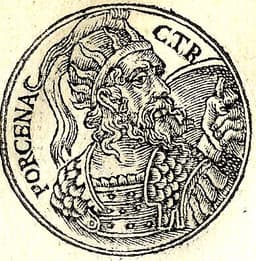
Lars Porsena
Emperor · Ancient
43.7Total

Napoleon Bonaparte
General · Modern
70.9Total
Basic Information
Born
-520
1769
Died
-480
1821
Era
Ancient
Modern
Nationality
Etruria
France
Occupation
Emperor
General
Civilization
Western
Western
Score Comparison
Military (10%)
25.0
94.0
Political (20%)
37.9
72.0
Influence (20%)
48.6
40.0
Legacy (20%)
40.8
80.0
Leadership (15%)
58.8
78.0
Strategy (15%)
43.3
90.0
TOTAL
43.7
70.9
Lars Porsena — Complete Timeline
508 BC
Siege of RomeWar◆ Major
Lars Porsena led an Etruscan army to besiege Rome in an attempt to restore the exiled king Tarquinius Superbus. The siege was marked by legendary acts of Roman heroism, such as Horatius Cocles defending the bridge, but Porsena eventually lifted the siege after negotiations.
SiegeEtruscan-Roman WarTarquin Restoration
Impact: regional
Peace Treaty with RomePolitical Action◆ Major
Lars Porsena made peace with the Roman Republic, agreeing to withdraw his forces in exchange for hostages and territory. The treaty ended the siege and recognized the Republic's independence, though Porsena failed to restore Tarquinius to the throne.
Peace TreatyDiplomacyRoman Independence
Impact: regional
Gift of Insignia to RomeOther
According to some accounts, Lars Porsena, impressed by Roman bravery, presented the Romans with his royal insignia, including the ivory chair and the fasces. These symbols were adopted by Roman magistrates and became enduring emblems of Roman authority.
Cultural ExchangeSymbols of PowerEtruscan Gift
Impact: nationalconstructive
500 BC
War with the Latin LeagueWar
Lars Porsena waged war against the Latin League, seeking to expand Etruscan influence. He defeated the Latins at the Battle of Aricia but was subsequently defeated by a coalition of Latin and Greek forces, ending his expansionist ambitions.
Etruscan ExpansionLatin WarBattle of Aricia
Impact: regional
Napoleon Bonaparte — Complete Timeline
1799 AD
Coup of 18 BrumaireOther◆ Major
Napoleon Bonaparte, with support from his brother Lucien and key political figures, overthrew the Directory in a bloodless coup. He established the Consulate with himself as First Consul, effectively becoming the ruler of France. This event ended the French Revolution's most unstable period.
French RevolutionCoupRise to Power
Impact: regional
1804 AD
Promulgation of the Napoleonic CodeOther◆ Major
Napoleon enacted the Civil Code of the French, known as the Napoleonic Code, a comprehensive set of laws that replaced the fragmented feudal legal systems. The code established legal equality, protected property rights, and secularized law. It became the basis for legal systems in many European and world countries.
Legal ReformNapoleonic CodeCivil Law
Impact: globalconstructive
1805 AD
Battle of AusterlitzWar◆ Major
Napoleon's Grande Arm
Napoleonic WarsBattleDecisive Victory
Impact: global
1812 AD
Invasion of RussiaWar◆ Major
Napoleon led the Grande Arm
Napoleonic WarsInvasionDisaster
Impact: globaldestructive
1815 AD
Battle of WaterlooWar◆ Major
Napoleon's French army was defeated by the combined forces of the Duke of Wellington's Anglo-Allied army and Gebhard Leberecht von Bl
Napoleonic WarsBattleFinal Defeat
Impact: globaldestructive
Expert Analysis
lars-porsena-vs-napoleon-bonaparte
# The Shadow and the Sun: Why Napoleon Conquered an Age While Lars Porsena Faded Into Myth
On a June morning in 1815, Napoleon Bonaparte watched from a ridge as his Imperial Guard marched up the muddy slope toward the British lines at Waterloo. He had staked everything—an empire, a legacy, a dream of European unity—on one final gambit. Twenty-three centuries earlier, another king stood before the gates of Rome, his Etruscan army arrayed beneath the Tiber's walls, ready to restore a fallen dynasty. Both men reached for history's crown. Only one seized it.
Origins
Napoleon was born in 1769 on the Mediterranean island of Corsica, a place that had just passed from Genoese to French control. His family were minor nobles, proud and impoverished, speaking Italian-accented French in a world that mocked both. This outsider's hunger shaped everything. He devoured military history, studied artillery mathematics, and absorbed the Enlightenment's radical ideas about merit over birth. The French Revolution, erupting when he was twenty, shattered the old order and opened a door for a man of talent without pedigree.
Lars Porsena came from the opposite world. Born around 520 BC, he was king of Clusium, one of the twelve great cities of the Etruscan League. Etruria was ancient Europe's superpower—wealthy from iron mines, sophisticated in art and religion, dominant over Rome for centuries. Porsena inherited a throne, not a revolution. His world was stable, hierarchical, and confident in its traditions. He had no reason to question the order that made him king.
Their eras dictated their trajectories. Napoleon's was a time of collapse and creation, when a young artillery officer could become emperor in a decade. Porsena's was an age of city-states and tribal wars, where power moved through bloodlines, not cannon fire.
Rise to Power
Napoleon's ascent was a masterpiece of opportunism. In 1793, at twenty-four, he drove British forces from the port of Toulon with brilliant artillery placement. By 1796, he commanded the Army of Italy, where he turned starving, mutinous troops into a conquering force. His Italian campaign of 1796-1797 was not just a military triumph but a political one—he negotiated his own treaties, sent millions in loot to Paris, and made himself indispensable. The coup of 18 Brumaire in 1799 made him First Consul at thirty. By 1804, he crowned himself Emperor.
Porsena's rise is lost in the mists of pre-Roman Italy. He was already king when history first mentions him in 508 BC. His power came from Etruscan tradition: the *lucumo*, or king-priest, who wielded both secular and religious authority. He did not climb; he inherited. The only question was how he would use what he had.
Leadership & Governance
Napoleon governed with the energy of a man who believed the world could be remade. His Napoleonic Code, enacted in 1804, standardized French law across a fragmented nation, enshrining equality before the law, property rights, and secular administration. He reformed education, centralized the bureaucracy, and built roads and canals that connected his empire. As a military commander, his strategy was revolutionary: rapid marches, concentration of force, and the destruction of enemy armies rather than the capture of territory. His 1805 victory at Austerlitz remains a textbook example of tactical genius—drawing the Allies onto a frozen lake, then shattering their center with a feigned retreat.
Porsena's governance is barely recorded, but his actions speak. When the exiled Roman king Tarquinius Superbus begged for restoration, Porsena saw an opportunity. He besieged Rome in 508 BC, cutting off trade and threatening starvation. Yet the siege revealed his limits. According to Roman tradition, a young noble named Gaius Mucius Scaevola infiltrated the Etruscan camp, failed to kill Porsena, and thrust his right hand into a sacrificial fire to prove Roman resolve. Porsena, reportedly impressed, negotiated a peace. He withdrew in exchange for hostages and territory—but he also, according to some accounts, presented the Romans with his royal insignia, a gesture of respect that suggests a leader who valued honor over conquest.
Triumph & Tragedy
Napoleon's triumph was total. From 1805 to 1812, he dominated Europe: defeating Austria, Prussia, and Russia, installing his brothers on thrones, and redrawing the map of a continent. His tragedy was equally colossal. The 1812 invasion of Russia destroyed his Grand Army—over 400,000 men lost to cold, hunger, and guerrilla warfare. He was exiled to Elba in 1814, returned for a hundred days in 1815, and met final defeat at Waterloo. The man who had conquered from Madrid to Moscow ended his days on a windswept Atlantic island, dictating memoirs that would shape his legend.
Porsena's triumph was the siege itself. He brought the rising Roman Republic to its knees, extracted tribute, and returned to Clusium with his reputation intact. His tragedy was that he did not finish the job. By withdrawing, he allowed Rome to survive and eventually conquer Etruria. Within a century, the Etruscan cities would fall to Roman legions. Porsena's moment of mercy—or pragmatism—sealed his civilization's doom.
Character & Destiny
Napoleon's character was a furnace of ambition, intelligence, and insecurity. He drove himself and others without mercy, sleeping four hours a night, dictating multiple letters simultaneously. "Impossible is a word to be found only in the dictionary of fools," he said. Yet his arrogance blinded him. He believed he could defeat Russia as he had defeated Austria, ignoring the vastness of the steppes and the tenacity of its people. His personality made his rise possible and his fall inevitable.
Porsena's character is harder to read. The Romans portrayed him as a noble enemy, a man who could admire courage in his foes. If true, this reveals a leader bound by the codes of his age—honor, ritual, and respect for the gods. He fought for restoration, not revolution. He did not imagine a world without Rome; he only wanted Rome to know its place. That conservatism, so different from Napoleon's radical ambition, limited what he could achieve.
Legacy
Napoleon's legacy reshaped the modern world. His legal code influenced civil law across Europe, Latin America, and beyond. His military innovations became the foundation of modern warfare. He is remembered as both a liberator who spread revolutionary ideals and a tyrant who drowned them in blood. His score of 82.4 reflects this complexity—a military genius rated at 94, a political leader at 75, a strategist at 93.
Lars Porsena's legacy is a whisper. He is remembered primarily as a footnote to Roman history, a king who almost changed the course of Western civilization but did not. His scores—50.1 total, with military at 32.6 and strategy at 44.6—reflect a figure who was competent but not transformative. Yet his story endures because of what it reveals: that history turns on small decisions. A king's respect for a burning hand, a general's decision to negotiate rather than destroy—these moments echo across millennia.
Conclusion
Napoleon and Porsena stand at opposite ends of history's spectrum: one the architect of a new world, the other the guardian of an old one. Napoleon's ambition was limitless, his methods ruthless, his impact seismic. Porsena's ambition was measured, his methods traditional, his impact contained. One changed the world; the other failed to prevent the world from changing.
Yet both remind us that leadership is not merely about winning battles or passing laws. It is about seeing what is possible and having the courage to act. Napoleon saw a continent that could be unified under a single code. Porsena saw a city that could be humbled but not destroyed. One reached for the sun and burned; the other grasped at shadows and faded. In the end, perhaps the difference is not in their genius but in their imagination—what they dared to dream, and what they feared to lose.
Rankings
🥇
Napoleon BonaparteLeader
Mil: 94.0Pol: 72.0Inf: 40.0
70.9
🥈
Lars Porsena
Mil: 25.0Pol: 37.9Inf: 48.6
43.7
+27.2 behind
How This Comparison Works
Algorithm
Each figure is scored on 6 dimensions (0—100 scale) based on structured historical data: Military (10%), Political (20%), Influence (20%), Legacy (20%), Leadership (15%), Strategy (15%). The weighted total produces the final ranking.
Data Sources
Scores are computed from structured sub-indicators in the database. Scale factors adjust for era (Ancient ×0.85, Modern ×1.0) and civilization size (Eastern ×1.05, Other ×0.80) to account for differences in population and military scale.
Maximum 3 Figures
Comparisons are limited to 2—3 figures to ensure readability and statistical meaningfulness.
Error Margins
±5 points per dimension — Sub-scores are derived from historical records with inherent uncertainty. Two figures within 5 points on a dimension should be considered roughly equivalent in that area.
Total Score Accuracy
±3 points overall — The weighted combination of 6 dimensions produces a total score with approximately ±3 points of uncertainty. Differences of less than 3 points are not statistically significant— the figures are effectively tied.
Known Limitations
- Historical records are incomplete and uneven across civilizations
- Figures from oral-tradition societies may be underrepresented
- Occupation labels can misclassify multi-role figures
- Scores measure capability and impact, not moral character
- Quantitative scoring is a comparison tool, not absolute truth
Capability Radar
Military (10%) — Battles & Warfare
Battles
40
95
Win Rate
35
90
Expansion
30
95
Political (20%) — Governance & Reform
Reform
20
95
Diplomacy
50
80
Economy
30
85
Influence (20%) — Cultural & Global Reach
Cultural
30
85
Global
20
90
Legacy (20%) — Historical Impact
Historical
40
95
Longevity
25
90
Leadership (15%) — Power & Stability
Tenure
40
85
Stability
35
70
Strategy (15%) — Tactics & Innovation
Strategy
40
95
Tactics
45
98
Reform
20
92
Similar Comparisons
Comments & Discussion
TheNapWhisperer6/17/2026
Calling Lars Porsena "Napoleon's equal" is pure romantic myth. One man was a minor Etruscan king who got his teeth kicked in at Aricia in 504 BCE, failing even to secure his own conquest of Rome. The other reshaped Europe's legal, military, and political DNA. Porsena left a treaty and a legend. Napoleon left the Napoleonic Code. There's no contest—one was a footnote, the other a revolution.
数据屠夫6/17/2026
光看纸面数据对比就是耍流氓。波塞纳是铁器时代的城邦小头目,统治范围撑死几万平方公里;拿破仑直接控制过法国、意大利、荷兰甚至波兰,军队规模数十万。你拿几个古老传说对抗精确到营的战场部署?五百年前的“超神”放到拿破仑时代连个师都指挥不动。别把神话当史实。
UmbrianSkeptic6/17/2026
Classics scholars need to stop making Lars Porsena into a "shadow emperor." We have maybe two contemporary sources, both Roman propagandists like Livy who inflated Etruscan threats to glorify Rome's survival. Meanwhile, we have Napoleon's own letters, battle plans, and memoirs—thousands of documents. Porsena is a character in a national origin story. Napoleon is a man we can actually study. One is fog; the other is sunlight. One is myth; the other is history.
战史实鉴6/17/2026
现实是:拿破仑重塑了战争本身。他发明了军级体制、大规模参谋部、闪击式机动战略。波塞纳的所谓“军事成就”不过是围攻罗马三年——结局还是被赶跑。拿破仑从意大利到埃及到俄国,连打四十多场战役,胜率超过百分之七十。一个是三流棋手只想过河,一个是国际象棋宗师的级别。别侮辱真正的军事天才。
MarbleRevenant6/17/2026
What interests me is how both men were erased. Napoleon ended up on St. Helena, a prisoner of the British and written out of Europe's future. Porsena ended up... well, we're still arguing if he even existed the way Livy says. Both reached for power and both failed—Porsena didn't take Rome, and Napoleon didn't keep his empire. The difference is Napoleon's failure is epic, while Porsena's is hazy. Fame isn't a measure of success; it's just better documented failure.