Loading...
Chen Yi vs Omar al-Mukhtar
Chen Yi leads by 0.1 pts · 2 figures compared
…
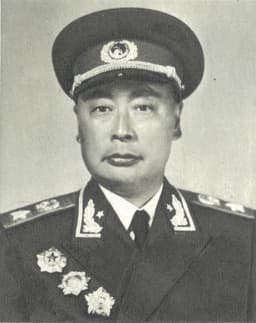
Chen Yi
General · Modern
57.5Total
Omar al-Mukhtar
General · Modern
57.4Total
Basic Information
Born
1901
1858
Died
1972
1931
Era
Modern
Modern
Nationality
China
Libya
Occupation
General
General
Civilization
Eastern
Middle Eastern
Score Comparison
Military (10%)
52.5
46.7
Political (20%)
68.0
32.2
Influence (20%)
57.2
82.0
Legacy (20%)
50.0
55.0
Leadership (15%)
62.0
50.7
Strategy (15%)
60.0
60.0
TOTAL
57.5
57.4
Chen Yi — Complete Timeline
1945 AD
Commander of the Third Field Army in the Chinese Civil WarWar◆ Major
Chen Yi commanded the Third Field Army, which played a key role in the Huaihai Campaign and the capture of Nanjing and Shanghai. His forces were instrumental in the Communist victory in eastern China.
Chinese Civil WarMilitary Campaign
Impact: nationaldestructive
1949 AD
First Mayor of Communist ShanghaiPolitical Action◆ Major
Chen Yi was appointed the first mayor of Shanghai after the Communist takeover. He oversaw the transition of China's largest city from Nationalist to Communist control, implementing economic stabilization and political consolidation.
GovernmentShanghaiCommunist China
Impact: nationalconstructive
1955 AD
Appointed Marshal of the People's Liberation ArmyPolitical Action◆ Major
Chen Yi was appointed as one of the ten marshals of the People's Liberation Army. This honor recognized his military leadership during the civil war and his role in the Communist victory.
Military HonorPLA
Impact: nationalconstructive
1958 AD
Minister of Foreign Affairs of the People's Republic of ChinaPolitical Action◆ Major
Chen Yi was appointed Minister of Foreign Affairs, serving until 1972. He represented China at international conferences, including the Geneva Conference on Laos, and advocated for the Bandung principles of non-alignment.
DiplomacyForeign Policy
Impact: global
Omar al-Mukhtar — Complete Timeline
1915 AD
Battle of al-QurdabiyaWar◆ Major
Omar al-Mukhtar led Sanusi forces in a victory against Italian colonial troops at al-Qurdabiya. This battle established his reputation as a skilled guerrilla commander and marked the beginning of his sustained resistance campaign in Cyrenaica.
BattleLibyan ResistanceItalian Colonization
Impact: regional
1923 AD
Appointment as Commander of the MujahideenPolitical Action◆ Major
Omar al-Mukhtar was appointed supreme commander of the Libyan resistance forces by the Sanusi leadership. He organized guerrilla warfare against Italian occupation, using knowledge of the desert terrain to conduct hit-and-run attacks on Italian positions.
LeadershipLibyan ResistanceSanusi
Impact: regional
1928 AD
Battle of BueratWar
Omar al-Mukhtar's forces ambushed an Italian column near Buerat, inflicting heavy casualties. This victory demonstrated the effectiveness of his guerrilla tactics and prolonged the resistance despite Italy's superior military resources.
BattleGuerrilla WarfareLibyan Resistance
1931 AD
Capture and ExecutionPolitical Action◆ Major
Omar al-Mukhtar was wounded and captured by Italian forces at the Battle of Slonta. He was tried by a military court and publicly hanged in Suluq, Libya. His execution galvanized anti-colonial sentiment and made him a symbol of resistance.
ExecutionLibyan ResistanceItalian Colonization
Impact: regionaltragic
Expert Analysis
Origins
Chen Yi was born on August 26, 1901, in Lezhi County, Sichuan, China, into a moderately wealthy scholar-official family. He studied in France from 1919 to 1921 as a work-study student, where he was exposed to Marxist ideas. Upon returning to China, he joined the Communist Party in 1923 and participated in the Northern Expedition. His early military experience came from the Nanchang Uprising (1927) and the subsequent guerrilla warfare in Jiangxi.
Omar al-Mukhtar was born around 1858 in the village of Janzour, Cyrenaica (eastern Libya), into the Mnifa tribe. He lost his father early and was raised by Sheikh Hussein Ghariani, a religious scholar. Al-Mukhtar studied Islamic jurisprudence and became a teacher and later a leader of the Sanusi order. His early involvement in resistance began in 1900 against French colonial expansion in Chad, but his main struggle started with the Italian invasion of Libya in 1911.
Rise to Power
Chen Yi rose through the ranks of the Chinese Red Army, becoming a commander in the Jiangxi Soviet. During the Long March (1934–1935), he remained behind to lead guerrilla operations. His key turning point came during the Chinese Civil War (1945–1949), when he commanded the Third Field Army. The Huaihai Campaign (November 1948–January 1949) was a decisive victory, with Chen's forces capturing Nanjing and Shanghai. He was appointed the first mayor of Communist Shanghai in 1949, a role that solidified his political standing.
Omar al-Mukhtar's rise to prominence occurred after the Italian invasion. In 1923, after the death of leader Idris al-Mahdi, al-Mukhtar was appointed commander of the Mujahideen by the Sanusi leadership. He organized guerrilla warfare, using hit-and-run tactics against Italian forces. The Battle of al-Qurdabiya (1914) had already established his reputation, but his appointment as supreme commander made him the central figure of the resistance. His leadership was characterized by mobility and knowledge of the desert terrain.
Leadership & Governance
Chen Yi's leadership style combined military command with political administration. As mayor of Shanghai, he faced the challenge of stabilizing a city of 5 million. He implemented policies to control inflation, restore public services, and integrate former Nationalist officials. His governance was pragmatic, allowing some capitalist enterprises to continue temporarily. In foreign affairs, as Minister of Foreign Affairs (1958–1972), he advocated for the Non-Aligned Movement and represented China at the Geneva Conference (1961–1962). However, he was sidelined during the Cultural Revolution.
Omar al-Mukhtar's leadership was based on religious authority and guerrilla tactics. He governed the resistance through a network of Sanusi lodges (zawiyas). His forces never controlled large territory but disrupted Italian colonization. He imposed strict discipline, forbidding looting and treating prisoners according to Islamic law. His military strategy relied on surprise attacks and withdrawal into the desert, forcing the Italians to commit over 100,000 troops. However, his governance was limited by the lack of a state structure.
Triumph & Tragedy
Chen Yi's greatest success was the peaceful takeover of Shanghai in May 1949, avoiding urban destruction. He also played a key role in the Korean War armistice negotiations (1953). His tragedy was the Cultural Revolution (1966–1976), where he was criticized by Red Guards and removed from effective power. He died in 1972, partially rehabilitated but politically damaged.
Omar al-Mukhtar's greatest success was sustaining a 20-year guerrilla war against a technologically superior enemy. The Battle of Buerat (1914) exemplified his tactical skill. His tragedy was his capture in 1931 at the Battle of Slonta, followed by a swift trial and public execution in Suluq on September 11, 1931. His death marked the effective end of organized resistance in Cyrenaica.
Character & Destiny
Chen Yi was known for his pragmatism and diplomatic skills. He wrote poetry and was considered a cultured leader. His ability to adapt—from guerrilla commander to urban administrator to diplomat—showed flexibility. However, his loyalty to Mao Zedong sometimes conflicted with his own judgment, leading to his downfall during the Cultural Revolution.
Omar al-Mukhtar was characterized by his unwavering faith and stoicism. He refused Italian offers of amnesty and continued fighting despite overwhelming odds. His capture and execution turned him into a martyr. Historical assessments highlight his courage but note his inability to adapt to changing Italian tactics, such as the construction of a barbed wire fence along the Egyptian border to cut off his supply lines.
Legacy
Chen Yi's legacy is mixed. In China, he is remembered as one of the ten marshals and a founder of the People's Liberation Army. His governance of Shanghai is studied as a model of communist urban administration. Internationally, he is less known. His scores reflect this: Military 52.5, Political 68.0, Influence 57.2, Legacy 50.0, Leadership 62.0, Strategy 60.0, TOTAL 57.5.
Omar al-Mukhtar's legacy is powerful in Libya and the Arab world. He is a symbol of anti-colonial resistance, memorialized in films like "Lion of the Desert" (1980). His image appears on Libyan currency and stamps. His guerrilla tactics influenced later insurgencies. His scores: Military 46.7, Political 32.2, Influence 82.0, Legacy 55.0, Leadership 50.7, Strategy 60.0, TOTAL 57.4.
Conclusion
While Chen Yi had a higher total score (57.5 vs 57.4), Omar al-Mukhtar's influence score (82.0) dwarfs Chen's (57.2). Al-Mukhtar's status as a martyr and symbol of resistance gives him a more enduring global impact. Chen Yi's achievements were confined to China's internal development and diplomacy, which, though significant, lack the universal resonance of al-Mukhtar's struggle. Therefore, Omar al-Mukhtar had greater impact in terms of symbolic and inspirational legacy, despite Chen Yi's broader political career. The data shows that influence often outweighs governance in long-term historical memory.
Rankings
🥇
Chen YiLeader
Mil: 52.5Pol: 68.0Inf: 57.2
57.5
🥈
Omar al-Mukhtar
Mil: 46.7Pol: 32.2Inf: 82.0
57.4
+0.1 behind
How This Comparison Works
Algorithm
Each figure is scored on 6 dimensions (0—100 scale) based on structured historical data: Military (10%), Political (20%), Influence (20%), Legacy (20%), Leadership (15%), Strategy (15%). The weighted total produces the final ranking.
Data Sources
Scores are computed from structured sub-indicators in the database. Scale factors adjust for era (Ancient ×0.85, Modern ×1.0) and civilization size (Eastern ×1.05, Other ×0.80) to account for differences in population and military scale.
Maximum 3 Figures
Comparisons are limited to 2—3 figures to ensure readability and statistical meaningfulness.
Error Margins
±5 points per dimension — Sub-scores are derived from historical records with inherent uncertainty. Two figures within 5 points on a dimension should be considered roughly equivalent in that area.
Total Score Accuracy
±3 points overall — The weighted combination of 6 dimensions produces a total score with approximately ±3 points of uncertainty. Differences of less than 3 points are not statistically significant— the figures are effectively tied.
Known Limitations
- Historical records are incomplete and uneven across civilizations
- Figures from oral-tradition societies may be underrepresented
- Occupation labels can misclassify multi-role figures
- Scores measure capability and impact, not moral character
- Quantitative scoring is a comparison tool, not absolute truth
Capability Radar
Military (10%) — Battles & Warfare
Battles
55
45
Win Rate
60
30
Expansion
40
10
Political (20%) — Governance & Reform
Reform
50
15
Diplomacy
55
25
Economy
45
10
Influence (20%) — Cultural & Global Reach
Cultural
40
60
Global
35
50
Legacy (20%) — Historical Impact
Historical
50
65
Longevity
40
55
Leadership (15%) — Power & Stability
Tenure
60
30
Stability
50
20
Strategy (15%) — Tactics & Innovation
Strategy
55
55
Tactics
50
65
Reform
30
20
Similar Comparisons
Comments & Discussion
No comments yet. Be the first to share your thoughts!