Loading...
Cheng Tang of Shang vs Julius Caesar
Julius Caesar leads by 24.5 pts · 2 figures compared
…
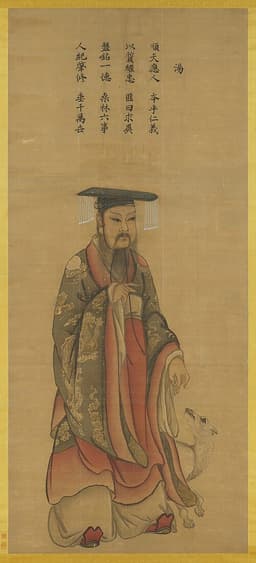
Cheng Tang of Shang
Emperor · Ancient
58.3Total

Julius Caesar
General · Ancient
82.8Total
Basic Information
Born
-1675
-100
Died
-1646
-44
Era
Ancient
Ancient
Nationality
Shang China
Roman Republic
Occupation
Emperor
General
Civilization
Eastern
Western
Score Comparison
Military (10%)
63.3
88.0
Political (20%)
68.0
78.0
Influence (20%)
57.2
85.0
Legacy (20%)
58.0
82.0
Leadership (15%)
53.2
80.0
Strategy (15%)
50.0
85.0
TOTAL
58.3
82.8
Cheng Tang of Shang — Complete Timeline
1675 BC
Battle of MingtiaoWar
Cheng Tang led a coalition of tribes against the Xia dynasty at Mingtiao. The Shang forces defeated the Xia army, leading to the overthrow of King Jie. This battle established Cheng Tang as the first king of the Shang dynasty.
Founding BattleDynastic ChangeXia-Shang Transition
Impact: regional
Establishment of Shang Capital at BoPolitical Action◆ Major
After defeating the Xia, Cheng Tang established his capital at Bo (near modern-day Shangqiu, Henan). This city became the political and ritual center of the early Shang state, consolidating control over the Central Plains.
Capital FoundationState Building
Impact: regionalconstructive
Promulgation of Tang's EdictPolitical Action◆ Major
Cheng Tang issued a public edict justifying the overthrow of the Xia dynasty, accusing King Jie of moral depravity and misrule. This document established the concept of the 'Mandate of Heaven' as a justification for dynastic change.
Political PhilosophyMandate of HeavenPropaganda
Impact: regionalconstructive
1660 BC
Institution of Ritual ReformsCultural
Cheng Tang implemented new state rituals and sacrifices to Shangdi (the high god) and ancestral spirits. These reforms standardized religious practices across the Shang domain, reinforcing the king's role as chief priest.
ReligionRitualState Religion
Impact: regionalconstructive
Julius Caesar — Complete Timeline
58 BC
Gallic WarsWar◆ Major
Caesar, as proconsul of Gaul, launched a series of campaigns that conquered all of Gaul (modern France, Belgium, and parts of Switzerland). He fought numerous battles, including against the Helvetii, the Belgae, and the Gallic chieftain Vercingetorix. The wars brought immense wealth and a loyal army to Caesar.
Gallic WarsConquestRoman Expansion
Impact: regional
49 BC
Crossing the RubiconPolitical Action◆ Major
Caesar led Legio XIII across the Rubicon River into Italy, defying the Roman Senate's order to disband his army. This act triggered a civil war against Pompey and the Optimates, ultimately leading to Caesar's dictatorship and the end of the Roman Republic.
Roman Civil WarEnd of RepublicPower Struggle
Impact: global
48 BC
Battle of PharsalusWar◆ Major
Caesar's outnumbered army defeated the larger forces of Pompey the Great at Pharsalus in Greece. Caesar's tactical use of a reserve line to counter Pompey's cavalry charge proved decisive. Pompey fled to Egypt, where he was assassinated, leaving Caesar as the undisputed master of the Roman world.
Roman Civil WarBattleDecisive Victory
Impact: regional
44 BC
Appointment as Dictator for LifePolitical Action◆ Major
The Roman Senate appointed Caesar dictator perpetuo (dictator for life), granting him unprecedented personal power. This move concentrated military, legislative, and judicial authority in one person, effectively ending the Roman Republic's traditional system of checks and balances and alarming many senators.
DictatorshipEnd of RepublicPower Consolidation
Impact: regionaldestructive
Assassination on the Ides of MarchPolitical Action◆ Major
A group of Roman senators, led by Marcus Junius Brutus and Gaius Cassius Longinus, stabbed Caesar to death at a meeting of the Senate in the Theatre of Pompey. The assassination was intended to restore the Republic, but instead triggered another civil war that led to the rise of the Roman Empire.
AssassinationRoman PoliticsEnd of Republic
Impact: globaldestructive
Expert Analysis
cheng-tang-of-shang-vs-julius-caesar
# The Conqueror and the Founder
On a spring morning in 49 BCE, Julius Caesar stood at the banks of the Rubicon River, contemplating an act that would shatter centuries of Roman law. A few hundred miles away, in a different century entirely, another ancient leader had faced his own moment of decision—Cheng Tang, a tribal chieftain in the Yellow River valley, preparing to march against a tyrant who claimed divine right to rule. Both men would change the world. One would build an empire that lasted five centuries; the other would found a dynasty that endured for six. But their paths, their characters, and their ultimate fates could not have been more different. Why did one die on the floor of a Senate chamber, while the other died peacefully in his bed, surrounded by heirs?
Origins
Gaius Julius Caesar was born into the twilight of the Roman Republic, a world of senatorial intrigue, civil wars, and crumbling traditions. His family, the Julii, claimed descent from the goddess Venus, but they were politically marginal—patricians in name only. Caesar grew up in a Rome where power belonged to men who could command armies and buy votes, where the old republican virtues were giving way to naked ambition. His father died when Caesar was sixteen, leaving him to navigate a treacherous world of alliances and enemies.
Cheng Tang emerged from a very different world. In the second millennium BCE, the Yellow River valley was a patchwork of tribal states bound by ritual and kinship. The Xia dynasty, China's first hereditary monarchy, had ruled for centuries, but its last king, Jie, had become a byword for cruelty and decadence. Tang was the leader of the Shang tribe, a vassal of the Xia, living under a system where legitimacy came from heaven, not from votes. His world was one of bronze vessels, oracle bones, and ancestral spirits—a world where the mandate to rule was a matter of cosmic order, not political maneuvering.
Rise to Power
Caesar's ascent was a masterclass in Roman ambition. He borrowed fortunes to fund lavish games and bribes, climbed the ladder of Roman offices—quaestor, aedile, praetor—and forged a critical alliance with Pompey and Crassus, the First Triumvirate. His governorship of Gaul (58–50 BCE) was his launching pad: eight years of brutal conquest that made him a military legend and a multimillionaire. He wrote his own propaganda, the *Commentaries*, which are still read today. When his enemies in the Senate demanded he disband his army, he chose war. Crossing the Rubicon was a gamble that paid off in dictatorship.
Cheng Tang's rise was slower, more ceremonial, and driven by moral rather than military calculation. According to Chinese historical tradition, Tang began by building a reputation for virtue. He governed his Shang tribe with justice, attracting refugees from Jie's tyranny. He waited for the right moment—a famine, a rebellion, a sign from heaven. In 1675 BCE, at the Battle of Mingtiao, he led a coalition of discontented tribes against the Xia. It was not a lightning campaign of personal glory but a ritualized conflict, framed as a righteous punishment. After victory, Tang did not march on the capital in triumph; he established a new capital at Bo and issued an edict justifying his actions, accusing Jie of moral depravity. He was not seizing power; he was restoring cosmic balance.
Leadership & Governance
Caesar governed as a revolutionary. As dictator, he reformed the calendar (the Julian calendar we still use), granted citizenship to Gauls, redistributed land to veterans, and centralized authority in his own hands. He was a political genius who understood that the Republic was dying and that only strong leadership could save Rome. But his reforms were hasty, his enemies numerous, and his arrogance fatal. He famously refused a crown, but he also refused to share power. His military genius was undeniable—at Alesia, at Pharsalus, at Zela—but his political wisdom was undermined by his contempt for the Senate.
Tang governed as a founder. He instituted new state rituals, sacrificing to Shangdi and ancestral spirits, creating a religious framework that would define Chinese statecraft for millennia. He issued edicts about proper governance, emphasizing virtue, justice, and the welfare of the people. His military campaigns were limited; after the Xia, he focused on consolidation, not expansion. He built a bureaucracy of ritual specialists and scribes, establishing the Shang as a hereditary monarchy. Where Caesar tore down the old order, Tang built a new one on the ruins of the old, but he did so with the language of tradition, not revolution.
Triumph & Tragedy
Caesar's greatest moment was his triumph over Gaul—the conquest of a vast territory, the subjugation of hundreds of tribes, the wealth and glory that made him master of Rome. His greatest tragedy was his assassination on the Ides of March, 44 BCE, stabbed by senators he had pardoned. He died not in battle but in a meeting, his blood pooling on the floor of the Curia. His final words—according to legend, "Et tu, Brute?"—captured the ultimate betrayal.
Tang's greatest moment was the Battle of Mingtiao, where he overthrew a dynasty that had ruled for centuries. His greatest tragedy was none—he died of natural causes around 1646 BCE, after a reign of roughly thirty years. No assassins, no civil war, no dramatic fall. He was succeeded by his son, and the Shang dynasty continued for another five hundred years. His tragedy, if one can call it that, is that we know so little about him—his story is preserved in fragments, mythologized, stripped of the human complexity that makes Caesar so vivid.
Character & Destiny
Caesar was driven by an insatiable hunger for glory. He was brilliant, charismatic, and ruthless, a man who believed he was destined for greatness. His personality shaped his decisions: he pardoned his enemies because he believed they would admire his magnanimity; he crossed the Rubicon because he could not imagine defeat; he refused a bodyguard because he thought himself invincible. His character was his destiny—his ambition made him, and his arrogance destroyed him.
Tang was driven by a sense of cosmic duty. He was patient, ritualistic, and careful, a man who believed that heaven's mandate could be lost through immorality. His personality shaped his decisions: he waited for the right moment to strike; he justified his rebellion with moral arguments; he built institutions, not a personality cult. His character was also his destiny—he founded a dynasty that outlasted him by centuries, precisely because he built for permanence, not for personal glory.
Legacy
Caesar's legacy is paradoxical. He destroyed the Roman Republic, but his name became synonymous with imperial rule—"Caesar" became the title of emperors, kaisers, and tsars. His writings are studied, his military campaigns analyzed, his assassination dramatized. He is remembered as a man of genius and hubris, a figure who changed the world but could not save himself.
Tang's legacy is quieter but more enduring. He is remembered as the founder of the Shang dynasty, the first historically verifiable Chinese dynasty, and as a model of virtuous rebellion—the "mandate of heaven" argument he pioneered would justify every future Chinese dynasty change. He is honored in Confucian texts as a sage-king, a ruler who overthrew tyranny without becoming a tyrant himself. His name is less known in the West, but in China, he is a foundational figure, a man who proved that power must serve morality.
Conclusion
Standing at the Rubicon, Caesar saw only one path forward—himself, alone, against the world. Standing before the Xia, Tang saw a different path—himself, as part of a cosmic order, restoring balance. One conquered; one founded. One died betrayed; one died honored. Their differences are not merely personal but civilizational: Caesar was a product of a competitive, individualistic Mediterranean world; Tang was a product of a hierarchical, ritualistic East Asian world. Yet both faced the same fundamental question: when does ambition become tyranny, and when does rebellion become justice? Their answers shaped history, and their stories remind us that the greatest leaders are not those who seek power for its own sake, but those who build something that outlasts them.
Rankings
🥇
Julius CaesarLeader
Mil: 88.0Pol: 78.0Inf: 85.0
82.8
🥈
Cheng Tang of Shang
Mil: 63.3Pol: 68.0Inf: 57.2
58.3
+24.5 behind
How This Comparison Works
Algorithm
Each figure is scored on 6 dimensions (0—100 scale) based on structured historical data: Military (10%), Political (20%), Influence (20%), Legacy (20%), Leadership (15%), Strategy (15%). The weighted total produces the final ranking.
Data Sources
Scores are computed from structured sub-indicators in the database. Scale factors adjust for era (Ancient ×0.85, Modern ×1.0) and civilization size (Eastern ×1.05, Other ×0.80) to account for differences in population and military scale.
Maximum 3 Figures
Comparisons are limited to 2—3 figures to ensure readability and statistical meaningfulness.
Error Margins
±5 points per dimension — Sub-scores are derived from historical records with inherent uncertainty. Two figures within 5 points on a dimension should be considered roughly equivalent in that area.
Total Score Accuracy
±3 points overall — The weighted combination of 6 dimensions produces a total score with approximately ±3 points of uncertainty. Differences of less than 3 points are not statistically significant— the figures are effectively tied.
Known Limitations
- Historical records are incomplete and uneven across civilizations
- Figures from oral-tradition societies may be underrepresented
- Occupation labels can misclassify multi-role figures
- Scores measure capability and impact, not moral character
- Quantitative scoring is a comparison tool, not absolute truth
Capability Radar
Military (10%) — Battles & Warfare
Battles
60
95
Win Rate
70
92
Expansion
60
97
Political (20%) — Governance & Reform
Reform
60
90
Diplomacy
55
85
Economy
50
82
Influence (20%) — Cultural & Global Reach
Cultural
55
88
Global
50
94
Legacy (20%) — Historical Impact
Historical
70
95
Longevity
65
96
Leadership (15%) — Power & Stability
Tenure
65
75
Stability
55
60
Strategy (15%) — Tactics & Innovation
Strategy
65
94
Tactics
55
96
Reform
50
88
Similar Comparisons
Comments & Discussion
RedRubicund6/17/2026
Sure, Caesar crossing the Rubicon shows he was a gambler, not a founder. Cheng Tang waited, studied the Xia’s rot, built his case, then struck. Caesar grabbed power in a night; Tang won heaven’s mandate over years. That’s why Tang’s dynasty lasted 600 years and Caesar’s got knifed in five. Military feints don’t beat statecraft.
乱世刀客6/17/2026
拿凯撒比商汤,简直是在侮辱中国第一场革命。凯撒就是个贵族军阀,仗着军功和债务法案收买人心;商汤推翻夏桀时,连葛伯的祭品都计较,靠德行而非刀剑赢天下。你说凯撒跨过卢比孔河?那是背弃共和的叛变。商汤伐桀是替天行道,记录在《尚书》里,凯撒那点政变算什么?
VeritasGladiata6/17/2026
Data skeptic here. We’ve got maybe five contemporary lines about Cheng Tang—mostly bronze inscriptions and later Zhou propaganda. Caesar wrote the Gallic Wars himself. Comparing their “ambition” is like comparing a whisper to a recording. Tang exists as a founding myth to justify the Shang; Caesar is a documented disaster. One was real, the other is a ghost wearing a king’s crown.
庙堂碎碎念6/17/2026
说凯撒和汤都是征服者,太表面了。凯撒至死没称帝,哪怕元老院给他权利;他更像个孤注一掷的投机者。汤不一样,他伐桀前已经周旋了十七年,等夏人离心离德才出手。凯撒败在太急,汤赢在极忍。一个是霸王硬上弓,一个是火候刚好——所以一人血流成河,一人青史名垂。
QuiritesRex6/17/2026
Amazing how we call Caesar a “founder” when his “empire” needed Augustus to actually build it, and Tang founded a dynasty that lasted six centuries. Caesar didn’t even pacify Gaul without a genocide debate. Tang? He toppled a tyrant, restored order, and passed the throne cleanly. One was a brilliant warlord; the other, a founding king. Different leagues.