Loading...
This comparison has not been analyzed yet.
One-time AI generation (~1 minute). Scores and timeline are already available below.
Choe Kwang vs Rodion Malinovsky
Rodion Malinovsky leads by 13.9 pts · 2 figures compared
…

Choe Kwang
General · Modern
46.1Total
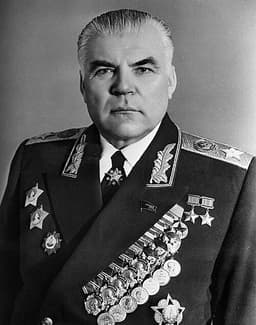
Rodion Malinovsky
General · Modern
60.0Total
Basic Information
Born
1918
1898
Died
1997
1967
Era
Modern
Modern
Nationality
North Korea
USSR
Occupation
General
General
Civilization
Eastern
Western
Score Comparison
Military (10%)
38.3
72.0
Political (20%)
36.5
45.0
Influence (20%)
53.3
55.0
Legacy (20%)
40.8
58.0
Leadership (15%)
65.0
72.0
Strategy (15%)
35.0
69.6
TOTAL
46.1
60.0
Choe Kwang — Complete Timeline
1995 AD
Appointed Minister of the People's Armed ForcesPolitical Action◆ Major
Choe Kwang succeeded O Jin-u as Minister of the People's Armed Forces, becoming the top military official in North Korea. He oversaw the Korean People's Army during the mid-1990s famine and the early years of Kim Jong-il's rule.
Military AppointmentNorth KoreaKim Jong-il
Impact: national
Promoted to MarshalPolitical Action◆ Major
Choe Kwang was promoted to the rank of Marshal of the Korean People's Army, the highest military rank in North Korea. This promotion reflected his central role in the military hierarchy under Kim Jong-il.
Military RankNorth KoreaPromotion
Impact: national
1997 AD
Died in OfficeOther◆ Major
Choe Kwang died while serving as Minister of the People's Armed Forces. His death led to a reshuffle in North Korea's military leadership, with Kim Il-chol succeeding him.
DeathNorth KoreaMilitary
Impact: national
Rodion Malinovsky — Complete Timeline
1939 AD
Battle of Khalkhin GolWar
Malinovsky served as a division commander during the Battle of Khalkhin Gol against Japan. The Soviet victory secured the eastern border and influenced Japan's decision not to attack the USSR in 1941.
Soviet-Japanese Border WarMongoliaVictory
Impact: regional
1942 AD
Battle of StalingradWar◆ Major
Malinovsky commanded the 2nd Guards Army during the Battle of Stalingrad. His forces played a key role in repelling the German relief attempt by Army Group Don, securing the encirclement of the 6th Army.
World War IIStalingradCounteroffensive
Impact: global
1944 AD
Jassy–Kishinev OffensiveWar◆ Major
Malinovsky commanded the 2nd Ukrainian Front in the Jassy
World War IIRomaniaOffensive
Impact: regional
1957 AD
Appointment as Minister of Defense of the USSRPolitical Action◆ Major
Malinovsky was appointed Minister of Defense of the USSR by Khrushchev. He oversaw the Soviet military during the Cold War, including the Cuban Missile Crisis and the buildup of nuclear forces.
Cold WarDefense MinisterNuclear
Impact: global
This comparison has not been analyzed yet.
One-time AI generation (~1 minute). Scores and timeline are already available below.
Rankings
🥇
Rodion MalinovskyLeader
Mil: 72.0Pol: 45.0Inf: 55.0
60.0
🥈
Choe Kwang
Mil: 38.3Pol: 36.5Inf: 53.3
46.1
+13.9 behind
How This Comparison Works
Algorithm
Each figure is scored on 6 dimensions (0—100 scale) based on structured historical data: Military (10%), Political (20%), Influence (20%), Legacy (20%), Leadership (15%), Strategy (15%). The weighted total produces the final ranking.
Data Sources
Scores are computed from structured sub-indicators in the database. Scale factors adjust for era (Ancient ×0.85, Modern ×1.0) and civilization size (Eastern ×1.05, Other ×0.80) to account for differences in population and military scale.
Maximum 3 Figures
Comparisons are limited to 2—3 figures to ensure readability and statistical meaningfulness.
Error Margins
±5 points per dimension — Sub-scores are derived from historical records with inherent uncertainty. Two figures within 5 points on a dimension should be considered roughly equivalent in that area.
Total Score Accuracy
±3 points overall — The weighted combination of 6 dimensions produces a total score with approximately ±3 points of uncertainty. Differences of less than 3 points are not statistically significant— the figures are effectively tied.
Known Limitations
- Historical records are incomplete and uneven across civilizations
- Figures from oral-tradition societies may be underrepresented
- Occupation labels can misclassify multi-role figures
- Scores measure capability and impact, not moral character
- Quantitative scoring is a comparison tool, not absolute truth
Capability Radar
Military (10%) — Battles & Warfare
Battles
30
85
Win Rate
40
80
Expansion
20
75
Political (20%) — Governance & Reform
Reform
20
55
Diplomacy
30
60
Economy
15
50
Influence (20%) — Cultural & Global Reach
Cultural
15
45
Global
15
60
Legacy (20%) — Historical Impact
Historical
20
65
Longevity
15
50
Leadership (15%) — Power & Stability
Tenure
55
65
Stability
25
60
Strategy (15%) — Tactics & Innovation
Strategy
40
85
Tactics
35
78
Reform
25
70
Similar Comparisons
Comments & Discussion
No comments yet. Be the first to share your thoughts!