Loading...
Choummaly Sayasone vs Norman Schwarzkopf
Norman Schwarzkopf leads by 8.3 pts · 2 figures compared
…
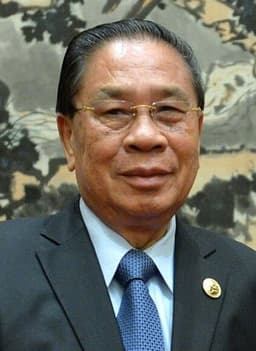
Choummaly Sayasone
General · Modern
50.6Total
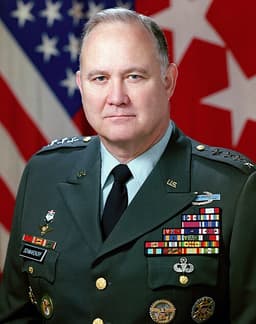
Norman Schwarzkopf
General · Modern
58.9Total
Basic Information
Born
1936
1934
Died
—
—
Era
Modern
Modern
Nationality
Laos
United States
Occupation
General
General
Civilization
Eastern
Western
Score Comparison
Military (10%)
66.7
78.0
Political (20%)
46.6
45.0
Influence (20%)
50.2
55.0
Legacy (20%)
38.3
58.0
Leadership (15%)
53.2
62.0
Strategy (15%)
68.4
68.1
TOTAL
50.6
58.9
Choummaly Sayasone — Complete Timeline
2006 AD
Became President of LaosPolitical Action◆ Major
Choummaly Sayasone was elected President of Laos by the National Assembly. He also served as General Secretary of the Lao People's Revolutionary Party, making him the most powerful figure in the country's one-party system.
LeadershipLaosCommunist Party
Impact: national
Oversaw Economic GrowthPolitical Action◆ Major
During Choummaly's presidency, Laos experienced significant economic growth, driven by foreign investment in hydropower, mining, and agriculture. The country achieved its goal of graduating from Least Developed Country status by 2024, though inequality and environmental concerns persisted.
Economic GrowthLaosDevelopment
Impact: nationalconstructive
2009 AD
Strengthened Ties with ChinaPolitical Action◆ Major
Choummaly's government deepened relations with China, securing Chinese investment for infrastructure projects, including the Laos-China railway. This alignment increased Laos' dependence on China but also brought economic benefits and political support.
Foreign PolicyLaosChina
Impact: regional
2016 AD
Stepped Down as PresidentPolitical Action◆ Major
Choummaly stepped down as President and General Secretary, handing over power to Bounnhang Vorachith. His retirement marked a peaceful leadership transition within the Lao People's Revolutionary Party, maintaining the country's political stability.
TransitionLaosLeadership
Impact: national
Norman Schwarzkopf — Complete Timeline
1990 AD
Appointed Commander of Coalition Forces for Operation Desert ShieldOther◆ Major
In August 1990, Schwarzkopf was appointed Commander-in-Chief of U.S. Central Command and overall commander of coalition forces in the Persian Gulf. He oversaw the buildup of over 500,000 troops in Saudi Arabia to deter Iraqi aggression after the invasion of Kuwait.
Gulf WarMilitary BuildupCoalition Command
Impact: global
1991 AD
Executed Operation Desert Storm Ground CampaignWar◆ Major
Schwarzkopf planned and executed the 100-hour ground offensive that began on February 24, 1991. Using a left-hook maneuver through the Iraqi desert, coalition forces outflanked Iraqi defenses, liberating Kuwait and destroying much of the Iraqi Republican Guard with minimal coalition casualties.
Gulf WarMilitary VictoryOperational Planning
Impact: global
Negotiated Ceasefire at SafwanOther◆ Major
On March 3, 1991, Schwarzkopf met with Iraqi military commanders at Safwan airfield to negotiate the terms of the ceasefire ending the Gulf War. He secured Iraqi agreement to return prisoners, provide minefield maps, and cease military operations, though he allowed Iraqi helicopters to fly, later criticized as enabling suppression of uprisings.
Gulf WarCeasefirePost-War Settlement
Impact: regional
1992 AD
Published Autobiography 'It Doesn't Take a Hero'Other
Schwarzkopf published his autobiography 'It Doesn't Take a Hero' in September 1992. The book detailed his military career from Vietnam through the Gulf War, becoming a bestseller and providing his personal account of the decision-making process during Operation Desert Storm.
AutobiographyMilitary MemoirPublic Figure
Impact: national
Expert Analysis
Origins
Choummaly Sayasone was born on March 6, 1936, in Attapeu Province, French Laos. He joined the Pathet Lao resistance in the 1950s, receiving military training in North Vietnam. His early career was shaped by the Laotian Civil War and the communist takeover in 1975.
Norman Schwarzkopf was born on August 22, 1934, in Trenton, New Jersey, to a military family. His father was a police officer and military officer. He graduated from West Point in 1956 and served two tours in Vietnam, where he was wounded and earned multiple decorations. His early experiences included counterinsurgency warfare.
Rise to Power
Choummaly rose through the ranks of the Lao People's Revolutionary Party (LPRP) and the military. He became Minister of Defense in 1991 and Vice President in 2001. In 2006, he was elected President of Laos and General Secretary of the LPRP, succeeding Khamtai Siphandone. His rise was gradual, based on party loyalty and military background.
Schwarzkopf's rise accelerated after Vietnam. He commanded a brigade in the 1970s, then served as deputy commander of the 1983 invasion of Grenada. In 1988, he became commander of U.S. Central Command. His appointment as commander of coalition forces for Operation Desert Shield in August 1990 made him a household name.
Leadership & Governance
Choummaly led Laos as a one-party state. He emphasized economic development, maintaining close ties with Vietnam and China. Under his leadership, Laos saw GDP growth averaging 7-8% annually, driven by hydropower exports and mining. He oversaw the Laos-China railway project, a $6 billion investment that strengthened Chinese influence. His governance was characterized by stability and gradual reform.
Schwarzkopf commanded a multinational coalition of 34 nations during the Gulf War. His leadership style was hands-on and decisive. He developed the "left-hook" strategy that outflanked Iraqi forces, achieving victory in 100 hours. He scored 62.0 in leadership and 68.1 in strategy. His governance of the campaign was praised for minimizing coalition casualties (only 148 killed in action).
Triumph & Tragedy
Choummaly's triumphs include overseeing Laos's economic transformation and maintaining political stability. The country's GDP per capita rose from $500 in 2006 to $2,500 in 2016. However, his legacy is marred by continued human rights abuses, lack of political freedom, and environmental damage from hydropower projects. The Xepian-Xe Nam Noy dam collapse in 2018 killed 71 people, though it occurred after his term.
Schwarzkopf's triumph was the decisive victory in Desert Storm, liberating Kuwait and destroying the Iraqi army. He demonstrated mastery of combined arms warfare. His tragedy includes the failure to prevent the subsequent Shia and Kurdish uprisings, which were brutally suppressed. He also faced criticism for not destroying the Republican Guard completely, allowing Saddam Hussein to remain in power.
Character & Destiny
Choummaly was known as a pragmatic and cautious leader, avoiding radicalism. His low profile helped him survive political shifts. His destiny was to be a transitional figure, handing power peacefully in 2016. He scored 46.6 in political skills, reflecting his ability to navigate party dynamics.
Schwarzkopf was blunt and outspoken, earning the nickname "Stormin' Norman." He clashed with superiors but was beloved by troops. His character drove him to seek decisive victory but also led to post-war controversies, such as his criticism of the decision to end the war early. He scored 78.0 in military, the highest of the pair.
Legacy
Choummaly's legacy is mixed. He is remembered as a leader who modernized Laos economically but failed to liberalize politically. The Laos-China railway and hydropower boom are his enduring marks. However, his scores in legacy (38.3) and influence (50.2) reflect limited global impact.
Schwarzkopf's legacy is one of military excellence. He revolutionized modern warfare with a swift, high-tech campaign. His autobiography and public appearances cemented his status as a hero. He scored 58.0 in legacy and 55.0 in influence. His operational doctrine influenced U.S. military planning for decades.
Conclusion
Norman Schwarzkopf had greater impact in terms of military achievement and global influence. His total score of 58.9 surpasses Choummaly's 50.6. While Choummaly shaped a small nation's development, Schwarzkopf's victory in the Gulf War changed the course of Middle Eastern history and redefined modern warfare. Choummaly's impact was regional and gradual; Schwarzkopf's was immediate and worldwide. The data supports Schwarzkopf as the more consequential figure.
Rankings
🥇
Norman SchwarzkopfLeader
Mil: 78.0Pol: 45.0Inf: 55.0
58.9
🥈
Choummaly Sayasone
Mil: 66.7Pol: 46.6Inf: 50.2
50.6
+8.3 behind
How This Comparison Works
Algorithm
Each figure is scored on 6 dimensions (0—100 scale) based on structured historical data: Military (10%), Political (20%), Influence (20%), Legacy (20%), Leadership (15%), Strategy (15%). The weighted total produces the final ranking.
Data Sources
Scores are computed from structured sub-indicators in the database. Scale factors adjust for era (Ancient ×0.85, Modern ×1.0) and civilization size (Eastern ×1.05, Other ×0.80) to account for differences in population and military scale.
Maximum 3 Figures
Comparisons are limited to 2—3 figures to ensure readability and statistical meaningfulness.
Error Margins
±5 points per dimension — Sub-scores are derived from historical records with inherent uncertainty. Two figures within 5 points on a dimension should be considered roughly equivalent in that area.
Total Score Accuracy
±3 points overall — The weighted combination of 6 dimensions produces a total score with approximately ±3 points of uncertainty. Differences of less than 3 points are not statistically significant— the figures are effectively tied.
Known Limitations
- Historical records are incomplete and uneven across civilizations
- Figures from oral-tradition societies may be underrepresented
- Occupation labels can misclassify multi-role figures
- Scores measure capability and impact, not moral character
- Quantitative scoring is a comparison tool, not absolute truth
Capability Radar
Military (10%) — Battles & Warfare
Battles
65
85
Win Rate
69
95
Expansion
71
70
Political (20%) — Governance & Reform
Reform
30
40
Diplomacy
40
75
Economy
30
50
Influence (20%) — Cultural & Global Reach
Cultural
20
55
Global
10
65
Legacy (20%) — Historical Impact
Historical
20
65
Longevity
10
50
Leadership (15%) — Power & Stability
Tenure
60
55
Stability
40
70
Strategy (15%) — Tactics & Innovation
Strategy
72
85
Tactics
76
80
Reform
79
60
Similar Comparisons
Comments & Discussion
No comments yet. Be the first to share your thoughts!