Loading...
Norman Schwarzkopf vs Salih Hulusi Pasha
Norman Schwarzkopf leads by 22.4 pts · 2 figures compared
…
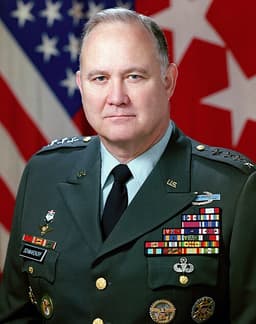
Norman Schwarzkopf
General · Modern
58.9Total

Salih Hulusi Pasha
General · Modern
36.5Total
Basic Information
Born
1934
1864
Died
—
1939
Era
Modern
Modern
Nationality
United States
Ottoman Empire
Occupation
General
General
Civilization
Western
Middle Eastern
Score Comparison
Military (10%)
78.0
10.2
Political (20%)
45.0
35.1
Influence (20%)
55.0
47.1
Legacy (20%)
58.0
37.5
Leadership (15%)
62.0
43.8
Strategy (15%)
68.1
25.0
TOTAL
58.9
36.5
Norman Schwarzkopf — Complete Timeline
1990 AD
Appointed Commander of Coalition Forces for Operation Desert ShieldOther◆ Major
In August 1990, Schwarzkopf was appointed Commander-in-Chief of U.S. Central Command and overall commander of coalition forces in the Persian Gulf. He oversaw the buildup of over 500,000 troops in Saudi Arabia to deter Iraqi aggression after the invasion of Kuwait.
Gulf WarMilitary BuildupCoalition Command
Impact: global
1991 AD
Executed Operation Desert Storm Ground CampaignWar◆ Major
Schwarzkopf planned and executed the 100-hour ground offensive that began on February 24, 1991. Using a left-hook maneuver through the Iraqi desert, coalition forces outflanked Iraqi defenses, liberating Kuwait and destroying much of the Iraqi Republican Guard with minimal coalition casualties.
Gulf WarMilitary VictoryOperational Planning
Impact: global
Negotiated Ceasefire at SafwanOther◆ Major
On March 3, 1991, Schwarzkopf met with Iraqi military commanders at Safwan airfield to negotiate the terms of the ceasefire ending the Gulf War. He secured Iraqi agreement to return prisoners, provide minefield maps, and cease military operations, though he allowed Iraqi helicopters to fly, later criticized as enabling suppression of uprisings.
Gulf WarCeasefirePost-War Settlement
Impact: regional
1992 AD
Published Autobiography 'It Doesn't Take a Hero'Other
Schwarzkopf published his autobiography 'It Doesn't Take a Hero' in September 1992. The book detailed his military career from Vietnam through the Gulf War, becoming a bestseller and providing his personal account of the decision-making process during Operation Desert Storm.
AutobiographyMilitary MemoirPublic Figure
Impact: national
Salih Hulusi Pasha — Complete Timeline
1920 AD
Appointed Grand VizierPolitical Action◆ Major
Salih Hulusi Pasha was appointed Grand Vizier by Sultan Mehmed VI in March 1920. His tenure lasted only a few weeks as he was dismissed by the sultan for refusing to sign the Treaty of S
Grand VizierTreaty of SèvresDismissal
Impact: national
Dismissed by Sultan Mehmed VIPolitical Action◆ Major
Salih Hulusi Pasha was dismissed as Grand Vizier by Sultan Mehmed VI after only two weeks in office. The sultan objected to his refusal to sign the Treaty of S
DismissalTreaty of SèvresSultan
Impact: national
Retired from PoliticsPolitical Action
After his dismissal, Salih Hulusi Pasha retired from political life. He lived quietly in Istanbul during the Turkish War of Independence and the early years of the Republic, dying in 1939.
RetirementTurkish War of Independence
Impact: national
Expert Analysis
Origins
Norman Schwarzkopf was born on August 22, 1934, in Trenton, New Jersey, into a military family. His father, Herbert Norman Schwarzkopf, was a West Point graduate and the first superintendent of the New Jersey State Police. The younger Schwarzkopf attended the Valley Forge Military Academy and later West Point, graduating in 1956. He served in the infantry and earned a master's degree in engineering from the University of Southern California. His early career included two tours in Vietnam, where he was wounded and awarded three Silver Stars.
Salih Hulusi Pasha was born in 1864 in Constantinople (Istanbul) into a prominent Ottoman family. He graduated from the Ottoman Military Academy (Mekteb-i Harbiye) and served in various military posts. He participated in the Balkan Wars (1912-1913) and World War I, rising to the rank of general. His political career peaked briefly in 1920 when he was appointed grand vizier by Sultan Mehmed VI.
Rise to Power
Schwarzkopf's rise was gradual and merit-based. After Vietnam, he held key staff and command positions, including assistant division commander of the 8th Infantry Division in Germany and deputy commander of the Joint Task Force in Grenada (1983). In 1988, he was appointed Commander-in-Chief of U.S. Central Command, overseeing military operations in the Middle East. His defining moment came on August 2, 1990, when Iraq invaded Kuwait. Within days, Schwarzkopf was appointed overall commander of coalition forces for Operation Desert Shield, a position he held until the war's end.
Salih Hulusi Pasha rose to prominence through his military career. He served as the Ottoman Minister of War (Harbiye Nazırı) in 1918-1919. In March 1920, Sultan Mehmed VI appointed him grand vizier, hoping he would help suppress the Turkish National Movement led by Mustafa Kemal Atatürk. However, his tenure lasted only two weeks (March 8-24, 1920) because he refused to sign the Treaty of Sèvres, which would have partitioned Anatolia. The sultan dismissed him for this refusal.
Leadership & Governance
Schwarzkopf's leadership style was direct and demanding. He earned the nickname "Stormin' Norman" for his explosive temper and high standards. He centralized planning but delegated execution, building a coalition of 34 nations with differing objectives. His governance of the coalition was pragmatic: he balanced U.S. dominance with allied input, ensuring Arab forces played visible roles. His strategic plan for the ground war—the "left hook" through the Iraqi desert—was a classic envelopment, demonstrating his grasp of maneuver warfare.
Salih Hulusi Pasha's leadership was constrained by his brief tenure. As grand vizier, he faced the collapse of the Ottoman Empire after World War I. His refusal to sign the Treaty of Sèvres showed integrity but limited political acumen. He lacked the power to challenge the sultan or the Allied powers effectively. His military leadership earlier in the Balkans and WWI was competent but unremarkable; he scored only 25.0 in strategy, reflecting his inability to shape events.
Triumph & Tragedy
Schwarzkopf's greatest triumph was the 100-hour ground campaign (February 24-28, 1991) of Operation Desert Storm. His plan destroyed 3,000 Iraqi tanks, captured 60,000 prisoners, and liberated Kuwait with minimal coalition casualties (fewer than 300 deaths). His ceasefire negotiation at Safwan on March 3, 1991, ended hostilities. However, his tragedy was the incomplete victory: he allowed the Iraqi Republican Guard to escape, and Saddam Hussein remained in power. This led to years of sanctions and later the 2003 Iraq War. Schwarzkopf also faced criticism for not preventing the postwar Shiite and Kurdish uprisings.
Salih Hulusi Pasha's triumph was his principled stand against the Treaty of Sèvres, which preserved Ottoman sovereignty in principle. His tragedy was his ineffectiveness: he was dismissed after two weeks and retired quietly. He lived through the Turkish War of Independence but had no role in shaping the new republic. His total score of 36.5 reflects his minimal impact.
Character & Destiny
Schwarzkopf was decisive, blunt, and detail-oriented. He micro-managed planning but trusted subordinates in execution. His character was shaped by his father's influence and Vietnam experience, which made him cautious about casualties. This caution led to the rapid ground war but also the decision to stop after 100 hours, allowing Iraqi forces to escape. His destiny was to be the face of a war that redefined U.S. military power but left a messy aftermath.
Salih Hulusi Pasha was conservative and loyal to the sultan, but his refusal to sign Sèvres showed a streak of nationalism. He lacked the ambition or ruthlessness to seize power or negotiate effectively. His destiny was to be a footnote in Ottoman history, overshadowed by Atatürk.
Legacy
Schwarzkopf's legacy is mixed. He is remembered as a capable commander who won a swift victory with minimal casualties. The Powell Doctrine (overwhelming force) bore his imprint. His autobiography "It Doesn't Take a Hero" (1992) cemented his image. However, the Gulf War's incomplete victory and subsequent conflicts diminished his reputation. He scores 58.9 total, with military at 78.0 and leadership at 62.0.
Salih Hulusi Pasha's legacy is negligible. He is rarely mentioned in Turkish history beyond his brief grand vizierate. His refusal to sign Sèvres is a point of honor, but it had no practical effect. He scores 36.5 total, with political at 35.1 and legacy at 37.5.
Conclusion
Norman Schwarzkopf had a significantly greater impact than Salih Hulusi Pasha. The score gap of 22.4 points underscores this. Schwarzkopf commanded the largest coalition since World War II and executed a decisive military campaign that shaped Middle Eastern geopolitics. Salih Hulusi Pasha, despite his principled stand, was powerless in a collapsing empire. Schwarzkopf's strategic innovation (the left hook) and coalition management set a standard for modern warfare, while Hulusi Pasha's tenure was too brief to influence events. The clear position is that Schwarzkopf's impact dwarfs that of his Ottoman counterpart.
Rankings
🥇
Norman SchwarzkopfLeader
Mil: 78.0Pol: 45.0Inf: 55.0
58.9
🥈
Salih Hulusi Pasha
Mil: 10.2Pol: 35.1Inf: 47.1
36.5
+22.4 behind
How This Comparison Works
Algorithm
Each figure is scored on 6 dimensions (0—100 scale) based on structured historical data: Military (10%), Political (20%), Influence (20%), Legacy (20%), Leadership (15%), Strategy (15%). The weighted total produces the final ranking.
Data Sources
Scores are computed from structured sub-indicators in the database. Scale factors adjust for era (Ancient ×0.85, Modern ×1.0) and civilization size (Eastern ×1.05, Other ×0.80) to account for differences in population and military scale.
Maximum 3 Figures
Comparisons are limited to 2—3 figures to ensure readability and statistical meaningfulness.
Error Margins
±5 points per dimension — Sub-scores are derived from historical records with inherent uncertainty. Two figures within 5 points on a dimension should be considered roughly equivalent in that area.
Total Score Accuracy
±3 points overall — The weighted combination of 6 dimensions produces a total score with approximately ±3 points of uncertainty. Differences of less than 3 points are not statistically significant— the figures are effectively tied.
Known Limitations
- Historical records are incomplete and uneven across civilizations
- Figures from oral-tradition societies may be underrepresented
- Occupation labels can misclassify multi-role figures
- Scores measure capability and impact, not moral character
- Quantitative scoring is a comparison tool, not absolute truth
Capability Radar
Military (10%) — Battles & Warfare
Battles
85
5
Win Rate
95
5
Expansion
70
5
Political (20%) — Governance & Reform
Reform
40
20
Diplomacy
75
25
Economy
50
15
Influence (20%) — Cultural & Global Reach
Cultural
55
5
Global
65
5
Legacy (20%) — Historical Impact
Historical
65
10
Longevity
50
5
Leadership (15%) — Power & Stability
Tenure
55
30
Stability
70
10
Strategy (15%) — Tactics & Innovation
Strategy
85
10
Tactics
80
10
Reform
60
15
Similar Comparisons
Comments & Discussion
No comments yet. Be the first to share your thoughts!