Loading...
Christian IV vs Letsie I
Christian IV leads by 8.0 pts · 2 figures compared
…
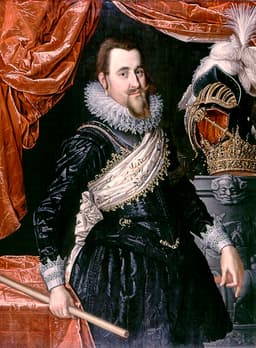
Christian IV
Emperor · Modern
55.4Total

Letsie I
Emperor · Modern
47.4Total
Basic Information
Born
1577
1811
Died
1648
1891
Era
Modern
Modern
Nationality
Denmark
Lesotho
Occupation
Emperor
Emperor
Civilization
Western
Other
Score Comparison
Military (10%)
55.0
50.0
Political (20%)
45.0
43.7
Influence (20%)
60.0
49.4
Legacy (20%)
49.2
39.2
Leadership (15%)
66.0
67.0
Strategy (15%)
60.0
36.8
TOTAL
55.4
47.4
Christian IV — Complete Timeline
1624 AD
Founding of Christiania (Oslo)Cultural◆ Major
After a fire destroyed Oslo, Christian IV ordered the city rebuilt on a new site and renamed it Christiania. He designed the new city with a grid plan and Renaissance architecture, which became the foundation of modern Oslo, Norway's capital.
Urban PlanningArchitectureNorway
Impact: regionalconstructive
1625 AD
Danish intervention in the Thirty Years' WarWar◆ Major
Christian IV led Denmark-Norway into the Thirty Years' War as a Protestant champion. His campaign ended in disaster after defeat by Imperial forces under Albrecht von Wallenstein at the Battle of Lutter (1626), leading to Danish occupation and loss of territory.
WarThirty Years' WarDefeat
Impact: regionaldestructive
1629 AD
Treaty of LübeckPolitical Action◆ Major
Christian IV signed the Treaty of L
TreatyThirty Years' WarDiplomacy
Impact: regional
1642 AD
Construction of the Round TowerCultural◆ Major
Christian IV commissioned the construction of the Round Tower in Copenhagen as an astronomical observatory. Part of the Trinitatis Complex, it was built to advance scientific knowledge and remains a symbol of his patronage of the arts and sciences.
ArchitectureScienceCopenhagen
constructive
Letsie I — Complete Timeline
1870 AD
Succession as Paramount ChiefPolitical Action◆ Major
Letsie I succeeded his father Moshoeshoe I as paramount chief of the Basotho. His succession was contested by some rivals, but he maintained unity under British protection.
SuccessionBasothoParamount Chief
Impact: regional
1880 AD
Gun War with BritishWar◆ Major
Letsie I led the Basotho in the Gun War against the British Cape Colony, which attempted to disarm the Basotho. The Basotho successfully resisted, forcing the British to abandon the disarmament policy.
Gun WarBritish ColonialismBasotho
Impact: regionalconstructive
1884 AD
Administration of BasutolandPolitical Action
Letsie I worked with British colonial administrators to govern Basutoland after it became a Crown colony. He maintained traditional authority while adapting to colonial rule, preserving Basotho autonomy.
Colonial AdministrationBasutolandGovernance
Impact: regional
Expert Analysis
Origins
Christian IV was born in 1577 at Frederiksborg Castle, Denmark, the son of King Frederick II and Sophie of Mecklenburg. He received a thorough education in statecraft, languages, and military theory, preparing him for rule from age 11 when his father died. His upbringing was steeped in Renaissance humanism and the ideals of absolute monarchy.
Letsie I was born around 1811 in the Basotho highlands, the first son of Moshoeshoe I, the founding paramount chief of the Basotho nation. He grew up during a period of intense conflict and consolidation, learning traditional governance and diplomacy from his father. His early life was marked by the challenges of unifying Basotho clans against external threats.
Rise to Power
Christian IV ascended the throne in 1588 at age 11, with a regency council governing until his coronation in 1596. He quickly asserted his authority, dismissing the regents and embarking on an ambitious program of building and reform. His early reign saw the construction of the Round Tower (1637-1642) and the founding of Christiania (Oslo) in 1624 after a fire destroyed the original city. He designed the new Oslo with a grid plan, a modern approach for its time.
Letsie I became paramount chief in 1870 upon the death of his father Moshoeshoe I. His succession was contested by rivals, but he maintained unity through alliances and negotiation. He inherited a Basutoland that was under British protection but facing increasing pressure from the Cape Colony. His rise was not marked by grand building projects but by the struggle to preserve Basotho autonomy.
Leadership & Governance
Christian IV governed Denmark-Norway with a hands-on approach, personally overseeing construction projects and economic ventures. He founded trading companies and sought to expand Danish influence in the Baltic and beyond. However, his governance was marred by costly wars and financial mismanagement. His total score of 55.4 reflects a mixed record: military 55.0, political 45.0, leadership 66.0.
Letsie I led the Basotho with a focus on traditional authority and diplomacy. He worked with British colonial administrators to govern Basutoland as a Crown colony, maintaining his role as paramount chief while adapting to colonial rule. His leadership score of 67.0 is higher than Christian IV's, but his political score of 43.7 indicates limited influence beyond his immediate realm.
Triumph & Tragedy
Christian IV's greatest triumph was the architectural legacy he left in Copenhagen, including the Round Tower, Rosenborg Castle, and the Børsen stock exchange. These structures remain iconic symbols of Danish culture. His greatest tragedy was the Danish intervention in the Thirty Years' War (1625-1629). He led Denmark into the war as a Protestant champion but suffered a disastrous defeat by Imperial forces under Albrecht von Wallenstein. The Treaty of Lübeck (1629) ended Denmark's involvement but cost the kingdom territory and prestige.
Letsie I's greatest success was the Gun War (1880-1881) against the British Cape Colony, which attempted to disarm the Basotho. Under his leadership, the Basotho successfully resisted, forcing the British to abandon the disarmament policy. This preserved Basotho military autonomy. His tragedy was the gradual erosion of Basotho sovereignty under colonial rule, as he had to cede more control to British administrators. His legacy score of 39.2 reflects this limited long-term impact.
Character & Destiny
Christian IV was energetic and ambitious, with a passion for building and a desire to elevate Denmark's status. His decision to enter the Thirty Years' War was driven by religious conviction and a miscalculation of his military strength. His character was that of a builder-king, but his destiny was shaped by the limits of Denmark's resources and the harsh realities of European power politics.
Letsie I was cautious and diplomatic, preferring negotiation over confrontation. He inherited a fragile kingdom and navigated colonial pressures with pragmatism. His character was shaped by the need to preserve Basotho unity in the face of external threats. His destiny was to be a transitional figure, maintaining tradition while adapting to colonialism.
Legacy
Christian IV's legacy is visible in the built environment of Copenhagen and Oslo. The Round Tower, Rosenborg Castle, and the grid plan of Oslo are enduring monuments. However, his political and military legacy is less positive: his war cost Denmark dearly, and his economic policies were often unsound. His influence score of 60.0 reflects his cultural impact.
Letsie I's legacy is more intangible. He preserved Basotho autonomy during a critical period and his resistance in the Gun War is remembered as a symbol of Basotho defiance. However, his reign did not produce lasting institutions or cultural monuments. His influence score of 49.4 indicates a moderate impact within Lesotho but limited global recognition.
Conclusion
Christian IV had a greater overall impact than Letsie I, as reflected in his total score of 55.4 versus 47.4. His architectural contributions continue to shape the urban landscape of Denmark and Norway, while his military failure serves as a cautionary tale. Letsie I's leadership was effective within his context, but his influence was largely confined to the colonial era. Christian IV's legacy is more visible and enduring, making him the more significant historical figure.
Rankings
🥇
Christian IVLeader
Mil: 55.0Pol: 45.0Inf: 60.0
55.4
🥈
Letsie I
Mil: 50.0Pol: 43.7Inf: 49.4
47.4
+8.0 behind
How This Comparison Works
Algorithm
Each figure is scored on 6 dimensions (0—100 scale) based on structured historical data: Military (10%), Political (20%), Influence (20%), Legacy (20%), Leadership (15%), Strategy (15%). The weighted total produces the final ranking.
Data Sources
Scores are computed from structured sub-indicators in the database. Scale factors adjust for era (Ancient ×0.85, Modern ×1.0) and civilization size (Eastern ×1.05, Other ×0.80) to account for differences in population and military scale.
Maximum 3 Figures
Comparisons are limited to 2—3 figures to ensure readability and statistical meaningfulness.
Error Margins
±5 points per dimension — Sub-scores are derived from historical records with inherent uncertainty. Two figures within 5 points on a dimension should be considered roughly equivalent in that area.
Total Score Accuracy
±3 points overall — The weighted combination of 6 dimensions produces a total score with approximately ±3 points of uncertainty. Differences of less than 3 points are not statistically significant— the figures are effectively tied.
Known Limitations
- Historical records are incomplete and uneven across civilizations
- Figures from oral-tradition societies may be underrepresented
- Occupation labels can misclassify multi-role figures
- Scores measure capability and impact, not moral character
- Quantitative scoring is a comparison tool, not absolute truth
Capability Radar
Military (10%) — Battles & Warfare
Battles
45
15
Win Rate
30
20
Expansion
30
10
Political (20%) — Governance & Reform
Reform
65
30
Diplomacy
40
35
Economy
60
25
Influence (20%) — Cultural & Global Reach
Cultural
60
25
Global
40
10
Legacy (20%) — Historical Impact
Historical
55
25
Longevity
50
20
Leadership (15%) — Power & Stability
Tenure
70
40
Stability
45
30
Strategy (15%) — Tactics & Innovation
Strategy
35
20
Tactics
40
15
Reform
50
10
Similar Comparisons
Comments & Discussion
No comments yet. Be the first to share your thoughts!