Loading...
This comparison has not been analyzed yet.
One-time AI generation (~1 minute). Scores and timeline are already available below.
Chukwuemeka Odumegwu Ojukwu vs Eloy Alfaro
Chukwuemeka Odumegwu Ojukwu leads by 2.3 pts · 2 figures compared
…
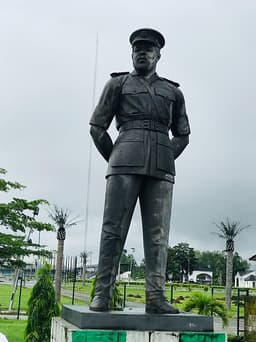
Chukwuemeka Odumegwu Ojukwu
General · Modern
56.9Total

Eloy Alfaro
General · Modern
54.6Total
Basic Information
Born
1933
1842
Died
—
1912
Era
Modern
Modern
Nationality
Nigeria
Ecuador
Occupation
General
General
Civilization
Other
Western
Score Comparison
Military (10%)
40.0
40.0
Political (20%)
68.0
45.0
Influence (20%)
60.0
60.0
Legacy (20%)
50.0
52.0
Leadership (15%)
64.5
71.0
Strategy (15%)
55.0
52.5
TOTAL
56.9
54.6
Chukwuemeka Odumegwu Ojukwu — Complete Timeline
1967 AD
Led Biafra in the Nigerian Civil WarWar◆ Major
Ojukwu served as the military leader and head of state of Biafra throughout the 30-month Nigerian Civil War (1967-1970). He commanded Biafran forces against the Nigerian federal army, directing the defense of the secessionist state through a prolonged and devastating conflict.
Civil WarBiafraMilitary Leadership
Impact: regional
Declared Independence of BiafraPolitical Action
On May 30, 1967, Lieutenant Colonel Chukwuemeka Odumegwu Ojukwu declared the secession of the Eastern Region of Nigeria as the independent Republic of Biafra. This act followed months of ethnic violence against Igbo people in the north and failed negotiations with the federal government.
SecessionBiafraNigeria
Impact: regional
1970 AD
Surrendered and Went into ExileWar◆ Major
On January 12, 1970, Ojukwu fled Biafra for Ivory Coast as Nigerian forces closed in. His chief of staff, Philip Effiong, surrendered Biafra three days later. Ojukwu remained in exile in Ivory Coast for 13 years, granted asylum by President F
SurrenderExileBiafra
Impact: regionaltragic
Eloy Alfaro — Complete Timeline
1895 AD
Led the Liberal Revolution of 1895War
Eloy Alfaro led a liberal uprising against the conservative government of Ecuador. The revolution succeeded in overthrowing the government, establishing a liberal regime that promoted secularism, education, and infrastructure.
RevolutionLiberalEcuador
Impact: national
1906 AD
Enacted Secular ReformsReform◆ Major
Alfaro's government enacted a series of secular reforms, including the separation of church and state, legalization of civil marriage and divorce, and the establishment of secular public education. These reforms reduced the Catholic Church's influence.
SecularismChurch-State SeparationEducation
Impact: nationalconstructive
1908 AD
Completed the Guayaquil-Quito RailwayReform◆ Major
Alfaro oversaw the completion of the Guayaquil-Quito railway, a major infrastructure project connecting the coast to the highlands. The railway facilitated trade, transportation, and national integration.
InfrastructureRailwayModernization
Impact: nationalconstructive
1912 AD
Assassinated by a MobPolitical Action◆ Major
After being overthrown and imprisoned, Alfaro was dragged from prison by a conservative mob in Quito. He was brutally killed, and his body was dragged through the streets and burned. The event symbolized the deep political divisions in Ecuador.
AssassinationPolitical ViolenceEcuador
Impact: nationaltragic
This comparison has not been analyzed yet.
One-time AI generation (~1 minute). Scores and timeline are already available below.
Rankings
🥇
Chukwuemeka Odumegwu OjukwuLeader
Mil: 40.0Pol: 68.0Inf: 60.0
56.9
🥈
Eloy Alfaro
Mil: 40.0Pol: 45.0Inf: 60.0
54.6
+2.3 behind
How This Comparison Works
Algorithm
Each figure is scored on 6 dimensions (0—100 scale) based on structured historical data: Military (10%), Political (20%), Influence (20%), Legacy (20%), Leadership (15%), Strategy (15%). The weighted total produces the final ranking.
Data Sources
Scores are computed from structured sub-indicators in the database. Scale factors adjust for era (Ancient ×0.85, Modern ×1.0) and civilization size (Eastern ×1.05, Other ×0.80) to account for differences in population and military scale.
Maximum 3 Figures
Comparisons are limited to 2—3 figures to ensure readability and statistical meaningfulness.
Error Margins
±5 points per dimension — Sub-scores are derived from historical records with inherent uncertainty. Two figures within 5 points on a dimension should be considered roughly equivalent in that area.
Total Score Accuracy
±3 points overall — The weighted combination of 6 dimensions produces a total score with approximately ±3 points of uncertainty. Differences of less than 3 points are not statistically significant— the figures are effectively tied.
Known Limitations
- Historical records are incomplete and uneven across civilizations
- Figures from oral-tradition societies may be underrepresented
- Occupation labels can misclassify multi-role figures
- Scores measure capability and impact, not moral character
- Quantitative scoring is a comparison tool, not absolute truth
Capability Radar
Military (10%) — Battles & Warfare
Battles
55
45
Win Rate
40
50
Expansion
30
30
Political (20%) — Governance & Reform
Reform
40
70
Diplomacy
45
50
Economy
35
45
Influence (20%) — Cultural & Global Reach
Cultural
45
50
Global
45
40
Legacy (20%) — Historical Impact
Historical
55
55
Longevity
40
45
Leadership (15%) — Power & Stability
Tenure
50
55
Stability
20
35
Strategy (15%) — Tactics & Innovation
Strategy
55
55
Tactics
50
40
Reform
45
60
Similar Comparisons
Comments & Discussion
No comments yet. Be the first to share your thoughts!