Loading...
Chukwuemeka Odumegwu Ojukwu vs Napoleon Bonaparte
Napoleon Bonaparte leads by 14.0 pts · 2 figures compared
…
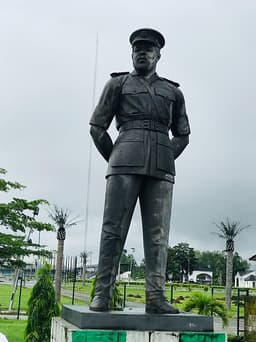
Chukwuemeka Odumegwu Ojukwu
General · Modern
56.9Total

Napoleon Bonaparte
General · Modern
70.9Total
Basic Information
Born
1933
1769
Died
—
1821
Era
Modern
Modern
Nationality
Nigeria
France
Occupation
General
General
Civilization
Other
Western
Score Comparison
Military (10%)
40.0
94.0
Political (20%)
68.0
72.0
Influence (20%)
60.0
40.0
Legacy (20%)
50.0
80.0
Leadership (15%)
64.5
78.0
Strategy (15%)
55.0
90.0
TOTAL
56.9
70.9
Chukwuemeka Odumegwu Ojukwu — Complete Timeline
1967 AD
Led Biafra in the Nigerian Civil WarWar◆ Major
Ojukwu served as the military leader and head of state of Biafra throughout the 30-month Nigerian Civil War (1967-1970). He commanded Biafran forces against the Nigerian federal army, directing the defense of the secessionist state through a prolonged and devastating conflict.
Civil WarBiafraMilitary Leadership
Impact: regional
Declared Independence of BiafraPolitical Action
On May 30, 1967, Lieutenant Colonel Chukwuemeka Odumegwu Ojukwu declared the secession of the Eastern Region of Nigeria as the independent Republic of Biafra. This act followed months of ethnic violence against Igbo people in the north and failed negotiations with the federal government.
SecessionBiafraNigeria
Impact: regional
1970 AD
Surrendered and Went into ExileWar◆ Major
On January 12, 1970, Ojukwu fled Biafra for Ivory Coast as Nigerian forces closed in. His chief of staff, Philip Effiong, surrendered Biafra three days later. Ojukwu remained in exile in Ivory Coast for 13 years, granted asylum by President F
SurrenderExileBiafra
Impact: regionaltragic
Napoleon Bonaparte — Complete Timeline
1799 AD
Coup of 18 BrumaireOther◆ Major
Napoleon Bonaparte, with support from his brother Lucien and key political figures, overthrew the Directory in a bloodless coup. He established the Consulate with himself as First Consul, effectively becoming the ruler of France. This event ended the French Revolution's most unstable period.
French RevolutionCoupRise to Power
Impact: regional
1804 AD
Promulgation of the Napoleonic CodeOther◆ Major
Napoleon enacted the Civil Code of the French, known as the Napoleonic Code, a comprehensive set of laws that replaced the fragmented feudal legal systems. The code established legal equality, protected property rights, and secularized law. It became the basis for legal systems in many European and world countries.
Legal ReformNapoleonic CodeCivil Law
Impact: globalconstructive
1805 AD
Battle of AusterlitzWar◆ Major
Napoleon's Grande Arm
Napoleonic WarsBattleDecisive Victory
Impact: global
1812 AD
Invasion of RussiaWar◆ Major
Napoleon led the Grande Arm
Napoleonic WarsInvasionDisaster
Impact: globaldestructive
1815 AD
Battle of WaterlooWar◆ Major
Napoleon's French army was defeated by the combined forces of the Duke of Wellington's Anglo-Allied army and Gebhard Leberecht von Bl
Napoleonic WarsBattleFinal Defeat
Impact: globaldestructive
Expert Analysis
chukwuemeka-odumegwu-ojukwu-vs-napoleon-bonaparte
# The Emperor and the Secessionist: Two Generals Who Defined Their Eras
On a June morning in 1815, Napoleon Bonaparte surveyed the muddy fields of Waterloo, his Grand Army poised for what would be his final gamble. A hundred and fifty-two years later, almost to the day, another general stood before a microphone in Enugu, Nigeria, and declared the independence of a nation that would exist for only thirty months. One man had conquered Europe; the other could not hold a single region. Yet both were shaped by the same forces—ambition, war, and the brutal arithmetic of history. Why did one build an empire while the other watched his dream collapse into starvation and surrender?
Origins
Napoleon was born in 1769 on Corsica, an island that had just passed from Italian to French control. His family was minor nobility, poor enough to know hunger but connected enough to send him to French military academies. He was a small, intense boy who read Plutarch’s *Lives* by candlelight, dreaming of Alexander. The French Revolution, which erupted when he was twenty, shattered the old order and opened paths that birth alone could never have granted. Napoleon was a child of chaos, and chaos was his element.
Chukwuemeka Odumegwu Ojukwu was born in 1933 into wealth. His father, Sir Louis Ojukwu, was one of Nigeria’s richest men, a transport magnate who had built a fortune under British colonial rule. Young Ojukwu studied at Oxford, drove a sports car, and seemed destined for a comfortable elite life. But Nigeria in the 1960s was a powder keg: three major ethnic groups—Hausa, Yoruba, and Igbo—forced into a single state by British mapmakers. When the powder exploded, Ojukwu, an Igbo officer in the Nigerian army, found himself at the center.
Rise to Power
Napoleon’s ascent was meteoric. At twenty-four, he cleared the streets of Paris of royalist insurgents with what he called “a whiff of grapeshot.” At twenty-six, he led a ragged army across the Alps into Italy and won six victories in a year. By thirty, he was First Consul of France. By thirty-five, Emperor. His rise was not luck—it was calculation. He understood that in revolutionary France, merit mattered more than blood. He promoted talented officers, won battles through speed and deception, and always, always kept moving.
Ojukwu’s path was slower and more painful. He joined the Nigerian army in 1957, one of the first university-educated officers. When a military coup in 1966 killed northern leaders and installed an Igbo president, the north retaliated with massacres of Igbos living in their region. Ojukwu, now military governor of the Eastern Region, watched as tens of thousands of his people were slaughtered. He tried negotiation, then compromise. Only when it became clear that the north would never accept Igbo equality did he act. On May 30, 1967, he declared the Republic of Biafra.
Leadership & Governance
Napoleon governed as he fought: decisively and ruthlessly. He centralized the French state, created the Bank of France, and established lycées that educated a generation. His Napoleonic Code—a single, clear legal system—replaced the tangle of feudal laws and endures today across Europe and beyond. He understood that power needed institutions, not just bayonets. Yet he also understood propaganda: he controlled newspapers, commissioned paintings of his victories, and staged his coronation to suggest he was both revolutionary and monarch.
Ojukwu faced a different challenge. He was not conquering a continent; he was trying to hold a territory the size of Portugal against a vastly larger enemy. His leadership was moral and symbolic. He wore military uniform but spoke as a statesman, appealing to the world for recognition while his people starved. He created a functioning government, printed Biafran currency, and kept an army fighting for thirty months. But he could not feed his people. By 1969, Biafran children were dying of kwashiorkor by the thousands. Ojukwu’s governance became a desperate triage—keep the war going, keep hope alive, keep the world watching.
Triumph & Tragedy
Napoleon’s greatest triumph was Austerlitz in 1805, where he destroyed a combined Russian and Austrian army with a feigned retreat that lured the enemy into a trap. It was a masterpiece. His greatest tragedy was the invasion of Russia in 1812—600,000 men marched east; fewer than 40,000 returned. He never recovered. Exiled to Elba, he escaped and ruled for a Hundred Days, but Waterloo ended it. His final years were spent on Saint Helena, dictating memoirs and blaming the weather.
Ojukwu’s triumph was simply surviving for so long. Against an enemy armed by Britain and the Soviet Union, Biafra held out for two and a half years. His tragedy was the surrender. On January 12, 1970, as Nigerian troops closed in, Ojukwu fled to Ivory Coast. His chief of staff, Philip Effiong, signed the surrender. The Biafran dream ended not with a bang but with a whimper—and a million dead from starvation.
Character & Destiny
Napoleon was driven by an insatiable hunger. “I am,” he once said, “a man called upon by destiny.” He believed he could impose order on chaos through will and force. That belief made him great, but it also made him blind. He could not stop. He could not consolidate. He kept marching, kept fighting, until the continent he had conquered bled him dry.
Ojukwu was more cautious, more political. He did not want war—he had tried every diplomatic avenue. But once committed, he could not surrender his people’s dignity. His flaw was perhaps the opposite of Napoleon’s: he trusted that the world would intervene, that justice would prevail. It did not. The world watched Biafra starve and did nothing.
Legacy
Napoleon’s legacy is written in law codes, street names, and the borders of modern Europe. He is remembered as both tyrant and reformer, conqueror and lawgiver. His military tactics are still studied. His shadow falls across two centuries.
Ojukwu’s legacy is more contested. In Nigeria, he is still a traitor to some, a hero to others. In Igboland, he is a symbol of a lost nation. He returned from exile in 1982, was pardoned, and lived as a political figure until his death. The Biafran cause never died—it flickers today in separatist movements. But Ojukwu’s true legacy is the question he forced the world to ask: what happens when a state cannot protect its own citizens?
Conclusion
Two generals, two centuries, two very different wars. Napoleon fought for glory; Ojukwu fought for survival. Napoleon built an empire that crumbled under its own weight; Ojukwu built a nation that starved to death. One died in exile, bitter and alone; the other died in his homeland, honored by the very country he had tried to leave. History does not judge them equally—Napoleon gets a score of 82.4, Ojukwu a 61.0—but perhaps the numbers miss the point. Napoleon changed the world; Ojukwu tried to save his people. In the end, both were defeated by forces larger than themselves: the first by his own ambition, the second by the indifference of the world. And both remind us that generals, for all their power, are never truly masters of their fate.
Rankings
🥇
Napoleon BonaparteLeader
Mil: 94.0Pol: 72.0Inf: 40.0
70.9
🥈
Chukwuemeka Odumegwu Ojukwu
Mil: 40.0Pol: 68.0Inf: 60.0
56.9
+14.0 behind
How This Comparison Works
Algorithm
Each figure is scored on 6 dimensions (0—100 scale) based on structured historical data: Military (10%), Political (20%), Influence (20%), Legacy (20%), Leadership (15%), Strategy (15%). The weighted total produces the final ranking.
Data Sources
Scores are computed from structured sub-indicators in the database. Scale factors adjust for era (Ancient ×0.85, Modern ×1.0) and civilization size (Eastern ×1.05, Other ×0.80) to account for differences in population and military scale.
Maximum 3 Figures
Comparisons are limited to 2—3 figures to ensure readability and statistical meaningfulness.
Error Margins
±5 points per dimension — Sub-scores are derived from historical records with inherent uncertainty. Two figures within 5 points on a dimension should be considered roughly equivalent in that area.
Total Score Accuracy
±3 points overall — The weighted combination of 6 dimensions produces a total score with approximately ±3 points of uncertainty. Differences of less than 3 points are not statistically significant— the figures are effectively tied.
Known Limitations
- Historical records are incomplete and uneven across civilizations
- Figures from oral-tradition societies may be underrepresented
- Occupation labels can misclassify multi-role figures
- Scores measure capability and impact, not moral character
- Quantitative scoring is a comparison tool, not absolute truth
Capability Radar
Military (10%) — Battles & Warfare
Battles
55
95
Win Rate
40
90
Expansion
30
95
Political (20%) — Governance & Reform
Reform
40
95
Diplomacy
45
80
Economy
35
85
Influence (20%) — Cultural & Global Reach
Cultural
45
85
Global
45
90
Legacy (20%) — Historical Impact
Historical
55
95
Longevity
40
90
Leadership (15%) — Power & Stability
Tenure
50
85
Stability
20
70
Strategy (15%) — Tactics & Innovation
Strategy
55
95
Tactics
50
98
Reform
45
92
Similar Comparisons
Comments & Discussion
Emperor's Shadow6/17/2026
Comparing Ojukwu to Napoleon is like comparing a chess master to a checkers player. Napoleon redrew the map of Europe with the Napoleonic Code, established the Banque de France, and created lasting institutions. Ojukwu led Biafra through 30 months of starvation and infighting, mismanaging both his military strategy and international diplomacy. One changed the course of Western civilization; the other's legacy is the name of a failed state. The scale isn't even close.
数据清理者6/17/2026
吹什么拿破仑?他统治的国家当时有2800万人口,而奥朱古只有1400万伊博人。拿破仑在1812年入侵俄国时损失了50万人,奥朱古在比夫拉战争中指挥部队面对10倍于己的敌人坚持了30个月。拿宏观战绩比细节公正?错。拿破仑的滑铁卢和比夫拉的乌穆阿希亚——两场都是败仗,但后者的敌军更持久更强大。历史欺负小人物。
Classics Scholar6/17/2026
By Plutarch's method, both men shared a fatal flaw: they believed will could conquer logistics. Napoleon's Grande Armée of 600,000 marched into Russia with no adequate supply chain; Ojukwu's Biafra had one functional airstrip for arms smuggling. Napoleon at least enforced the Napoleonic Code across Europe—his legal reforms survive. Ojukwu's "Biafran" stamps are collector's items. One left a system; the other left a symbol. Symbols don't feed armies.
历史爱好者6/17/2026
有趣的是,两人都输给了英国人的干预。拿破仑被威灵顿公爵在滑铁卢击溃,而奥朱古被英国支持的尼日利亚联邦军队碾压。但拿破仑在1814年流放厄尔巴岛后还能重返百日王朝,奥朱古1970年出逃科特迪瓦后再也没能踏足尼日利亚。两人都曾是征服者,但拿破仑的征服是帝国的引擎,奥朱古的只是绝望的燃料。别搞混了。
Revisionist Critic6/17/2026
Spare me the European triumphalism. Napoleon's greatness depends on genocide in Haiti, forced conscription in Spain, and the deaths of millions in pointless wars. Ojukwu's Biafra was a desperate response to the massacre of 30,000 Igbo in the 1966 pogroms. Napoleon invaded Russia for glory; Ojukwu fought for survival. Which is more "stupendous"? A man who destroyed the Haitian Revolution or one who kept his people alive through starvation for 30 months? The analysis whitewashes colonial context e