Loading...
King Solomon vs Ptolemy XII Auletes
King Solomon leads by 19.4 pts · 2 figures compared
…
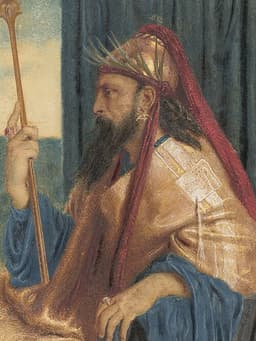
King Solomon
Emperor · Ancient
64.8Total

Ptolemy XII Auletes
Emperor · Ancient
45.4Total
Basic Information
Born
-970
-117
Died
-931
-51
Era
Ancient
Ancient
Nationality
Israel
Egypt
Occupation
Emperor
Emperor
Civilization
Middle Eastern
Middle Eastern
Score Comparison
Military (10%)
45.0
22.6
Political (20%)
72.0
37.9
Influence (20%)
65.0
53.3
Legacy (20%)
70.0
43.3
Leadership (15%)
72.0
62.2
Strategy (15%)
50.0
39.6
TOTAL
64.8
45.4
King Solomon — Complete Timeline
960 BC
Establishment of the Kingdom's AdministrationReform◆ Major
Solomon reorganized Israel into twelve administrative districts, each responsible for providing provisions for the royal court for one month. This system centralized power and increased tax revenue but also created regional disparities.
AdministrationTaxationReform
Impact: national
957 BC
Construction of the First TempleCultural
Solomon built the First Temple in Jerusalem on Mount Moriah, using materials and craftsmen provided by King Hiram of Tyre. The temple housed the Ark of the Covenant and became the central place of worship for the Israelites.
TempleJerusalemWorship
Impact: globalconstructive
950 BC
Visit of the Queen of ShebaPolitical Action◆ Major
The Queen of Sheba visited Solomon in Jerusalem, bringing spices, gold, and precious stones. She tested his wisdom with riddles and was impressed by his wealth and court. This visit established trade relations between Israel and Sheba.
DiplomacyTradeSheba
Impact: regionalconstructive
Marriage to Foreign WivesPolitical Action◆ Major
Solomon married many foreign women, including Pharaoh's daughter and Moabite, Ammonite, Edomite, Sidonian, and Hittite princesses. These marriages secured political alliances but also introduced foreign religious practices into Israel.
MarriageAlliancesIdolatry
Impact: nationaldestructive
Ptolemy XII Auletes — Complete Timeline
80 BC
Accession as Pharaoh of EgyptPolitical Action◆ Major
Ptolemy XII Auletes became pharaoh of Egypt after the death of Ptolemy XI Alexander II. His reign was marked by political instability, economic decline, and increasing Roman influence. He was known for his pro-Roman policies and lavish spending.
AccessionPtolemaic DynastyRoman Influence
Impact: regional
58 BC
Exile from EgyptPolitical Action◆ Major
Ptolemy XII was driven from Egypt by a popular revolt, likely due to his heavy taxation and pro-Roman stance. He fled to Rome, where he sought support for his restoration. His daughter Berenice IV took the throne in his absence.
ExileRevoltRoman Support
Impact: regionaltragic
55 BC
Restoration to the ThronePolitical Action◆ Major
Ptolemy XII was restored to the Egyptian throne with military support from the Roman governor of Syria, Aulus Gabinius. The Roman army helped him defeat the forces of Berenice IV. He executed his daughter and resumed his pro-Roman policies.
RestorationRoman InterventionExecution
Impact: regionaldestructive
Will Naming Rome as GuardianPolitical Action◆ Major
Ptolemy XII made a will naming the Roman Republic as the guardian of his children and the Egyptian kingdom. This will later be used by Julius Caesar to justify Roman intervention in Egypt after Ptolemy's death, leading to the Alexandrian War.
WillRoman GuardianshipSuccession
Impact: regional
Expert Analysis
Origins
King Solomon, born around 990 BCE in Jerusalem, was the son of King David and Bathsheba. He inherited a united Israelite kingdom and received a traditional education in law and governance. His early life was marked by the political consolidation of David's conquests.
Ptolemy XII Auletes (c. 117-51 BCE), born in Alexandria, was a descendant of Ptolemy I, a general of Alexander the Great. His lineage was Macedonian Greek, ruling over a Hellenistic Egypt. He grew up amid court intrigues and the declining power of the Ptolemaic dynasty.
Rise to Power
Solomon ascended the throne around 970 BCE after David's death, following a power struggle with his half-brother Adonijah. He quickly eliminated rivals and secured his position through alliances, including marriage to Pharaoh's daughter. His wisdom, famously demonstrated in the judgment of two women claiming a child, solidified his reputation.
Ptolemy XII became pharaoh in 80 BCE after the murder of Ptolemy XI. He faced immediate challenges: a depleted treasury, growing Roman influence, and internal unrest. To secure his throne, he paid huge bribes to Roman senators and supported Rome's interests in the region, earning the epithet "Auletes" (flute-player) for his musical performances.
Leadership & Governance
Solomon's governance scored 72.0 in leadership. He reorganized Israel into twelve administrative districts for efficient tax collection, built a centralized bureaucracy, and established a standing army with chariots. He undertook massive building projects, including the First Temple in Jerusalem, completed around 957 BCE. His wisdom attracted foreign dignitaries like the Queen of Sheba, who brought gold and spices. However, his heavy taxation and forced labor caused resentment.
Ptolemy XII's leadership scored 62.2. He relied heavily on Roman support, paying huge sums to maintain favor. His taxation was oppressive, leading to a revolt in 58 BCE that forced him into exile. He was restored in 55 BCE by Roman troops under Aulus Gabinius, after which he executed many of his opponents. His governance was characterized by corruption and subservience to Rome, scoring a political score of 37.9.
Triumph & Tragedy
Solomon's greatest triumph was the construction of the First Temple, a central religious and national symbol. His wisdom and wealth brought prosperity and international prestige. His tragedy was his later idolatry, influenced by his many foreign wives, and the eventual division of the kingdom after his death. His scores: military 45.0, strategy 50.0.
Ptolemy XII's success was his restoration to the throne with Roman help, securing his rule for a few more years. His tragedy was his complete dependence on Rome, which undermined Egyptian sovereignty and left his children, including Cleopatra, vulnerable. His military score was 22.6, strategy 39.6.
Character & Destiny
Solomon was known for his wisdom, but also for his ambition and excess. His decision to marry foreign wives for political alliances backfired, leading to religious syncretism and decline. His character shaped a legacy of wisdom literature but also of a fractured kingdom.
Ptolemy XII was pragmatic but weak, prioritizing personal survival over national interests. He was a skilled diplomat in the Roman sphere but failed to strengthen Egypt internally. His character led to a dynasty dependent on external powers.
Legacy
Solomon's legacy is profound: he is credited with the Book of Proverbs, Ecclesiastes, and Song of Solomon. The Temple became the center of Jewish worship until its destruction. His influence score is 65.0, legacy 70.0. He remains a symbol of wisdom and wealth in Western culture.
Ptolemy XII's legacy is overshadowed by his daughter Cleopatra. His actions facilitated Roman control over Egypt, leading to its annexation in 30 BCE. His influence score is 53.3, legacy 43.3. He is remembered as a weak ruler who sold out his kingdom.
Conclusion
King Solomon had a greater impact, scoring 64.8 total against Ptolemy XII's 45.4. Solomon's temple and wisdom shaped religious traditions for millennia, while Ptolemy's subservience accelerated Egypt's decline. Solomon's achievements in governance and culture far outweigh Ptolemy's temporary survival tactics.
Rankings
🥇
King SolomonLeader
Mil: 45.0Pol: 72.0Inf: 65.0
64.8
🥈
Ptolemy XII Auletes
Mil: 22.6Pol: 37.9Inf: 53.3
45.4
+19.4 behind
How This Comparison Works
Algorithm
Each figure is scored on 6 dimensions (0—100 scale) based on structured historical data: Military (10%), Political (20%), Influence (20%), Legacy (20%), Leadership (15%), Strategy (15%). The weighted total produces the final ranking.
Data Sources
Scores are computed from structured sub-indicators in the database. Scale factors adjust for era (Ancient ×0.85, Modern ×1.0) and civilization size (Eastern ×1.05, Other ×0.80) to account for differences in population and military scale.
Maximum 3 Figures
Comparisons are limited to 2—3 figures to ensure readability and statistical meaningfulness.
Error Margins
±5 points per dimension — Sub-scores are derived from historical records with inherent uncertainty. Two figures within 5 points on a dimension should be considered roughly equivalent in that area.
Total Score Accuracy
±3 points overall — The weighted combination of 6 dimensions produces a total score with approximately ±3 points of uncertainty. Differences of less than 3 points are not statistically significant— the figures are effectively tied.
Known Limitations
- Historical records are incomplete and uneven across civilizations
- Figures from oral-tradition societies may be underrepresented
- Occupation labels can misclassify multi-role figures
- Scores measure capability and impact, not moral character
- Quantitative scoring is a comparison tool, not absolute truth
Capability Radar
Military (10%) — Battles & Warfare
Battles
20
10
Win Rate
25
10
Expansion
20
5
Political (20%) — Governance & Reform
Reform
75
20
Diplomacy
80
50
Economy
85
30
Influence (20%) — Cultural & Global Reach
Cultural
90
30
Global
85
30
Legacy (20%) — Historical Impact
Historical
95
40
Longevity
95
30
Leadership (15%) — Power & Stability
Tenure
70
60
Stability
70
20
Strategy (15%) — Tactics & Innovation
Strategy
25
10
Tactics
30
10
Reform
15
5
Similar Comparisons
Comments & Discussion
No comments yet. Be the first to share your thoughts!