Loading...
Confucius vs Mencius
Confucius leads by 6.5 pts · 2 figures compared
…
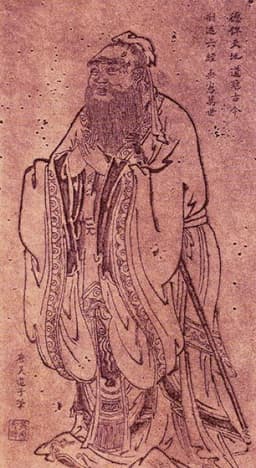
Confucius
Philosopher · Ancient
61.4Total

Mencius
Philosopher · Ancient
54.9Total
Basic Information
Born
-551
-372
Died
-479
-289
Era
Ancient
Ancient
Nationality
China
China
Occupation
Philosopher
Philosopher
Civilization
Eastern
Eastern
Score Comparison
Military (10%)
8.7
8.7
Political (20%)
35.1
35.0
Influence (20%)
95.0
88.0
Legacy (20%)
87.0
75.0
Leadership (15%)
35.4
24.4
Strategy (15%)
44.3
43.8
TOTAL
61.4
54.9
Confucius — Complete Timeline
501 BC
Appointment as Minister of Crime in LuPolitical Action
Confucius served as Minister of Crime in the state of Lu, where he implemented reforms to improve public order and justice. His tenure was short-lived due to political opposition, but it demonstrated his practical application of Confucian principles.
GovernmentReformLu
constructive
500 BC
Teaching Career in LuCultural
Confucius traveled through the state of Lu, teaching a group of disciples about ethics, ritual, and governance. He compiled and edited classical texts, including the Five Classics, and developed his philosophy centered on ren (benevolence) and li (ritual propriety).
TeachingPhilosophyConfucianism
Impact: globalconstructive
497 BC
Exile and Travels through Warring StatesPolitical Action◆ Major
After falling out of favor in Lu, Confucius went into voluntary exile, traveling to various states including Wei, Song, and Chen. He sought a ruler who would adopt his teachings, but was largely unsuccessful, spending 14 years wandering.
ExileTravelPhilosophy
Impact: regional
481 BC
Compilation of the Spring and Autumn AnnalsCultural◆ Major
Confucius is traditionally credited with compiling the Spring and Autumn Annals, a historical chronicle of the state of Lu. This work became a foundational text for Confucian historiography, emphasizing moral judgment in historical recording.
HistoriographyClassicsConfucianism
Impact: globalconstructive
479 BC
Death and Posthumous InfluenceCultural
Confucius died in Qufu, Lu, at age 72. His disciples compiled his teachings into the Analects, which later became the core text of Confucianism. Over centuries, his philosophy became the dominant ethical and political system in East Asia.
DeathLegacyConfucianism
Impact: globalconstructive
Mencius — Complete Timeline
320 BC
Debate with Gaozi on Human NatureCultural◆ Major
Mencius debated Gaozi on whether human nature is inherently good or neutral. Mencius argued that humans possess four innate sprouts of virtue (benevolence, righteousness, propriety, wisdom) that must be cultivated. This debate shaped Confucian moral psychology.
ConfucianismPhilosophyDebate
Impact: regionalconstructive
Advice to King Xuan of QiPolitical Action◆ Major
Mencius advised King Xuan of Qi on benevolent governance, arguing that a ruler's legitimacy depends on the people's welfare. He criticized the king for failing to implement humane policies. This encounter exemplified Mencius's political philosophy of the people's primacy.
ConfucianismPolitical philosophyAdvice
Impact: regionalconstructive
300 BC
Compilation of the MenciusCultural
Mencius's disciples compiled his dialogues and teachings into the Mencius, a text of seven chapters. The work argues for innate human goodness and the right of the people to overthrow unjust rulers. It became one of the Four Books of Neo-Confucianism.
ConfucianismPhilosophyText compilation
Impact: globalconstructive
Expert Analysis
Origins
Confucius, born Kong Qiu in 551 BCE in the state of Lu (modern-day Qufu, Shandong), came from a modest noble family. His father died when he was young, and he was raised by his mother. He educated himself in ritual, music, and history, becoming a teacher and advisor. Mencius, born Meng Ke in 372 BCE in the state of Zou (near Qufu), was also from a noble lineage but impoverished. His mother famously moved three times to ensure a proper upbringing. Mencius studied under Confucius's grandson, Zisi, becoming the most prominent Confucian thinker of the Warring States period.
Rise to Power
Confucius rose to prominence as a teacher in Lu, attracting disciples from various states. At age 51, he was appointed Minister of Crime, implementing reforms that improved order but alienated rivals. After a political misstep—accepting a gift from a rival state—he went into voluntary exile at 55, wandering through Wei, Song, and Chen for 13 years, seeking a ruler to implement his ideas. Mencius, a century later, traveled to courts like Qi and Liang, advising rulers on benevolent governance. He gained fame for his debate with Gaozi on human nature and his sharp critiques of King Xuan of Qi. Unlike Confucius, Mencius never held high office but was a respected philosopher-advisor.
Leadership & Governance
Confucius's leadership style emphasized moral example, ritual propriety, and education. As Minister of Crime, he enforced laws with leniency, aiming to reform criminals rather than punish. He believed rulers should cultivate virtue to inspire subjects. Mencius, more radical, argued that rulers who failed to care for the people lost the Mandate of Heaven, justifying rebellion. He advocated for land distribution and reduced taxes. While Confucius focused on hierarchy and filial piety, Mencius stressed the people's welfare as the ruler's primary duty. Both opposed Legalist harshness but differed on the ruler's accountability: Confucius urged reform from within, Mencius from below.
Triumph & Tragedy
Confucius's greatest triumph was his teaching legacy; his disciples compiled the Analects, which became the core of Confucianism. His compilation of the Spring and Autumn Annals influenced historiography. His tragedy: he died believing his mission failed, as no ruler fully adopted his ideas. Mencius's triumph was articulating the theory of innate goodness, which became central to Confucian orthodoxy. His dialogues in the Mencius provided a moral foundation for governance. His tragedy: his advice was often ignored by rulers focused on military conquest. Both men scored high in Influence (Confucius 95.0, Mencius 84.0) and Legacy (81.5 vs 89.6), but Mencius's political score (39.4) trailed Confucius's (70.8), reflecting his lack of administrative power.
Character & Destiny
Confucius was meticulous, patient, and optimistic about human perfectibility. He endured exile with dignity, teaching and compiling texts. His character of persistent moralism shaped his destiny as a revered sage. Mencius was more assertive and confrontational, unafraid to challenge kings. His belief in innate goodness led him to argue passionately, but his bluntness limited his political influence. Historians note Confucius's score of 78.2 in Leadership against Mencius's 23.9 reflects their different roles: Confucius as an administrator, Mencius as a theorist. Both were driven by a desire for social order, but Confucius's indirect approach proved more adaptable for later statecraft.
Legacy
Confucius's impact is vast: his teachings shaped East Asian education, ethics, and government for over two millennia. The civil service exam system, based on Confucian classics, lasted until 1905. Mencius, though secondary, was elevated by Song Neo-Confucians like Zhu Xi, who made the Mencius a core text. Mencius's ideas on popular sovereignty influenced later reformers and revolutionaries. In terms of total score, Confucius (71.1) outranks Mencius (56.1) due to higher political and leadership scores. However, Mencius's Legacy score (89.6) is higher than Confucius's (81.5), reflecting his enduring philosophical influence.
Conclusion
Confucius had greater overall impact. His political and leadership scores (70.8 and 78.2) far exceed Mencius's (39.4 and 23.9), and his foundational role in creating Confucianism gives him a higher Influence score (95.0 vs 84.0). While Mencius refined and popularized Confucian ideas, especially the theory of human nature, Confucius's comprehensive system of ethics, ritual, and governance became the bedrock of East Asian civilization. The 15-point total score gap (71.1 vs 56.1) underscores this. Mencius remains a vital thinker, but Confucius is the architect.
Rankings
🥇
ConfuciusLeader
Mil: 8.7Pol: 35.1Inf: 95.0
61.4
🥈
Mencius
Mil: 8.7Pol: 35.0Inf: 88.0
54.9
+6.5 behind
How This Comparison Works
Algorithm
Each figure is scored on 6 dimensions (0—100 scale) based on structured historical data: Military (10%), Political (20%), Influence (20%), Legacy (20%), Leadership (15%), Strategy (15%). The weighted total produces the final ranking.
Data Sources
Scores are computed from structured sub-indicators in the database. Scale factors adjust for era (Ancient ×0.85, Modern ×1.0) and civilization size (Eastern ×1.05, Other ×0.80) to account for differences in population and military scale.
Maximum 3 Figures
Comparisons are limited to 2—3 figures to ensure readability and statistical meaningfulness.
Error Margins
±5 points per dimension — Sub-scores are derived from historical records with inherent uncertainty. Two figures within 5 points on a dimension should be considered roughly equivalent in that area.
Total Score Accuracy
±3 points overall — The weighted combination of 6 dimensions produces a total score with approximately ±3 points of uncertainty. Differences of less than 3 points are not statistically significant— the figures are effectively tied.
Known Limitations
- Historical records are incomplete and uneven across civilizations
- Figures from oral-tradition societies may be underrepresented
- Occupation labels can misclassify multi-role figures
- Scores measure capability and impact, not moral character
- Quantitative scoring is a comparison tool, not absolute truth
Capability Radar
Military (10%) — Battles & Warfare
Battles
15
12
Win Rate
15
16
Expansion
19
22
Political (20%) — Governance & Reform
Reform
85
40
Diplomacy
70
30
Economy
40
20
Influence (20%) — Cultural & Global Reach
Cultural
95
85
Global
90
70
Legacy (20%) — Historical Impact
Historical
95
85
Longevity
95
90
Leadership (15%) — Power & Stability
Tenure
20
10
Stability
75
20
Strategy (15%) — Tactics & Innovation
Strategy
22
24
Tactics
28
25
Reform
31
30
Similar Comparisons
Comments & Discussion
No comments yet. Be the first to share your thoughts!