Loading...
Conrad III vs Julius Caesar
Julius Caesar leads by 40.0 pts · 2 figures compared
…
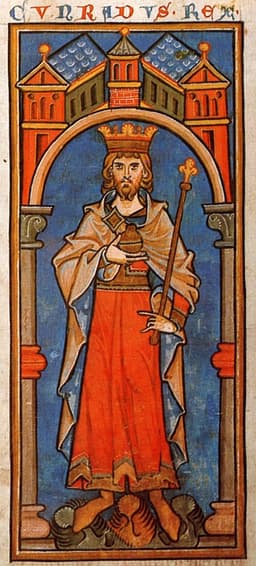
Conrad III
Emperor · Medieval
42.8Total

Julius Caesar
General · Ancient
82.8Total
Basic Information
Born
1093
-100
Died
1152
-44
Era
Medieval
Ancient
Nationality
Holy Roman Empire
Roman Republic
Occupation
Emperor
General
Civilization
Western
Western
Score Comparison
Military (10%)
45.0
88.0
Political (20%)
27.9
78.0
Influence (20%)
50.2
85.0
Legacy (20%)
41.7
82.0
Leadership (15%)
48.4
80.0
Strategy (15%)
38.3
85.0
TOTAL
42.8
82.8
Conrad III — Complete Timeline
1138 AD
Conflict with the WelfsWar
Conrad III engaged in a civil war with the Welf party, led by Henry the Proud and later Henry the Lion, from 1138 to 1142. The conflict ended with a compromise that allowed the Welfs to retain some territories.
Civil WarWelf Conflict
Impact: regionaldestructive
Election as King of GermanyPolitical Action◆ Major
Conrad III was elected King of Germany in 1138, becoming the first ruler of the Hohenstaufen dynasty. His election was opposed by the Welf party, leading to a prolonged conflict with Henry the Proud.
SuccessionHohenstaufen Dynasty
Impact: regional
1147 AD
Leadership of the Second CrusadeWar◆ Major
Conrad III led the German contingent of the Second Crusade to the Holy Land in 1147-1148. His army was defeated by the Seljuk Turks at the Battle of Dorylaeum in 1147, and the crusade ended in failure.
CrusadeMilitary Defeat
Impact: regionaltragic
1148 AD
Siege of DamascusWar
Conrad III participated in the Siege of Damascus in July 1148 during the Second Crusade. The siege failed after only four days due to internal disputes among crusader leaders, leading to the crusade's collapse.
CrusadeSiege
Impact: regionaltragic
Julius Caesar — Complete Timeline
58 BC
Gallic WarsWar◆ Major
Caesar, as proconsul of Gaul, launched a series of campaigns that conquered all of Gaul (modern France, Belgium, and parts of Switzerland). He fought numerous battles, including against the Helvetii, the Belgae, and the Gallic chieftain Vercingetorix. The wars brought immense wealth and a loyal army to Caesar.
Gallic WarsConquestRoman Expansion
Impact: regional
49 BC
Crossing the RubiconPolitical Action◆ Major
Caesar led Legio XIII across the Rubicon River into Italy, defying the Roman Senate's order to disband his army. This act triggered a civil war against Pompey and the Optimates, ultimately leading to Caesar's dictatorship and the end of the Roman Republic.
Roman Civil WarEnd of RepublicPower Struggle
Impact: global
48 BC
Battle of PharsalusWar◆ Major
Caesar's outnumbered army defeated the larger forces of Pompey the Great at Pharsalus in Greece. Caesar's tactical use of a reserve line to counter Pompey's cavalry charge proved decisive. Pompey fled to Egypt, where he was assassinated, leaving Caesar as the undisputed master of the Roman world.
Roman Civil WarBattleDecisive Victory
Impact: regional
44 BC
Appointment as Dictator for LifePolitical Action◆ Major
The Roman Senate appointed Caesar dictator perpetuo (dictator for life), granting him unprecedented personal power. This move concentrated military, legislative, and judicial authority in one person, effectively ending the Roman Republic's traditional system of checks and balances and alarming many senators.
DictatorshipEnd of RepublicPower Consolidation
Impact: regionaldestructive
Assassination on the Ides of MarchPolitical Action◆ Major
A group of Roman senators, led by Marcus Junius Brutus and Gaius Cassius Longinus, stabbed Caesar to death at a meeting of the Senate in the Theatre of Pompey. The assassination was intended to restore the Republic, but instead triggered another civil war that led to the rise of the Roman Empire.
AssassinationRoman PoliticsEnd of Republic
Impact: globaldestructive
Expert Analysis
conrad-iii-vs-julius-caesar
### The Rubicon and the Rhine: Two Paths to Power
History rarely offers a starker contrast than the one between Julius Caesar, the architect of the Roman Empire, and Conrad III, the first Hohenstaufen king of Germany. One crossed a river and changed the world; the other crossed a desert and lost a crusade. Both men inherited a fractured political landscape, but their responses—and their fates—could not have been more different. What separates a legend from a footnote? The answer lies not merely in talent, but in the raw material of their eras and the choices they made when history came calling.
### Origins
Gaius Julius Caesar was born into the twilight of the Roman Republic in 100 BCE, a world of senatorial intrigue, civil wars, and vast imperial ambition. His family, the Julii, claimed descent from the goddess Venus, but their political influence had waned. Caesar’s Rome was a ruthless meritocracy where a man could rise through military glory, popular politics, and sheer audacity. He was a product of a civilization that worshipped ambition as a virtue and conquest as a duty.
Conrad III emerged from a very different world. Born in 1093, he lived in the Holy Roman Empire, a patchwork of duchies, bishoprics, and free cities that had never known the centralized power of Rome. The Empire was a contest of great families—the Hohenstaufen and the Welfs—locked in a ceaseless struggle for supremacy. Conrad was a prince of the Hohenstaufen line, but his authority was always conditional, always negotiated. His Europe was a world of feudal oaths, sacred relics, and the looming shadow of the Papacy. Where Caesar saw a Republic to be mastered, Conrad saw a crown to be held.
### Rise to Power
Caesar’s ascent was a masterclass in calculated risk. He built his reputation in the provinces—as a military commander in Hispania, as a governor in Gaul—while carefully cultivating his image in Rome. His conquest of Gaul (58–50 BCE) was not just a war; it was a political machine. The wealth, the legions, the fame—all were leveraged to break the power of the Senate. When the Senate ordered him to disband his army, Caesar made his choice. In 49 BCE, he crossed the Rubicon River, a line that no general could legally cross with his troops. “The die is cast,” he is said to have declared. It was a revolution in a single sentence.
Conrad’s rise was a matter of election, not revolution. In 1138, he was chosen as King of Germany in a contested vote, becoming the first Hohenstaufen ruler. But his kingship was a fragile thing. The Welf dynasty, led by Henry the Proud, refused to recognize him, plunging the Empire into a civil war that lasted from 1138 to 1142. Conrad’s power was never absolute; it was a throne built on compromise, alliances, and the constant threat of rebellion. He could not afford to cross a Rubicon—he was too busy trying to keep his own house in order.
### Leadership & Governance
Caesar governed as a revolutionary reformer. As dictator, he overhauled the calendar, granted citizenship to provincials, reformed debt laws, and began massive public works. His military genius was inseparable from his political vision: he understood that war was a tool of statecraft. His legions were loyal not to Rome, but to *him*. His leadership was personal, charismatic, and ruthless.
Conrad III governed as a medieval king, his authority circumscribed by the Church and the great nobles. His military score of 49.2 and political score of 57.0 reflect a ruler who was competent but never dominant. His great test came in 1147, when he led the German contingent of the Second Crusade. It was a disaster. His army was defeated by the Seljuk Turks in Anatolia, and the subsequent Siege of Damascus in July 1148 failed after only four days. Conrad’s crusade collapsed not from a lack of faith, but from a lack of strategic coordination and supply. He was a general who could win battles, but not a campaign.
### Triumph & Tragedy
Caesar’s triumph was total: he conquered Gaul, defeated his rivals Pompey and Cato, and became dictator for life. His tragedy was the Ides of March, 44 BCE, when a conspiracy of senators stabbed him to death in the Senate house. His final act was one of betrayal, but his legacy was the Empire he had built.
Conrad’s tragedy was quieter. He never suffered a dramatic assassination; he died in 1152, a king who had failed to unite his realm or achieve lasting glory. His crusade was a humiliation, and his civil war with the Welfs remained unresolved. His triumph, if it can be called that, was simply surviving as the first Hohenstaufen king. He laid the foundation for his nephew, Frederick Barbarossa, who would become one of the greatest medieval emperors. Conrad’s failure was the seed of another man’s success.
### Character & Destiny
Caesar was driven by an insatiable hunger for glory. Plutarch records that he once said, “I would rather be first in a little Iberian village than second in Rome.” His character was bold, calculating, and utterly unafraid of the gods or men. That confidence made him unstoppable—and ultimately, it made him a target.
Conrad was a man of his time, bound by piety and feudal obligation. He led a crusade because his age demanded it, not because he saw a strategic opportunity. His character was more cautious, more traditional. He was a king who played by the rules of his world, and those rules did not allow for the kind of revolutionary ambition that Caesar embodied. His destiny was not to change history, but to endure it.
### Legacy
Caesar’s legacy is immeasurable. His name became synonymous with imperial power—Kaiser, Tsar, Caesar. His writings, especially the *Commentaries on the Gallic War*, are still studied. He transformed the Roman Republic into an empire, and that empire shaped the Western world.
Conrad III is remembered, if at all, as a transitional figure. His legacy score of 55.0 reflects a king who was overshadowed by his successors. He founded a dynasty, but his own reign was a prelude. The Second Crusade, which he led, is remembered as a failure. In the annals of history, he is the answer to a trivia question: who was the first Hohenstaufen king?
### Conclusion
Standing on the banks of the Rubicon, Caesar saw a world he could remake. Standing before the walls of Damascus, Conrad saw a world he could not change. Their differences are not merely about talent—they are about the eras they inhabited. Caesar lived in a time when one man could seize the levers of a centralized state and bend them to his will. Conrad lived in a time when power was fragmented, sacred, and stubbornly resistant to any single will. The general and the king both reached for greatness. One grasped it and was destroyed by its weight. The other reached and found only the thin air of a medieval sky. In the end, history remembers not just the outcome, but the audacity of the attempt.
Rankings
🥇
Julius CaesarLeader
Mil: 88.0Pol: 78.0Inf: 85.0
82.8
🥈
Conrad III
Mil: 45.0Pol: 27.9Inf: 50.2
42.8
+40.0 behind
How This Comparison Works
Algorithm
Each figure is scored on 6 dimensions (0—100 scale) based on structured historical data: Military (10%), Political (20%), Influence (20%), Legacy (20%), Leadership (15%), Strategy (15%). The weighted total produces the final ranking.
Data Sources
Scores are computed from structured sub-indicators in the database. Scale factors adjust for era (Ancient ×0.85, Modern ×1.0) and civilization size (Eastern ×1.05, Other ×0.80) to account for differences in population and military scale.
Maximum 3 Figures
Comparisons are limited to 2—3 figures to ensure readability and statistical meaningfulness.
Error Margins
±5 points per dimension — Sub-scores are derived from historical records with inherent uncertainty. Two figures within 5 points on a dimension should be considered roughly equivalent in that area.
Total Score Accuracy
±3 points overall — The weighted combination of 6 dimensions produces a total score with approximately ±3 points of uncertainty. Differences of less than 3 points are not statistically significant— the figures are effectively tied.
Known Limitations
- Historical records are incomplete and uneven across civilizations
- Figures from oral-tradition societies may be underrepresented
- Occupation labels can misclassify multi-role figures
- Scores measure capability and impact, not moral character
- Quantitative scoring is a comparison tool, not absolute truth
Capability Radar
Military (10%) — Battles & Warfare
Battles
30
95
Win Rate
25
92
Expansion
20
97
Political (20%) — Governance & Reform
Reform
15
90
Diplomacy
30
85
Economy
20
82
Influence (20%) — Cultural & Global Reach
Cultural
25
88
Global
15
94
Legacy (20%) — Historical Impact
Historical
30
95
Longevity
20
96
Leadership (15%) — Power & Stability
Tenure
40
75
Stability
20
60
Strategy (15%) — Tactics & Innovation
Strategy
25
94
Tactics
30
96
Reform
10
88
Similar Comparisons
Comments & Discussion
CiceroSaysWhat6/17/2026
Caesar wasn't just crossing rivers; he was rewriting the rulebook of power. Conrad III's failure at Damascus wasn't bad luck—it was strategic illiteracy. Caesar conquered Gaul in eight years with discipline and logistics. Conrad lost a crusade because he couldn't keep his army fed. The difference isn't talent; it's that Caesar understood that war is a science, not a romantic gesture. Conrad was a medieval king playing pretend Rome. Footnote status earned.
数据侦探6/17/2026
别被“伟大”叙事忽悠了。凯撒的辉煌建立在系统性掠夺高卢上,估计百万死伤;康拉德三世虽失败,但十字军东征规模受限于物资,是时代局限,不是个人能力。数据不说谎:凯撒的《高卢战记》不仅宣传稿,更掩盖了经济殖民的真相。中世纪王权本就弱,你拿罗马集权制比中世纪联邦?这比较本身就有病。
SophoclesInTogas6/17/2026
The real contrast is philosophical. Caesar saw power as individual will incarnate—crossing the Rubicon was a personal declaration of sovereignty. Conrad III, however, was trapped in a feudal web where authority was negotiated, not seized. Caesar could rewrite laws; Conrad had to beg dukes for support. That's not just two eras—it's two definitions of leadership. One built an empire from ego; the other got crushed by the weight of compromise. Historians miss this.
历史杂学家6/17/2026
你们吹凯撒,我偏站康拉德。高卢战争赢在对手弱小:高卢部落各自为战,罗马军制碾压。康拉德面对的是拜占庭密谋和突厥骑兵,且圣战心理压力巨大。凯撒英年早逝没见到帝国崩盘;康拉德至少让霍亨斯陶芬王朝稳住特权。历史评价太双重标准了:一个下注成功叫天才,一个运气不好叫庸才。呵,胜者叙事罢了。
IronLegionnaire6/17/2026
Caesar didn't just win battles—he invented the blueprint for modern autocracy. Conrad III? He couldn't even keep his own German dukes in line during the Second Crusade. Look at the Siege of Weinsberg in 1140: Caesar would have crushed those rebels with a swift show of force. Conrad negotiated. That's the difference between a titan and a caretaker. Rome gave Caesar legions; the Empire gave Conrad factions. But a great leader rises above circumstances. Conrad didn't.