Loading...
Constans II vs Darius III
Constans II leads by 14.4 pts · 2 figures compared
…
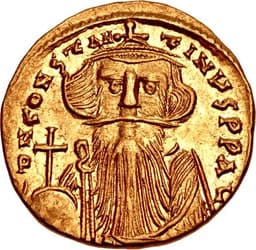
Constans II
Emperor · Ancient
55.2Total
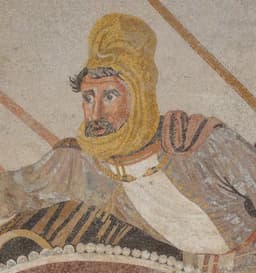
Darius III
Emperor · Ancient
40.8Total
Basic Information
Born
-630
-380
Died
—
-330
Era
Ancient
Ancient
Nationality
Byzantine Empire
Persia
Occupation
Emperor
Emperor
Civilization
Western
Middle Eastern
Score Comparison
Military (10%)
55.0
50.0
Political (20%)
68.0
25.0
Influence (20%)
51.0
47.9
Legacy (20%)
44.2
43.3
Leadership (15%)
65.0
38.1
Strategy (15%)
60.0
35.7
TOTAL
55.2
40.8
Constans II — Complete Timeline
648 AD
Issued the Typos of ConstansPolitical Action
Constans II issued the Typos, an edict that forbade discussion of the Monothelite controversy. The edict aimed to end religious strife but was condemned by the Papacy and failed to restore unity.
Religious PolicyChurch ControversyByzantine Empire
Impact: regional
663 AD
Visited RomePolitical Action◆ Major
Constans II became the last Byzantine emperor to visit Rome. He was received by Pope Vitalian and spent twelve days in the city, stripping it of many bronze ornaments and statues to be sent to Constantinople.
Imperial VisitRomeByzantine Empire
Impact: regional
668 AD
Murdered in SyracusePolitical Action◆ Major
While residing in Syracuse, Sicily, Constans II was assassinated in his bath by a chamberlain. His death was part of a conspiracy, and his son Constantine IV succeeded him after suppressing the usurper Mezezius.
AssassinationByzantine EmpireSuccession Crisis
Impact: nationaltragic
674 AD
Defended Constantinople against the Arab siegeWar◆ Major
Constans II's son, Constantine IV, was actually the emperor during the first Arab siege of Constantinople. Constans II himself faced Arab raids but did not command the defense of the capital during the major siege.
Arab-Byzantine WarsSiegeByzantine Empire
Impact: regional
Darius III — Complete Timeline
333 BC
Battle of IssusWar◆ Major
Darius III commanded the Persian army against Alexander the Great at Issus in Cilicia. Alexander's forces defeated the larger Persian army, and Darius fled the battlefield, leaving his family and baggage train to be captured.
Wars of AlexanderBattlePersian Empire
Impact: global
331 BC
Battle of GaugamelaWar
Darius III assembled a massive army from across the empire to confront Alexander near Arbela. Alexander's tactical brilliance led to a decisive Persian defeat, and Darius again fled the field, effectively ending Achaemenid resistance.
Wars of AlexanderBattlePersian Empire
Impact: global
330 BC
Loss of the Persian Capital PersepolisWar◆ Major
Alexander the Great captured and sacked Persepolis, the ceremonial capital of the Achaemenid Empire. The palace complex was burned, symbolizing the end of Persian imperial power and the transfer of hegemony to Macedonia.
Wars of AlexanderSackPersepolis
Impact: globaldestructive
Flight and Death of Darius IIIPolitical Action◆ Major
After Gaugamela, Darius fled eastward through Media and Parthia. He was deposed and imprisoned by his own satrap Bessus, then murdered by Bessus's followers near Hecatompylos. Alexander later gave Darius a royal burial at Persepolis.
DeathSuccessionAchaemenid Empire
Impact: globaltragic
Expert Analysis
Origins
Constans II was born in 630 CE in Constantinople, the son of Emperor Constantine III and grandson of Heraclius. His family was embroiled in dynastic struggles; his father reigned only a few months before dying, possibly poisoned. Constans was raised in the imperial court, receiving a military and political education. He became emperor at age 11 after his father's death and the brief usurpation of Heraclonas.
Darius III, originally named Artashata, was born around 380 BCE, a member of the Achaemenid royal family but not directly in line for the throne. He served as a satrap of Armenia before being elevated to king after the death of Artaxerxes IV. His early life was marked by the declining power of the Persian Empire, with internal rebellions and external threats from Macedon.
Rise to Power
Constans II ascended to the throne in 641 CE after a palace coup that removed his uncle Heraclonas. His reign began with the empire in crisis: the Arabs had conquered Syria, Egypt, and were raiding Anatolia. Constans consolidated power by eliminating rivals and focusing on administrative reforms. He appointed his son Constantine IV as co-emperor in 654 CE to secure succession.
Darius III became king in 336 BCE after the assassination of Artaxerxes IV by the eunuch Bagoas, who initially placed Darius on the throne. Darius soon executed Bagoas to assert independence. His rise was contested by other nobles, and he faced a fragmented empire. He attempted to reorganize the military but lacked time to fully stabilize his rule before Alexander's invasion in 334 BCE.
Leadership & Governance
Constans II's leadership was pragmatic. He issued the Typos in 648 CE to suppress religious disputes over Monothelitism, but it failed, alienating both sides. He moved his court to Syracuse in Sicily from 663 CE, focusing on defending the western provinces. This decision weakened the defense of the east and was unpopular. He also stripped Rome of its ancient bronzes and ornaments during his visit, damaging relations with the Papacy.
Darius III governed through a traditional satrapy system but was indecisive. He allowed his commanders to engage Alexander at the Granicus River in 334 BCE without his presence, resulting in a Persian defeat. At Issus (333 BCE) and Gaugamela (331 BCE), he personally led massive armies but failed to coordinate effectively, retreating each time and leaving his family behind. His leadership score of 38.1 reflects his inability to inspire loyalty or execute strategy.
Triumph & Tragedy
Constans II's greatest success was maintaining the Byzantine Empire's integrity against Arab raids, though he did not face the major siege of Constantinople (that fell to his son). He successfully defended Constantinople in 654 CE when the Arab fleet was destroyed by a storm. His tragedy was his assassination in 668 CE in Syracuse, murdered by a chamberlain while bathing, after his policies had made him unpopular.
Darius III's triumph was his initial accession and survival against internal plots. However, his tragedies were overwhelming: he lost three major battles to Alexander, saw Persepolis sacked, and was betrayed and murdered by his own satrap Bessus in 330 BCE. His political score of 25.0 and strategy of 35.7 underscore his failure to adapt.
Character & Destiny
Constans II was energetic but autocratic, willing to relocate the capital and confront religious controversy. His character was pragmatic but ultimately isolated him. His murder reflects the volatility of Byzantine politics.
Darius III was personally brave but lacked strategic vision. He fled battles, undermining his authority. His destiny was sealed by his inability to match Alexander's military genius or unite his empire. Historical assessments note his decent character but poor leadership.
Legacy
Constans II's legacy is mixed: he was the last emperor to visit Rome, symbolizing the shift of power eastward. His Typos failed, but his administrative reforms influenced later Byzantine governance. His total score of 55.2 reflects a competent but not transformative ruler.
Darius III's legacy is that of the last Achaemenid king, whose defeat enabled Hellenistic expansion. He is remembered as a tragic figure, but his failure to defend the empire ended Persian dominance. His legacy score of 43.3 is slightly below Constans.
Conclusion
Constans II had a greater impact than Darius III. His total score of 55.2 versus 40.8 reflects his relative success in preserving the Byzantine state during a crisis. While Darius III faced a superior foe, his decisions accelerated the empire's fall. Constans II's reforms and survival of Arab attacks ensured Byzantium endured for centuries, whereas Darius III's reign ended the Achaemenid line. Thus, Constans II's influence, though limited, surpasses Darius III's catastrophic legacy.
Rankings
🥇
Constans IILeader
Mil: 55.0Pol: 68.0Inf: 51.0
55.2
🥈
Darius III
Mil: 50.0Pol: 25.0Inf: 47.9
40.8
+14.4 behind
How This Comparison Works
Algorithm
Each figure is scored on 6 dimensions (0—100 scale) based on structured historical data: Military (10%), Political (20%), Influence (20%), Legacy (20%), Leadership (15%), Strategy (15%). The weighted total produces the final ranking.
Data Sources
Scores are computed from structured sub-indicators in the database. Scale factors adjust for era (Ancient ×0.85, Modern ×1.0) and civilization size (Eastern ×1.05, Other ×0.80) to account for differences in population and military scale.
Maximum 3 Figures
Comparisons are limited to 2—3 figures to ensure readability and statistical meaningfulness.
Error Margins
±5 points per dimension — Sub-scores are derived from historical records with inherent uncertainty. Two figures within 5 points on a dimension should be considered roughly equivalent in that area.
Total Score Accuracy
±3 points overall — The weighted combination of 6 dimensions produces a total score with approximately ±3 points of uncertainty. Differences of less than 3 points are not statistically significant— the figures are effectively tied.
Known Limitations
- Historical records are incomplete and uneven across civilizations
- Figures from oral-tradition societies may be underrepresented
- Occupation labels can misclassify multi-role figures
- Scores measure capability and impact, not moral character
- Quantitative scoring is a comparison tool, not absolute truth
Capability Radar
Military (10%) — Battles & Warfare
Battles
55
15
Win Rate
50
10
Expansion
30
10
Political (20%) — Governance & Reform
Reform
55
10
Diplomacy
50
20
Economy
45
25
Influence (20%) — Cultural & Global Reach
Cultural
40
20
Global
25
25
Legacy (20%) — Historical Impact
Historical
45
40
Longevity
30
30
Leadership (15%) — Power & Stability
Tenure
65
30
Stability
35
15
Strategy (15%) — Tactics & Innovation
Strategy
50
15
Tactics
45
20
Reform
40
10
Similar Comparisons
Comments & Discussion
No comments yet. Be the first to share your thoughts!