Loading...
Constans II vs Liu Bei
Liu Bei leads by 4.3 pts · 2 figures compared
…
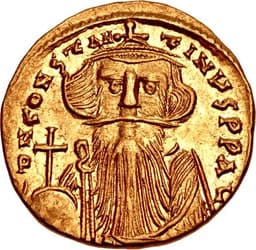
Constans II
Emperor · Ancient
55.2Total
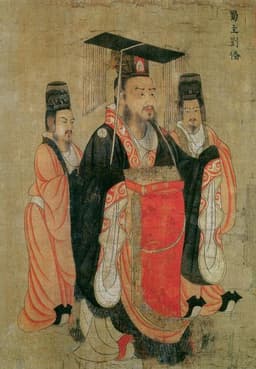
Liu Bei
Emperor · Ancient
59.5Total
Basic Information
Born
-630
161
Died
—
223
Era
Ancient
Ancient
Nationality
Byzantine Empire
China
Occupation
Emperor
Emperor
Civilization
Western
Eastern
Score Comparison
Military (10%)
55.0
65.0
Political (20%)
68.0
68.0
Influence (20%)
51.0
55.0
Legacy (20%)
44.2
72.0
Leadership (15%)
65.0
40.0
Strategy (15%)
60.0
50.0
TOTAL
55.2
59.5
Constans II — Complete Timeline
648 AD
Issued the Typos of ConstansPolitical Action
Constans II issued the Typos, an edict that forbade discussion of the Monothelite controversy. The edict aimed to end religious strife but was condemned by the Papacy and failed to restore unity.
Religious PolicyChurch ControversyByzantine Empire
Impact: regional
663 AD
Visited RomePolitical Action◆ Major
Constans II became the last Byzantine emperor to visit Rome. He was received by Pope Vitalian and spent twelve days in the city, stripping it of many bronze ornaments and statues to be sent to Constantinople.
Imperial VisitRomeByzantine Empire
Impact: regional
668 AD
Murdered in SyracusePolitical Action◆ Major
While residing in Syracuse, Sicily, Constans II was assassinated in his bath by a chamberlain. His death was part of a conspiracy, and his son Constantine IV succeeded him after suppressing the usurper Mezezius.
AssassinationByzantine EmpireSuccession Crisis
Impact: nationaltragic
674 AD
Defended Constantinople against the Arab siegeWar◆ Major
Constans II's son, Constantine IV, was actually the emperor during the first Arab siege of Constantinople. Constans II himself faced Arab raids but did not command the defense of the capital during the major siege.
Arab-Byzantine WarsSiegeByzantine Empire
Impact: regional
Liu Bei — Complete Timeline
208 AD
Battle of Red CliffsWar
Liu Bei and Sun Quan's combined forces defeated Cao Cao's navy at the Battle of Red Cliffs on the Yangtze River. The victory prevented Cao Cao from conquering the south and allowed Liu Bei to establish a base in Jing Province.
BattleRed CliffsAlliance
Impact: regional
Formation of the Alliance with Sun QuanPolitical Action◆ Major
Liu Bei, advised by Zhuge Liang, formed a strategic alliance with Sun Quan of Wu against the northern warlord Cao Cao. This alliance was crucial for the upcoming Battle of Red Cliffs and established the basis for the Three Kingdoms division.
AllianceSun QuanCao Cao
Impact: regionalconstructive
214 AD
Conquest of Yi ProvinceWar◆ Major
Liu Bei, with the help of Zhuge Liang and other advisors, conquered Yi Province (modern Sichuan) from its ruler Liu Zhang. This provided a wealthy and defensible base for his kingdom, fulfilling a key part of the Longzhong Plan.
ConquestYi ProvinceShu Han
Impact: regional
221 AD
Proclamation of the Shu Han DynastyPolitical Action
After Cao Pi usurped the Han throne, Liu Bei declared himself emperor of Shu Han in Chengdu, claiming to continue the Han dynasty. This formalized the Three Kingdoms period, with Shu, Wei, and Wu as rival states.
DynastyShu HanThree Kingdoms
Impact: national
222 AD
Battle of YilingWar◆ Major
Liu Bei launched a campaign against Sun Quan to avenge the death of his sworn brother Guan Yu. His forces were defeated by Wu general Lu Xun at the Battle of Yiling, resulting in heavy losses and Liu Bei's retreat to Baidi Cheng.
BattleDefeatWu
Impact: regionaltragic
Expert Analysis
Origins
Constans II (born 630 CE) was the son of Emperor Constantine III and grandson of Heraclius. He became emperor at age 11 after his father's death, with a regency led by the Senate. His early life was shaped by the ongoing Arab-Byzantine wars and religious controversies over Monothelitism. Liu Bei (born 161 CE) was a descendant of the Han imperial family, but his father died when he was young, leaving the family in poverty. He supported himself by weaving mats and selling sandals. Despite his humble beginnings, he was ambitious and befriended local heroes like Guan Yu and Zhang Fei, forming a brotherhood that would later become legendary.
Rise to Power
Constans II was crowned in 641 CE after a tumultuous succession. He consolidated power by eliminating potential rivals, including his uncle and cousins. His early reign focused on defending the empire from Arab raids. In 654 CE, he led a naval expedition against the Arabs but was defeated at the Battle of the Masts. He then turned to internal affairs, issuing the Typos (648 CE) to suppress the Monothelite controversy, which alienated both sides. Liu Bei's rise was slower. After participating in the Yellow Turban Rebellion (184 CE), he served various warlords. His turning point came in 208 CE when he allied with Sun Quan at the Battle of Red Cliffs, defeating Cao Cao. This victory secured his base in Jing Province. In 214 CE, he conquered Yi Province, establishing his own domain. In 221 CE, after Cao Pi usurped the Han throne, Liu Bei declared himself emperor of Shu Han, continuing the Han lineage.
Leadership & Governance
Constans II ruled with an authoritarian style, centralizing power and moving his court to Syracuse in 663 CE, a decision that weakened imperial control in the East. He stripped Rome of treasures during his visit in 663 CE, alienating the Pope and the West. His governance focused on military defense but lacked long-term vision. Liu Bei, by contrast, was known for his benevolent rule, emphasizing Confucian virtues. He appointed capable ministers like Zhuge Liang and treated his subjects with fairness. He implemented policies that stabilized Shu Han, including land reforms and tax reductions. However, his leadership was often driven by personal loyalty, which led to strategic errors. In governance scores, Constans II scored 68.0 politically, while Liu Bei also scored 68.0, indicating similar political acumen.
Triumph & Tragedy
Constans II's greatest success was holding the Byzantine Empire together against Arab pressure, though he lost Cyprus and Armenia. His visit to Rome was a symbolic triumph, but it also marked the end of imperial presence there. His tragedy was his assassination in 668 CE by a chamberlain in Syracuse, a victim of his own unpopularity and the empire's fragmentation. Liu Bei's triumph was founding Shu Han and securing a rich base in Sichuan. His greatest tragedy was the Battle of Yiling (222 CE), where he launched a reckless campaign to avenge Guan Yu, losing his army and dying soon after. This failure overshadowed his achievements. Liu Bei's military score of 65.0 reflects his strategic errors, while Constans II's 55.0 shows his defensive struggles.
Character & Destiny
Constans II was calculating, ruthless, and pragmatic. He suppressed religious debate not out of conviction but to maintain order. His decision to move west to Syracuse was a strategic miscalculation, as it left Constantinople vulnerable. His character led to isolation and assassination. Liu Bei was idealistic, valuing loyalty and righteousness. His emotional decision-making, as seen in the Yiling campaign, cost him dearly. Historians note that Liu Bei's benevolence was genuine but sometimes naive. Both leaders were shaped by their circumstances: Constans II by the decline of Byzantine power, Liu Bei by the chaos of the Three Kingdoms.
Legacy
Constans II is remembered as the last Byzantine emperor to visit Rome, a symbol of the empire's shift eastward. His Typos failed to resolve religious disputes, and his reign saw territorial losses. His legacy is mixed, with a total score of 55.2, reflecting moderate impact. Liu Bei's legacy is far greater. He is revered as a model of Confucian virtue, celebrated in the historical novel "Romance of the Three Kingdoms." The Shu Han dynasty he founded lasted until 263 CE. His legacy score of 72.0 is among the highest, indicating enduring influence in Chinese culture. Liu Bei's total score of 59.5 surpasses Constans II's 55.2 by 4.3 points.
Conclusion
While Constans II maintained the Byzantine Empire during a difficult period, his achievements were limited and his failures significant. Liu Bei, despite his military blunders, established a dynasty that embodied Han legitimacy and left a profound cultural impact. Liu Bei's higher scores in military (65.0 vs 55.0), legacy (72.0 vs 44.2), and total (59.5 vs 55.2) demonstrate his greater historical impact. Constans II's reign was a footnote in Byzantine decline, whereas Liu Bei's story became a cornerstone of Chinese identity. Thus, Liu Bei had a greater impact.
Rankings
🥇
Liu BeiLeader
Mil: 65.0Pol: 68.0Inf: 55.0
59.5
🥈
Constans II
Mil: 55.0Pol: 68.0Inf: 51.0
55.2
+4.3 behind
How This Comparison Works
Algorithm
Each figure is scored on 6 dimensions (0—100 scale) based on structured historical data: Military (10%), Political (20%), Influence (20%), Legacy (20%), Leadership (15%), Strategy (15%). The weighted total produces the final ranking.
Data Sources
Scores are computed from structured sub-indicators in the database. Scale factors adjust for era (Ancient ×0.85, Modern ×1.0) and civilization size (Eastern ×1.05, Other ×0.80) to account for differences in population and military scale.
Maximum 3 Figures
Comparisons are limited to 2—3 figures to ensure readability and statistical meaningfulness.
Error Margins
±5 points per dimension — Sub-scores are derived from historical records with inherent uncertainty. Two figures within 5 points on a dimension should be considered roughly equivalent in that area.
Total Score Accuracy
±3 points overall — The weighted combination of 6 dimensions produces a total score with approximately ±3 points of uncertainty. Differences of less than 3 points are not statistically significant— the figures are effectively tied.
Known Limitations
- Historical records are incomplete and uneven across civilizations
- Figures from oral-tradition societies may be underrepresented
- Occupation labels can misclassify multi-role figures
- Scores measure capability and impact, not moral character
- Quantitative scoring is a comparison tool, not absolute truth
Capability Radar
Military (10%) — Battles & Warfare
Battles
55
65
Win Rate
50
55
Expansion
30
65
Political (20%) — Governance & Reform
Reform
55
45
Diplomacy
50
75
Economy
45
50
Influence (20%) — Cultural & Global Reach
Cultural
40
80
Global
25
70
Legacy (20%) — Historical Impact
Historical
45
85
Longevity
30
85
Leadership (15%) — Power & Stability
Tenure
65
60
Stability
35
55
Strategy (15%) — Tactics & Innovation
Strategy
50
70
Tactics
45
60
Reform
40
40
Similar Comparisons
Comments & Discussion
No comments yet. Be the first to share your thoughts!