Loading...
Darius III vs Juba I of Numidia
Darius III leads by 0.9 pts · 2 figures compared
…
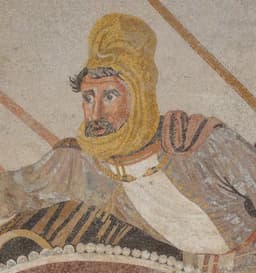
Darius III
Emperor · Ancient
40.8Total

Juba I of Numidia
Emperor · Ancient
39.9Total
Basic Information
Born
-380
-85
Died
-330
-46
Era
Ancient
Ancient
Nationality
Persia
Numidia
Occupation
Emperor
Emperor
Civilization
Middle Eastern
Other
Score Comparison
Military (10%)
50.0
10.0
Political (20%)
25.0
36.5
Influence (20%)
47.9
46.3
Legacy (20%)
43.3
38.3
Leadership (15%)
38.1
51.9
Strategy (15%)
35.7
45.0
TOTAL
40.8
39.9
Darius III — Complete Timeline
333 BC
Battle of IssusWar◆ Major
Darius III commanded the Persian army against Alexander the Great at Issus in Cilicia. Alexander's forces defeated the larger Persian army, and Darius fled the battlefield, leaving his family and baggage train to be captured.
Wars of AlexanderBattlePersian Empire
Impact: global
331 BC
Battle of GaugamelaWar
Darius III assembled a massive army from across the empire to confront Alexander near Arbela. Alexander's tactical brilliance led to a decisive Persian defeat, and Darius again fled the field, effectively ending Achaemenid resistance.
Wars of AlexanderBattlePersian Empire
Impact: global
330 BC
Loss of the Persian Capital PersepolisWar◆ Major
Alexander the Great captured and sacked Persepolis, the ceremonial capital of the Achaemenid Empire. The palace complex was burned, symbolizing the end of Persian imperial power and the transfer of hegemony to Macedonia.
Wars of AlexanderSackPersepolis
Impact: globaldestructive
Flight and Death of Darius IIIPolitical Action◆ Major
After Gaugamela, Darius fled eastward through Media and Parthia. He was deposed and imprisoned by his own satrap Bessus, then murdered by Bessus's followers near Hecatompylos. Alexander later gave Darius a royal burial at Persepolis.
DeathSuccessionAchaemenid Empire
Impact: globaltragic
Juba I of Numidia — Complete Timeline
49 BC
Alliance with PompeyPolitical Action
Juba I formed a military alliance with Pompey the Great and the Optimates against Julius Caesar. He provided troops and resources to the Pompeian cause, hoping to maintain Numidian independence and expand his influence in North Africa.
Roman Civil WarAlliancePompey
Impact: regional
46 BC
Battle of ThapsusWar◆ Major
Juba I of Numidia allied with the Optimates and fought against Julius Caesar at the Battle of Thapsus. Caesar's forces decisively defeated the Pompeian-Numidian army. Juba's kingdom was annexed by Rome, and he committed suicide to avoid capture.
Caesar's Civil WarBattleNumidia
Impact: regionaltragic
Expert Analysis
Origins
Darius III, born in 380 BCE, was a member of the Achaemenid dynasty, though not directly in the line of succession. He served as a satrap before being elevated to the throne in 336 BCE after the death of Artaxerxes III and the brief reign of Arses. His early life was marked by administrative service rather than military command, which shaped his cautious and reactive leadership style.
Juba I of Numidia, born around 85 BCE, was the son of King Hiempsal II. He inherited a kingdom that had been stabilized by his father's diplomacy with Rome. Juba was educated in Roman and Hellenistic culture, but his reign was dominated by the Roman civil wars. His background as a client king gave him limited autonomy, yet he leveraged his resources to become a key ally of Pompey.
Rise to Power
Darius III came to power through court intrigue after the assassination of his predecessor. He quickly faced revolts in Egypt and Babylon, which he suppressed, but his primary challenge was the rising Macedonian power under Alexander. Darius’s rise was not based on military prowess but on political maneuvering within the Persian court. His total score of 40.8 reflects his limited strategic acumen, with a military score of 50.0 and strategy of 35.7.
Juba I rose to prominence by aligning with the Optimates, the conservative faction in Rome led by Pompey. He provided cavalry and supplies to Pompey's forces during the civil war against Caesar. His political score of 36.5 indicates his ability to navigate Roman alliances, but his military score of 10.0 shows his tactical limitations. He was a regional power broker rather than a conqueror.
Leadership & Governance
Darius III governed a vast, multicultural empire through satraps and a centralized bureaucracy. He attempted to reform the military by incorporating Greek mercenaries, but his leadership was indecisive. At Issus (333 BCE) and Gaugamela (331 BCE), he commanded from the rear, losing control when battles turned against him. His governance score of 38.1 reflects his inability to inspire loyalty; many satraps defected to Alexander.
Juba I ruled Numidia as a client kingdom under Roman suzerainty. He maintained a strong court and used his wealth to support Pompey. His leadership score of 51.9 is higher than Darius’s, indicating his effectiveness within his limited sphere. However, his governance was constrained by Rome; he could not pursue independent policies. His alliance with Pompey was a strategic gamble that failed at Thapsus (46 BCE).
Triumph & Tragedy
Darius III’s greatest success was holding the empire together for several years despite Alexander’s invasions. He managed to raise large armies, such as at Gaugamela where he fielded over 100,000 men. His tragedy was his flight after each defeat, which eroded his authority. He was betrayed and murdered by his own satrap Bessus in 330 BCE, a stark failure of leadership. His legacy score of 43.3 is moderate, as the Achaemenid Empire ended with him.
Juba I’s triumph was his ability to mobilize Numidian forces for Pompey, contributing to early successes in Africa. His tragedy came at Thapsus, where his forces were routed by Caesar. He died by suicide after the battle, rather than face capture. His influence score of 46.3 reflects his role in the Roman civil wars, but his military failure was total.
Character & Destiny
Darius III was cautious and prone to pessimism. He consistently avoided decisive confrontation, preferring to retreat and regroup. This pattern made him ineffective against Alexander’s aggressive tactics. His character was shaped by his courtly upbringing; he lacked the military experience to command effectively. His total score of 40.8 is dragged down by his strategy (35.7) and leadership (38.1).
Juba I was ambitious but overconfident in his alliance with Pompey. He underestimated Caesar’s military genius and the loyalty of his own troops. His character was that of a Romanized king who believed in the Optimates’ cause, but his destiny was tied to their defeat. His total score of 39.9 is slightly lower than Darius’s, but his leadership score (51.9) is higher, showing he was a more capable ruler in a smaller context.
Legacy
Darius III is remembered as the last Achaemenid king, whose defeat enabled the Hellenistic era. His name is synonymous with the fall of a once-great empire. The burning of Persepolis and his flight became symbols of Persian decline. His legacy is largely negative, as he failed to defend his realm.
Juba I’s legacy is more localized. His defeat led to the annexation of Numidia by Rome, ending its independence. He is remembered as a loyal ally of Pompey and a symbol of resistance against Caesar. His son, Juba II, became a client king of Mauretania and a noted scholar, partially redeeming the family name.
Conclusion
Darius III and Juba I both faced superior opponents and lost their kingdoms. However, Darius III had a far greater impact on world history. His defeat by Alexander reshaped the ancient world, spreading Hellenistic culture across Asia. Juba I’s defeat was a minor episode in Rome’s civil wars. Despite Darius’s low scores (total 40.8 vs. Juba’s 39.9), his historical significance is immense. He presided over the end of the Achaemenid Empire, while Juba’s Numidia was a small client state. In terms of impact, Darius III is clearly the more consequential figure, even if his personal abilities were lacking.
Rankings
🥇
Darius IIILeader
Mil: 50.0Pol: 25.0Inf: 47.9
40.8
🥈
Juba I of Numidia
Mil: 10.0Pol: 36.5Inf: 46.3
39.9
+0.9 behind
How This Comparison Works
Algorithm
Each figure is scored on 6 dimensions (0—100 scale) based on structured historical data: Military (10%), Political (20%), Influence (20%), Legacy (20%), Leadership (15%), Strategy (15%). The weighted total produces the final ranking.
Data Sources
Scores are computed from structured sub-indicators in the database. Scale factors adjust for era (Ancient ×0.85, Modern ×1.0) and civilization size (Eastern ×1.05, Other ×0.80) to account for differences in population and military scale.
Maximum 3 Figures
Comparisons are limited to 2—3 figures to ensure readability and statistical meaningfulness.
Error Margins
±5 points per dimension — Sub-scores are derived from historical records with inherent uncertainty. Two figures within 5 points on a dimension should be considered roughly equivalent in that area.
Total Score Accuracy
±3 points overall — The weighted combination of 6 dimensions produces a total score with approximately ±3 points of uncertainty. Differences of less than 3 points are not statistically significant— the figures are effectively tied.
Known Limitations
- Historical records are incomplete and uneven across civilizations
- Figures from oral-tradition societies may be underrepresented
- Occupation labels can misclassify multi-role figures
- Scores measure capability and impact, not moral character
- Quantitative scoring is a comparison tool, not absolute truth
Capability Radar
Military (10%) — Battles & Warfare
Battles
15
45
Win Rate
10
40
Expansion
10
25
Political (20%) — Governance & Reform
Reform
10
20
Diplomacy
20
45
Economy
25
30
Influence (20%) — Cultural & Global Reach
Cultural
20
20
Global
25
15
Legacy (20%) — Historical Impact
Historical
40
30
Longevity
30
20
Leadership (15%) — Power & Stability
Tenure
30
40
Stability
15
25
Strategy (15%) — Tactics & Innovation
Strategy
15
30
Tactics
20
35
Reform
10
20
Similar Comparisons
Comments & Discussion
No comments yet. Be the first to share your thoughts!