Loading...
Liu Bei vs Muyeol of Silla
Muyeol of Silla leads by 4.0 pts · 2 figures compared
…
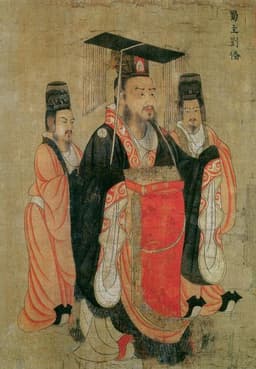
Liu Bei
Emperor · Ancient
59.5Total

Muyeol of Silla
Emperor · Ancient
63.5Total
Basic Information
Born
161
-604
Died
223
—
Era
Ancient
Ancient
Nationality
China
Korea
Occupation
Emperor
Emperor
Civilization
Eastern
Eastern
Score Comparison
Military (10%)
65.0
82.0
Political (20%)
68.0
60.0
Influence (20%)
55.0
62.0
Legacy (20%)
72.0
58.0
Leadership (15%)
40.0
72.0
Strategy (15%)
50.0
55.0
TOTAL
59.5
63.5
Liu Bei — Complete Timeline
208 AD
Battle of Red CliffsWar
Liu Bei and Sun Quan's combined forces defeated Cao Cao's navy at the Battle of Red Cliffs on the Yangtze River. The victory prevented Cao Cao from conquering the south and allowed Liu Bei to establish a base in Jing Province.
BattleRed CliffsAlliance
Impact: regional
Formation of the Alliance with Sun QuanPolitical Action◆ Major
Liu Bei, advised by Zhuge Liang, formed a strategic alliance with Sun Quan of Wu against the northern warlord Cao Cao. This alliance was crucial for the upcoming Battle of Red Cliffs and established the basis for the Three Kingdoms division.
AllianceSun QuanCao Cao
Impact: regionalconstructive
214 AD
Conquest of Yi ProvinceWar◆ Major
Liu Bei, with the help of Zhuge Liang and other advisors, conquered Yi Province (modern Sichuan) from its ruler Liu Zhang. This provided a wealthy and defensible base for his kingdom, fulfilling a key part of the Longzhong Plan.
ConquestYi ProvinceShu Han
Impact: regional
221 AD
Proclamation of the Shu Han DynastyPolitical Action
After Cao Pi usurped the Han throne, Liu Bei declared himself emperor of Shu Han in Chengdu, claiming to continue the Han dynasty. This formalized the Three Kingdoms period, with Shu, Wei, and Wu as rival states.
DynastyShu HanThree Kingdoms
Impact: national
222 AD
Battle of YilingWar◆ Major
Liu Bei launched a campaign against Sun Quan to avenge the death of his sworn brother Guan Yu. His forces were defeated by Wu general Lu Xun at the Battle of Yiling, resulting in heavy losses and Liu Bei's retreat to Baidi Cheng.
BattleDefeatWu
Impact: regionaltragic
Muyeol of Silla — Complete Timeline
654 AD
Formation of the Silla-Tang alliancePolitical Action
King Muyeol, as crown prince, negotiated a military alliance with the Tang dynasty of China. This alliance provided Silla with Chinese military support against Baekje and Goguryeo, setting the stage for the unification of the Korean Peninsula.
AllianceTang ChinaSilla
Impact: regionalconstructive
655 AD
Appointment of Kim Yushin as commanderPolitical Action
Muyeol appointed General Kim Yushin as the supreme commander of Silla's military forces. Kim Yushin's leadership was instrumental in the campaigns against Baekje and Goguryeo, and his strategic genius became a cornerstone of Silla's unification efforts.
MilitaryLeadershipSilla
Impact: nationalconstructive
660 AD
Conquest of BaekjeWar◆ Major
Muyeol, as king, led Silla forces in a joint campaign with Tang China to conquer Baekje. The allied army captured the Baekje capital, Sabi, and the kingdom fell. This victory eliminated one of Silla's major rivals and was a crucial step toward unification.
ConquestBaekjeSilla
Impact: regionaldestructive
661 AD
Death during unification campaignOther◆ Major
Muyeol died while Silla was still at war with Goguryeo. His death occurred before the final unification was achieved, but his alliance with Tang and conquest of Baekje had already set the course for Silla's eventual victory under his successor, King Munmu.
DeathUnificationSilla
Impact: regionaltragic
Expert Analysis
Origins
Liu Bei (161–223) was born in Zhuo Commandery (modern Hebei) during the late Eastern Han dynasty. He claimed descent from Emperor Jing of Han, but his family had declined into poverty. His father died early, and he sold mats and sandals with his mother to survive. Despite his humble beginnings, Liu Bei was ambitious and studied under the Confucian scholar Lu Zhi. His early life was marked by hardship, but he cultivated a reputation for benevolence and ambition to restore the Han dynasty.
Muyeol of Silla (604–661) was born Kim Chunchu, a member of the Silla royal family. His father was Kim Yongsu, a high-ranking official, and his mother was Princess Cheonmyeong, daughter of King Jinpyeong. Muyeol was well-educated in Confucian classics and military strategy. He served as a diplomat and general before becoming king. His early experiences in Tang China shaped his strategic thinking, particularly the importance of alliances.
Rise to Power
Liu Bei's rise was gradual and marked by numerous setbacks. He joined the campaign against the Yellow Turban Rebellion (184) and later served under various warlords, including Gongsun Zan, Tao Qian, and Cao Cao. After Cao Cao took control of the emperor, Liu Bei fled south. A turning point came in 208 when he allied with Sun Quan and defeated Cao Cao at the Battle of Red Cliffs. This victory secured his base in Jing Province. In 214, he conquered Yi Province, giving him a stable territory. In 221, after Cao Pi usurped the Han throne, Liu Bei declared himself emperor of Shu Han, claiming to continue the Han dynasty.
Muyeol rose to power through a combination of diplomacy and military prowess. As crown prince, he negotiated the critical Silla-Tang alliance in 648, securing Chinese support against Baekje and Goguryeo. In 654, he became king, succeeding his uncle King Jinpyeong. He immediately appointed General Kim Yushin as supreme commander, solidifying military leadership. His reign focused on unifying the Korean Peninsula under Silla rule.
Leadership & Governance
Liu Bei's leadership style emphasized benevolence and moral authority. He famously said, "Virtue alone cannot govern a state; neither can force alone secure the realm." He relied on advisors like Zhuge Liang, who implemented policies of agricultural reform, tax reduction, and legal codes. Liu Bei's governance was decentralized, allowing local officials autonomy. However, his emotional attachment to sworn brothers led to strategic errors, such as the campaign against Sun Quan after Guan Yu's death.
Muyeol governed with a focus on centralization and military efficiency. He strengthened the monarchy by reducing the power of the aristocratic council (Hwabaek). He implemented a land grant system to reward military merit and promoted Confucian education. His alliance with Tang was a masterstroke, providing advanced military technology and tactics. However, his reliance on Tang support created long-term dependency.
Triumph & Tragedy
Liu Bei's greatest success was founding the Shu Han dynasty and establishing a legitimate claim to the Han legacy. His conquest of Yi Province (214) and victory at Red Cliffs (208) were pivotal. Yet, his greatest failure was the disastrous Battle of Yiling (222) against Sun Quan, where his army was destroyed by fire attacks. This defeat not only cost him his life (he died the next year) but also weakened Shu Han permanently. His military score of 65.0 reflects his mixed record.
Muyeol's triumph was the conquest of Baekje in 660, a joint campaign with Tang that ended Baekje's existence. This was a crucial step toward unification. However, his tragedy was dying in 661 before completing the unification; Goguryeo fell only in 668 under his successor. His military score of 82.0 indicates his effectiveness, but his political score of 60.0 shows the limits of his alliance-dependent strategy.
Character & Destiny
Liu Bei was known for his charisma and benevolence, which attracted loyal followers. However, his emotional decision-making, especially regarding his sworn brothers, often clouded his judgment. His character—a mix of idealism and stubbornness—led to his rise but also his downfall. Historians note that his leadership score of 40.0 reflects his inability to separate personal feelings from strategic necessity.
Muyeol was pragmatic and calculating. His diplomatic skills and strategic vision enabled Silla to outmaneuver rivals. However, his willingness to submit to Tang suzerainty was controversial. His leadership score of 72.0 indicates decisiveness, but his legacy score of 58.0 suggests that his methods—relying on foreign allies—diminished his independent achievement.
Legacy
Liu Bei's legacy is enshrined in Chinese culture as the archetype of the benevolent ruler. The Shu Han dynasty he founded lasted until 263, and his story was romanticized in the novel "Romance of the Three Kingdoms." His emphasis on virtue influenced later Confucian governance. His total score of 59.5 reflects his enduring cultural impact despite limited political success.
Muyeol's legacy is the unification of the Korean Peninsula under Silla. His alliance with Tang set a precedent for Korean diplomacy. However, his dynasty fell to Goryeo in 935. His legacy score of 58.0 is modest because his unification was achieved with heavy Tang involvement, and his kingdom was not long-lasting.
Conclusion
While Muyeol of Silla has a higher total score (63.5 vs 59.5), Liu Bei's impact on Chinese history and culture is more profound. Muyeol's unification was a major achievement, but it was contingent on Tang support and did not create a lasting state. Liu Bei, despite lower military and leadership scores, founded a dynasty that symbolized the enduring ideal of Han restoration. His influence on literature and governance norms outweighs Muyeol's regional unification. Therefore, Liu Bei had greater historical impact.
Rankings
🥇
Muyeol of SillaLeader
Mil: 82.0Pol: 60.0Inf: 62.0
63.5
🥈
Liu Bei
Mil: 65.0Pol: 68.0Inf: 55.0
59.5
+4.0 behind
How This Comparison Works
Algorithm
Each figure is scored on 6 dimensions (0—100 scale) based on structured historical data: Military (10%), Political (20%), Influence (20%), Legacy (20%), Leadership (15%), Strategy (15%). The weighted total produces the final ranking.
Data Sources
Scores are computed from structured sub-indicators in the database. Scale factors adjust for era (Ancient ×0.85, Modern ×1.0) and civilization size (Eastern ×1.05, Other ×0.80) to account for differences in population and military scale.
Maximum 3 Figures
Comparisons are limited to 2—3 figures to ensure readability and statistical meaningfulness.
Error Margins
±5 points per dimension — Sub-scores are derived from historical records with inherent uncertainty. Two figures within 5 points on a dimension should be considered roughly equivalent in that area.
Total Score Accuracy
±3 points overall — The weighted combination of 6 dimensions produces a total score with approximately ±3 points of uncertainty. Differences of less than 3 points are not statistically significant— the figures are effectively tied.
Known Limitations
- Historical records are incomplete and uneven across civilizations
- Figures from oral-tradition societies may be underrepresented
- Occupation labels can misclassify multi-role figures
- Scores measure capability and impact, not moral character
- Quantitative scoring is a comparison tool, not absolute truth
Capability Radar
Military (10%) — Battles & Warfare
Battles
65
65
Win Rate
55
70
Expansion
65
80
Political (20%) — Governance & Reform
Reform
45
65
Diplomacy
75
85
Economy
50
60
Influence (20%) — Cultural & Global Reach
Cultural
80
55
Global
70
55
Legacy (20%) — Historical Impact
Historical
85
70
Longevity
85
65
Leadership (15%) — Power & Stability
Tenure
60
60
Stability
55
70
Strategy (15%) — Tactics & Innovation
Strategy
70
75
Tactics
60
60
Reform
40
55
Similar Comparisons
Comments & Discussion
No comments yet. Be the first to share your thoughts!