Loading...
Constantius I vs Julius Caesar
Julius Caesar leads by 25.0 pts · 2 figures compared
…
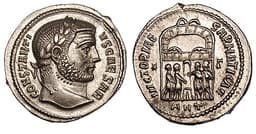
Constantius I
Emperor · Ancient
57.8Total

Julius Caesar
General · Ancient
82.8Total
Basic Information
Born
250
-100
Died
306
-44
Era
Ancient
Ancient
Nationality
Roman Empire
Roman Republic
Occupation
Emperor
General
Civilization
Western
Western
Score Comparison
Military (10%)
50.0
88.0
Political (20%)
68.0
78.0
Influence (20%)
54.9
85.0
Legacy (20%)
50.0
82.0
Leadership (15%)
74.0
80.0
Strategy (15%)
52.5
85.0
TOTAL
57.8
82.8
Constantius I — Complete Timeline
296 AD
Recovery of Britain from Carausius and AllectusWar◆ Major
Constantius I led an invasion to reclaim Britain from the usurper Allectus, who had succeeded Carausius. His forces landed near London and defeated Allectus, restoring Britain to the Roman Empire and ending the breakaway Britannic Empire.
BritainReconquestUsurper
Impact: regionalconstructive
298 AD
Campaign against the AlemanniWar◆ Major
Constantius I defeated the Alemanni at the Battle of Lingones (modern Langres) and later at Vindonissa. These victories secured the Rhine frontier and earned him the title Germanicus Maximus, strengthening his reputation as a capable military commander.
CampaignAlemanniRhine Frontier
Impact: regional
305 AD
Elevation to AugustusPolitical Action◆ Major
Upon the abdication of Diocletian and Maximian, Constantius I became the senior Augustus of the Western Roman Empire as part of the Tetrarchy. He ruled jointly with Galerius in the East, but his reign was short-lived as he died the following year.
TetrarchySuccessionAugustus
Impact: global
306 AD
Death at Eboracum (York)Other◆ Major
Constantius I died at Eboracum (modern York) while on campaign against the Picts in northern Britain. His son Constantine was proclaimed Augustus by the troops, setting the stage for Constantine's eventual rise to sole emperor.
DeathSuccessionConstantine
Impact: global
Toleration of Christians (Edict of Milan precursor)Political Action
Constantius I, unlike his co-emperor Galerius, was tolerant of Christians and did not enforce the Diocletianic persecution in his territories. This policy of religious tolerance foreshadowed the Edict of Milan issued by his son Constantine.
ToleranceChristianityReligion
Impact: regionalconstructive
Julius Caesar — Complete Timeline
58 BC
Gallic WarsWar◆ Major
Caesar, as proconsul of Gaul, launched a series of campaigns that conquered all of Gaul (modern France, Belgium, and parts of Switzerland). He fought numerous battles, including against the Helvetii, the Belgae, and the Gallic chieftain Vercingetorix. The wars brought immense wealth and a loyal army to Caesar.
Gallic WarsConquestRoman Expansion
Impact: regional
49 BC
Crossing the RubiconPolitical Action◆ Major
Caesar led Legio XIII across the Rubicon River into Italy, defying the Roman Senate's order to disband his army. This act triggered a civil war against Pompey and the Optimates, ultimately leading to Caesar's dictatorship and the end of the Roman Republic.
Roman Civil WarEnd of RepublicPower Struggle
Impact: global
48 BC
Battle of PharsalusWar◆ Major
Caesar's outnumbered army defeated the larger forces of Pompey the Great at Pharsalus in Greece. Caesar's tactical use of a reserve line to counter Pompey's cavalry charge proved decisive. Pompey fled to Egypt, where he was assassinated, leaving Caesar as the undisputed master of the Roman world.
Roman Civil WarBattleDecisive Victory
Impact: regional
44 BC
Appointment as Dictator for LifePolitical Action◆ Major
The Roman Senate appointed Caesar dictator perpetuo (dictator for life), granting him unprecedented personal power. This move concentrated military, legislative, and judicial authority in one person, effectively ending the Roman Republic's traditional system of checks and balances and alarming many senators.
DictatorshipEnd of RepublicPower Consolidation
Impact: regionaldestructive
Assassination on the Ides of MarchPolitical Action◆ Major
A group of Roman senators, led by Marcus Junius Brutus and Gaius Cassius Longinus, stabbed Caesar to death at a meeting of the Senate in the Theatre of Pompey. The assassination was intended to restore the Republic, but instead triggered another civil war that led to the rise of the Roman Empire.
AssassinationRoman PoliticsEnd of Republic
Impact: globaldestructive
Expert Analysis
constantius-i-vs-julius-caesar
# The Father and the Son Who Shaped an Empire
On a cold March morning in 44 BCE, the most powerful man in the Roman world fell beneath the daggers of his friends. Sixty-two senators, men he had promoted and pardoned, surrounded him in the Theatre of Pompey and struck again and again. Gaius Julius Caesar, conqueror of Gaul and dictator for life, died with twenty-three wounds, his blood pooling on the marble floor. Four hundred miles to the north, in the misty island of Britain, a very different Roman leader had died just a century and a half earlier. Constantius I, the pale-faced emperor who had reclaimed Britain for Rome, passed away peacefully at Eboracum in 306, his son Constantine at his bedside. One death marked the end of a republic; the other, the quiet passing of a torch that would ignite an empire. What drove these two men—one a titan of ambition, the other a steady hand in a crumbling world—to such different fates?
Origins
Julius Caesar was born into the chaos of the late Roman Republic, a world of civil wars, senatorial corruption, and soaring ambition. His family, the Julii, claimed descent from the goddess Venus, but they were not among the wealthiest or most powerful. Caesar’s father died when he was sixteen, leaving him to navigate a treacherous political landscape with little more than audacity and a keen mind. He was shaped by the violent rivalry between Marius and Sulla, learning early that in Rome, the pen and the sword were the same instrument.
Constantius I emerged in an entirely different world. Born in 250, he came of age during the Crisis of the Third Century, when Rome teetered on the brink of collapse—barbarians at every frontier, emperors rising and falling like autumn leaves, and the economy in ruins. Unlike Caesar, Constantius was not a patrician but a soldier-emperor, rising through the ranks of the Illyrian military aristocracy. His world was one of survival, not glory; of order, not revolution. Where Caesar inherited a republic that demanded conquest, Constantius inherited an empire that demanded repair.
Rise to Power
Caesar’s ascent was a masterpiece of calculated risk. He climbed the traditional ladder of Roman magistracies—quaestor, aedile, praetor—but always with an eye to the unconventional. His election as Pontifex Maximus in 63 BCE, at enormous personal expense, showed his willingness to gamble everything on prestige. The real turning point came in 58 BCE, when he secured the governorship of Gaul. Over the next eight years, he conquered a territory the size of Italy, built a loyal army, and amassed a fortune that dwarfed the treasury. When the Senate ordered him to disband his legions, he crossed the Rubicon in 49 BCE, igniting a civil war that ended with him as dictator.
Constantius I rose differently. He was appointed Caesar (junior emperor) in 293 as part of Diocletian’s Tetrarchy, a system designed to prevent the chaos of succession. His path was one of service, not rebellion. He was given command of the western provinces—Gaul, Britain, and Spain—and spent the next decade fighting Germanic tribes and reclaiming lost territory. His greatest military achievement came in 296, when he launched a naval invasion to recover Britain from the usurper Allectus. The campaign was swift and decisive, a model of logistical planning. Where Caesar seized power through audacious defiance, Constantius earned it through patient competence.
Leadership & Governance
Caesar governed as a revolutionary. As dictator, he reformed the calendar, granted citizenship to provincials, and initiated massive public works. He centralized power in his own hands, undermining the Senate and paving the way for monarchy. His military genius was undeniable—his siege of Alesia in 52 BCE remains a textbook example of tactical brilliance—but his political wisdom was flawed. He pardoned his enemies, hoping to win their loyalty, but they repaid him with daggers. His leadership was a blend of magnanimity and arrogance, and he never fully understood that the Republic’s traditions could not be swept aside without bloodshed.
Constantius ruled as a restorer. He enforced the Tetrarchy’s decrees, defended the frontiers, and—crucially—tolerated Christians when his co-emperor Galerius persecuted them. This decision, recorded in the events of 306, was not a grand moral stand but a pragmatic choice: he needed unity in his provinces. His military campaigns were defensive, not expansionist. At the Battle of Lingones in 298, he defeated the Alemanni but did not pursue them into their lands. He knew that Rome’s strength lay in consolidation, not conquest. His leadership was steady, unspectacular, and effective—the opposite of Caesar’s blazing genius.
Triumph & Tragedy
Caesar’s greatest triumph was the conquest of Gaul, which added a vast, wealthy province to Rome and made him the most famous man in the world. His tragedy was the Ides of March—a death that proved his reforms were too radical for the class he had displaced. He had conquered everything except the loyalty of his peers.
Constantius’s triumph was the recovery of Britain, a province that had been lost for a decade. His tragedy was that he never saw the empire he helped stabilize. He died at Eboracum in 306, aged fifty-six, on campaign against the Picts. But his greatest legacy—his son Constantine—was already at his side. Where Caesar’s death led to another civil war, Constantius’s death led to a smooth succession and, eventually, the Christianization of Rome.
Character & Destiny
Caesar was a gambler. He wrote *Commentaries* to shape his own legend, divorced his wife on suspicion of scandal, and crossed the Rubicon knowing it meant war. His personality—charming, ruthless, and supremely confident—drove him to take risks that no sane man would take. That same personality blinded him to the hatred he inspired. He believed his enemies would accept his mercy; they believed he would destroy them.
Constantius was a steward. He was called *Chlorus* (“the Pale”) for his complexion, but his character was anything but weak. He was cautious, loyal to the Tetrarchy, and focused on the long term. He did not seek glory; he sought stability. His personality shaped a destiny of quiet competence, not dramatic tragedy. He died in his bed, respected, his work unfinished but his dynasty secured.
Legacy
Caesar’s legacy is the Roman Empire. His name became a title—*Kaiser*, *Tsar*—and his reforms, from the calendar to provincial administration, outlasted the Republic he destroyed. He is remembered as a military genius, a political visionary, and a warning about the cost of unchecked ambition.
Constantius’s legacy is his son. Constantine the Great would complete what his father began: stabilizing the empire, founding Constantinople, and legalizing Christianity. Without Constantius’s tolerance, his military groundwork, and his peaceful death, the Christian Roman Empire might never have existed. He is remembered, if at all, as a footnote—but footnotes can change the world.
Conclusion
These two Romans embody a profound historical truth: ambition and stewardship both build empires, but they build them differently. Caesar’s fire consumed the Republic but lit the way to empire; Constantius’s steady flame kept the empire warm through its darkest winter. One died betrayed, the other in peace. One is remembered, the other forgotten. And yet, without Constantius, there might have been no Constantine—and without Caesar, no empire to inherit. The conqueror and the caretaker: each necessary, each incomplete without the other.
Rankings
🥇
Julius CaesarLeader
Mil: 88.0Pol: 78.0Inf: 85.0
82.8
🥈
Constantius I
Mil: 50.0Pol: 68.0Inf: 54.9
57.8
+25.0 behind
How This Comparison Works
Algorithm
Each figure is scored on 6 dimensions (0—100 scale) based on structured historical data: Military (10%), Political (20%), Influence (20%), Legacy (20%), Leadership (15%), Strategy (15%). The weighted total produces the final ranking.
Data Sources
Scores are computed from structured sub-indicators in the database. Scale factors adjust for era (Ancient ×0.85, Modern ×1.0) and civilization size (Eastern ×1.05, Other ×0.80) to account for differences in population and military scale.
Maximum 3 Figures
Comparisons are limited to 2—3 figures to ensure readability and statistical meaningfulness.
Error Margins
±5 points per dimension — Sub-scores are derived from historical records with inherent uncertainty. Two figures within 5 points on a dimension should be considered roughly equivalent in that area.
Total Score Accuracy
±3 points overall — The weighted combination of 6 dimensions produces a total score with approximately ±3 points of uncertainty. Differences of less than 3 points are not statistically significant— the figures are effectively tied.
Known Limitations
- Historical records are incomplete and uneven across civilizations
- Figures from oral-tradition societies may be underrepresented
- Occupation labels can misclassify multi-role figures
- Scores measure capability and impact, not moral character
- Quantitative scoring is a comparison tool, not absolute truth
Capability Radar
Military (10%) — Battles & Warfare
Battles
45
95
Win Rate
50
92
Expansion
35
97
Political (20%) — Governance & Reform
Reform
45
90
Diplomacy
55
85
Economy
50
82
Influence (20%) — Cultural & Global Reach
Cultural
30
88
Global
40
94
Legacy (20%) — Historical Impact
Historical
55
95
Longevity
60
96
Leadership (15%) — Power & Stability
Tenure
50
75
Stability
55
60
Strategy (15%) — Tactics & Innovation
Strategy
60
94
Tactics
55
96
Reform
40
88
Similar Comparisons
Comments & Discussion
No comments yet. Be the first to share your thoughts!