Loading...
Constantius III vs Julius Caesar
Julius Caesar leads by 33.8 pts · 2 figures compared
…
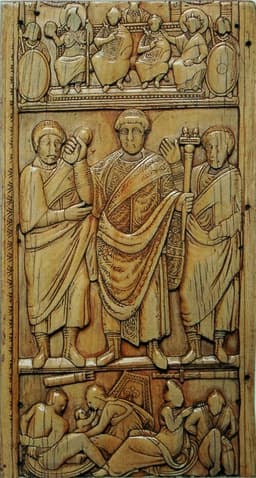
Constantius III
Emperor · Ancient
49.0Total

Julius Caesar
General · Ancient
82.8Total
Basic Information
Born
370
-100
Died
421
-44
Era
Ancient
Ancient
Nationality
Western Roman Empire
Roman Republic
Occupation
Emperor
General
Civilization
Western
Western
Score Comparison
Military (10%)
70.0
88.0
Political (20%)
43.7
78.0
Influence (20%)
47.1
85.0
Legacy (20%)
39.2
82.0
Leadership (15%)
48.4
80.0
Strategy (15%)
66.3
85.0
TOTAL
49.0
82.8
Constantius III — Complete Timeline
417 AD
Married Galla PlacidiaPolitical Action◆ Major
Constantius, a Roman general, married Galla Placidia, the half-sister of Emperor Honorius. This marriage strengthened his political position and made him a key figure in the Western Roman court.
MarriageRoman EmpireDynasty
Impact: nationalconstructive
421 AD
Appointed Co-Emperor as Constantius IIIPolitical Action◆ Major
Constantius was appointed co-emperor of the Western Roman Empire by Honorius, ruling as Constantius III. His reign lasted only seven months before he died of illness, but he was the de facto ruler of the West for years prior.
CoronationRoman EmpireCo-Emperor
Impact: national
Julius Caesar — Complete Timeline
58 BC
Gallic WarsWar◆ Major
Caesar, as proconsul of Gaul, launched a series of campaigns that conquered all of Gaul (modern France, Belgium, and parts of Switzerland). He fought numerous battles, including against the Helvetii, the Belgae, and the Gallic chieftain Vercingetorix. The wars brought immense wealth and a loyal army to Caesar.
Gallic WarsConquestRoman Expansion
Impact: regional
49 BC
Crossing the RubiconPolitical Action◆ Major
Caesar led Legio XIII across the Rubicon River into Italy, defying the Roman Senate's order to disband his army. This act triggered a civil war against Pompey and the Optimates, ultimately leading to Caesar's dictatorship and the end of the Roman Republic.
Roman Civil WarEnd of RepublicPower Struggle
Impact: global
48 BC
Battle of PharsalusWar◆ Major
Caesar's outnumbered army defeated the larger forces of Pompey the Great at Pharsalus in Greece. Caesar's tactical use of a reserve line to counter Pompey's cavalry charge proved decisive. Pompey fled to Egypt, where he was assassinated, leaving Caesar as the undisputed master of the Roman world.
Roman Civil WarBattleDecisive Victory
Impact: regional
44 BC
Appointment as Dictator for LifePolitical Action◆ Major
The Roman Senate appointed Caesar dictator perpetuo (dictator for life), granting him unprecedented personal power. This move concentrated military, legislative, and judicial authority in one person, effectively ending the Roman Republic's traditional system of checks and balances and alarming many senators.
DictatorshipEnd of RepublicPower Consolidation
Impact: regionaldestructive
Assassination on the Ides of MarchPolitical Action◆ Major
A group of Roman senators, led by Marcus Junius Brutus and Gaius Cassius Longinus, stabbed Caesar to death at a meeting of the Senate in the Theatre of Pompey. The assassination was intended to restore the Republic, but instead triggered another civil war that led to the rise of the Roman Empire.
AssassinationRoman PoliticsEnd of Republic
Impact: globaldestructive
Expert Analysis
constantius-iii-vs-julius-caesar
# The Shadow and the Sun
On the Ides of March, 44 BCE, Julius Caesar fell beneath twenty-three dagger strokes in the Theater of Pompey, his blood pooling on the marble floor as his murderers cried out for liberty. Four and a half centuries later, in 421 CE, Constantius III died of natural causes after just seven months as co-emperor of the Western Roman Empire—a reign so brief that many historians must pause to remember his name. One man’s death became the most famous assassination in history; the other’s passing barely registered in the annals of a dying empire. What separates a figure who reshapes the world from one who merely passes through it?
Origins
Caesar was born into the patrician Julian clan in 100 BCE, a family that claimed descent from the goddess Venus—but whose political fortunes had waned. His childhood unfolded during the twilight of the Roman Republic, an era of civil wars, slave revolts, and the collapse of traditional norms. The young Caesar learned early that in Rome, survival meant ambition. He was captured by pirates as a young man, laughed at their ransom demand, insisted they raise it, and after his release, crucified them—as he had promised he would while their captive. This was not cruelty for its own sake; it was a lesson in the power of reputation.
Constantius III was born around 370 CE, into a world already cracking. The Western Roman Empire had lost Britain, parts of Gaul, and much of its authority to barbarian incursions. He rose from obscure origins—likely Illyrian or Pannonian—through the military ranks, a man of competence rather than charisma. Where Caesar inherited a name and learned to wield it, Constantius inherited a collapsing system and learned to patch its holes.
Rise to Power
Caesar’s path was a masterwork of calculated risk. He allied with Pompey and Crassus in the First Triumvirate, conquered Gaul in a brutal eight-year campaign (58–50 BCE) that killed perhaps a million people and enslaved another million, crossed the Rubicon in 49 BCE to trigger civil war, and defeated his rivals one by one. Each step was a gamble, but each gamble was grounded in an unerring sense of what Rome’s soldiers and people would tolerate—and what they would reward.
Constantius rose through loyalty and marriage. As a general under Emperor Honorius, he campaigned against the Visigoths and usurpers, gradually accumulating power. His decisive move was political: in 417, he married Galla Placidia, the emperor’s half-sister, binding himself to the imperial family. This was not the crossing of a river with a legion at his back, but the careful weaving of a dynastic thread. In 421, Honorius appointed him co-emperor. The title was real, but the power was borrowed.
Leadership & Governance
Caesar governed as he campaigned: with brilliant speed and ruthless pragmatism. As dictator, he reformed the calendar (creating the Julian calendar we still use in modified form), extended citizenship to provincials, initiated public works, and centralized authority. He pardoned many former enemies—a calculated mercy that ultimately failed to protect him. His military genius lay in speed and logistics: he could move legions faster than his enemies could move messengers, and he understood that morale was a weapon as potent as a gladius.
Constantius III governed a realm in hospice care. He fought the Visigoths to a stalemate, settled them in Aquitaine as foederati (allied tribes), and stabilized the Gallic frontier. His reforms were defensive: shoring up borders, negotiating with barbarian chieftains, managing an empty treasury. Where Caesar expanded the empire, Constantius tried to keep it from dissolving. One built an empire; the other administered a decline.
Triumph & Tragedy
Caesar’s greatest triumph was the conquest of Gaul, a feat that added a vast, wealthy province to Rome and gave him an army personally loyal to him. His greatest tragedy was his assassination—not because he died, but because he misread the depth of the senatorial opposition. “The die is cast,” he said crossing the Rubicon, but he never fully grasped that the Republic’s elite would rather destroy him than accept his rule.
Constantius III’s triumph was brief: his appointment as co-emperor in 421, the culmination of years of service. His tragedy was that he achieved this pinnacle only to die months later, leaving no lasting reform, no dynasty, no legend. His wife Galla Placidia would go on to rule as regent for their son Valentinian III, but Constantius himself became a footnote.
Character & Destiny
Caesar was audacity incarnate. He wrote his own commentaries, controlled his own narrative, and believed that fortune favored the bold. “I came, I saw, I conquered,” he wrote of a campaign in Asia Minor—three Latin words that capture his essence. His flaw was not lack of caution but excess of confidence: he thought his charm and mercy could disarm enemies who would never forgive him.
Constantius was caution itself. He achieved power through patience, marriage, and bureaucratic maneuvering—the tools of a man who knew he was not a genius. His flaw was not pride but timing: he arrived too late to save the Western Empire, and his brief reign was a flicker in its long twilight.
Legacy
Caesar’s legacy is the Roman Empire itself. His adopted heir Octavian became Augustus, the first emperor, and the imperial system Caesar pioneered lasted five hundred years in the West and another thousand in the East. His name became a title: Kaiser, Tsar. His writings are still read in classrooms. He is the archetype of the military dictator—admired and feared, studied and condemned.
Constantius III left no legacy beyond a few lines in the history books. His marriage produced Valentinian III, who proved a weak emperor, and his brief reign changed nothing. He is remembered, if at all, as a placeholder—a competent general who became emperor just as the West began its final collapse.
Conclusion
What separates Caesar from Constantius is not merely talent but context. Caesar inherited a Republic that, though troubled, still possessed immense wealth, discipline, and ambition. He could conquer Gaul because Rome had the resources to field and supply his legions. Constantius inherited an empire that had lost its tax base, its army’s discipline, and its will to survive. He could not conquer because there was nothing left to conquer with.
But context alone does not explain the gulf between them. Caesar dreamed of a world remade in his image; Constantius dreamed of preserving what remained. One was a storm that reshaped the landscape; the other was a hand trying to hold back the tide. In the end, history remembers those who act as if they are writing its first chapter, not its last.
Rankings
🥇
Julius CaesarLeader
Mil: 88.0Pol: 78.0Inf: 85.0
82.8
🥈
Constantius III
Mil: 70.0Pol: 43.7Inf: 47.1
49.0
+33.8 behind
How This Comparison Works
Algorithm
Each figure is scored on 6 dimensions (0—100 scale) based on structured historical data: Military (10%), Political (20%), Influence (20%), Legacy (20%), Leadership (15%), Strategy (15%). The weighted total produces the final ranking.
Data Sources
Scores are computed from structured sub-indicators in the database. Scale factors adjust for era (Ancient ×0.85, Modern ×1.0) and civilization size (Eastern ×1.05, Other ×0.80) to account for differences in population and military scale.
Maximum 3 Figures
Comparisons are limited to 2—3 figures to ensure readability and statistical meaningfulness.
Error Margins
±5 points per dimension — Sub-scores are derived from historical records with inherent uncertainty. Two figures within 5 points on a dimension should be considered roughly equivalent in that area.
Total Score Accuracy
±3 points overall — The weighted combination of 6 dimensions produces a total score with approximately ±3 points of uncertainty. Differences of less than 3 points are not statistically significant— the figures are effectively tied.
Known Limitations
- Historical records are incomplete and uneven across civilizations
- Figures from oral-tradition societies may be underrepresented
- Occupation labels can misclassify multi-role figures
- Scores measure capability and impact, not moral character
- Quantitative scoring is a comparison tool, not absolute truth
Capability Radar
Military (10%) — Battles & Warfare
Battles
55
95
Win Rate
60
92
Expansion
50
97
Political (20%) — Governance & Reform
Reform
30
90
Diplomacy
55
85
Economy
35
82
Influence (20%) — Cultural & Global Reach
Cultural
25
88
Global
15
94
Legacy (20%) — Historical Impact
Historical
35
95
Longevity
20
96
Leadership (15%) — Power & Stability
Tenure
20
75
Stability
40
60
Strategy (15%) — Tactics & Innovation
Strategy
70
94
Tactics
65
96
Reform
40
88
Similar Comparisons
Comments & Discussion
No comments yet. Be the first to share your thoughts!