Loading...
Constantius III vs Napoleon Bonaparte
Napoleon Bonaparte leads by 21.9 pts · 2 figures compared
…
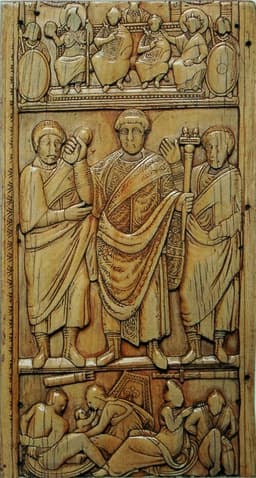
Constantius III
Emperor · Ancient
49.0Total

Napoleon Bonaparte
General · Modern
70.9Total
Basic Information
Born
370
1769
Died
421
1821
Era
Ancient
Modern
Nationality
Western Roman Empire
France
Occupation
Emperor
General
Civilization
Western
Western
Score Comparison
Military (10%)
70.0
94.0
Political (20%)
43.7
72.0
Influence (20%)
47.1
40.0
Legacy (20%)
39.2
80.0
Leadership (15%)
48.4
78.0
Strategy (15%)
66.3
90.0
TOTAL
49.0
70.9
Constantius III — Complete Timeline
417 AD
Married Galla PlacidiaPolitical Action◆ Major
Constantius, a Roman general, married Galla Placidia, the half-sister of Emperor Honorius. This marriage strengthened his political position and made him a key figure in the Western Roman court.
MarriageRoman EmpireDynasty
Impact: nationalconstructive
421 AD
Appointed Co-Emperor as Constantius IIIPolitical Action◆ Major
Constantius was appointed co-emperor of the Western Roman Empire by Honorius, ruling as Constantius III. His reign lasted only seven months before he died of illness, but he was the de facto ruler of the West for years prior.
CoronationRoman EmpireCo-Emperor
Impact: national
Napoleon Bonaparte — Complete Timeline
1799 AD
Coup of 18 BrumaireOther◆ Major
Napoleon Bonaparte, with support from his brother Lucien and key political figures, overthrew the Directory in a bloodless coup. He established the Consulate with himself as First Consul, effectively becoming the ruler of France. This event ended the French Revolution's most unstable period.
French RevolutionCoupRise to Power
Impact: regional
1804 AD
Promulgation of the Napoleonic CodeOther◆ Major
Napoleon enacted the Civil Code of the French, known as the Napoleonic Code, a comprehensive set of laws that replaced the fragmented feudal legal systems. The code established legal equality, protected property rights, and secularized law. It became the basis for legal systems in many European and world countries.
Legal ReformNapoleonic CodeCivil Law
Impact: globalconstructive
1805 AD
Battle of AusterlitzWar◆ Major
Napoleon's Grande Arm
Napoleonic WarsBattleDecisive Victory
Impact: global
1812 AD
Invasion of RussiaWar◆ Major
Napoleon led the Grande Arm
Napoleonic WarsInvasionDisaster
Impact: globaldestructive
1815 AD
Battle of WaterlooWar◆ Major
Napoleon's French army was defeated by the combined forces of the Duke of Wellington's Anglo-Allied army and Gebhard Leberecht von Bl
Napoleonic WarsBattleFinal Defeat
Impact: globaldestructive
Expert Analysis
constantius-iii-vs-napoleon-bonaparte
# The Emperor Who Never Was: Napoleon and Constantius III
In the summer of 421, a Roman general of humble Illyrian birth stood in the imperial palace at Ravenna, receiving the purple robe of co-emperor. Seven months later, he was dead. Fourteen centuries later and a thousand miles away, a Corsican artillery officer crowned himself emperor of the French, conquered Europe, and died a prisoner on a remote Atlantic island. Both men rose from obscurity to the pinnacle of power. One became a name that echoes through millennia; the other, a footnote. What separates a legend from a ghost?
Origins
Napoleon Bonaparte was born in 1769 on Corsica, an island that had become French only months before his birth. His family belonged to the minor nobility, but they were poor, and Napoleon spoke French with a thick Italian accent that invited ridicule at military school. He devoured histories of Alexander and Caesar, reading obsessively while other boys played. The French Revolution, which erupted when he was twenty, shattered the old order and opened doors that had been locked for centuries. For a brilliant young officer of modest means, it was the only door that mattered.
Constantius III was born around 370, likely in Naissus (modern Niš, Serbia), in the same Illyrian region that had produced several Roman emperors. Like Napoleon, he rose through military talent in an era of crisis. But where Napoleon’s world was being remade by revolution, Constantius’s world was being unmade by collapse. The Western Roman Empire had lost Britain, much of Gaul, and parts of Spain to barbarian invaders. The empire was not ascending; it was drowning.
Rise to Power
Napoleon’s ascent was meteoric. At twenty-four, he drove the British from Toulon and became a brigadier general. At twenty-six, he crushed a royalist uprising in Paris with a “whiff of grapeshot.” At twenty-seven, he took command of the French army in Italy and turned starving, mutinous troops into a victorious force that humbled Austria. His Italian campaign of 1796-1797 was a masterpiece of speed, deception, and daring—he consistently divided his enemies, struck their flanks, and seized their supply lines. Each victory fed the next. By 1799, he staged a coup and made himself First Consul. By 1804, he was emperor.
Constantius rose more slowly, through decades of grinding warfare. As a general under Emperor Honorius, he fought the Visigoths, the Vandals, and various usurpers. His great achievement came in 411, when he defeated the usurper Constantine III in Gaul, then systematically hunted down and destroyed other rivals. He was patient, methodical, and ruthless. In 417, he married Galla Placidia, the emperor’s half-sister—a political masterstroke that tied him to the imperial family. But he had to wait four more years before Honorius reluctantly made him co-emperor in February 421. He reigned for seven months.
Leadership & Governance
Napoleon governed as he conquered: with relentless energy and total control. He reformed French law into the Napoleonic Code, a system of civil rights, property protections, and secular governance that spread across Europe. He centralized the state, created the Bank of France, and built roads, canals, and schools. His military genius lay in his ability to concentrate overwhelming force at the decisive point, to read terrain and timing with near-supernatural precision, and to inspire men who would follow him into blizzards and cannon fire. At Austerlitz in 1805, he destroyed a larger Russo-Austrian army by feigning weakness, luring his enemies onto a frozen marsh, then crushing their center. It was his masterpiece.
Constantius ruled differently because he had different tools. The Western Roman Empire was bankrupt, its armies filled with barbarian mercenaries, its provinces under constant assault. He could not reform—he could only survive. His military strategy was defensive: secure the Rhine frontier, stabilize Italy, and negotiate with Visigothic king Wallia to return Galla Placidia (captured during the sack of Rome in 410) in exchange for land in Gaul. It was a deal that bought time, but it was also a surrender of Roman territory. Constantius was a capable general, but his political and leadership scores—58.2 and 44.2, respectively—reflect a man operating within impossible constraints.
Triumph & Tragedy
Napoleon’s greatest triumph was also the seed of his tragedy. By 1811, he ruled an empire from Spain to Poland, and his dynastic ambitions led him to divorce Joséphine and marry Marie Louise of Austria. But the same ambition drove him to invade Russia in 1812 with 600,000 men. The campaign was a catastrophe: the Russians refused to fight a decisive battle, burned their own land, and let the Russian winter destroy the Grand Army. Napoleon returned to France with fewer than 100,000 survivors. He was exiled to Elba in 1814, escaped in 1815, rallied France, and was finally defeated at Waterloo. He died in 1821 on Saint Helena, a prisoner of the British, at age fifty-one.
Constantius’s tragedy was quieter but more absolute. He had spent twenty years saving a dying empire, only to die himself before he could rule. His son, Valentinian III, was born in 419 and became emperor at age six—a child who would reign for thirty years while the empire crumbled around him. Constantius’s triumph was merely to hold the line, and even that line did not hold.
Character & Destiny
Napoleon was driven by an insatiable hunger for glory, a belief that he was a man of destiny. “I am not a man,” he once said, “but a thing.” He saw himself as history’s instrument, and that conviction gave him the audacity to attempt the impossible. But it also blinded him to limits. He could not stop, could not compromise, could not share power. His character was his fate.
Constantius was a survivor, not a visionary. He played the political game with patience and cunning, but he lacked the revolutionary energy to reshape his world. He was a product of the late empire, a system that rewarded loyalty, caution, and compromise—and that was dying anyway. He did not fail; he simply arrived too late.
Legacy
Napoleon’s legacy is immense. The Napoleonic Code influenced legal systems across Europe and the Americas. His military campaigns are still studied in war colleges. His name is synonymous with genius and ambition, with the promise and peril of the self-made man. His total score of 82.4 reflects a figure who changed the world, for better and worse.
Constantius III has a total score of 55.9. He is remembered, if at all, as a footnote in the decline of Rome—a competent general who married the right woman and died before he could matter. His legacy is not failure but irrelevance.
Conclusion
Standing on the deck of HMS *Bellerophon* in 1815, Napoleon watched the coast of France disappear. “I have lived a hundred years in fifty,” he said. He had. Constantius III, in his seven months as emperor, had barely lived at all. The difference between them is not talent or ambition—it is timing. Napoleon rode the wave of a revolution that broke the old world open. Constantius tried to patch a boat that was already underwater. History does not reward the man who saves the furniture; it remembers the one who builds the house.
Rankings
🥇
Napoleon BonaparteLeader
Mil: 94.0Pol: 72.0Inf: 40.0
70.9
🥈
Constantius III
Mil: 70.0Pol: 43.7Inf: 47.1
49.0
+21.9 behind
How This Comparison Works
Algorithm
Each figure is scored on 6 dimensions (0—100 scale) based on structured historical data: Military (10%), Political (20%), Influence (20%), Legacy (20%), Leadership (15%), Strategy (15%). The weighted total produces the final ranking.
Data Sources
Scores are computed from structured sub-indicators in the database. Scale factors adjust for era (Ancient ×0.85, Modern ×1.0) and civilization size (Eastern ×1.05, Other ×0.80) to account for differences in population and military scale.
Maximum 3 Figures
Comparisons are limited to 2—3 figures to ensure readability and statistical meaningfulness.
Error Margins
±5 points per dimension — Sub-scores are derived from historical records with inherent uncertainty. Two figures within 5 points on a dimension should be considered roughly equivalent in that area.
Total Score Accuracy
±3 points overall — The weighted combination of 6 dimensions produces a total score with approximately ±3 points of uncertainty. Differences of less than 3 points are not statistically significant— the figures are effectively tied.
Known Limitations
- Historical records are incomplete and uneven across civilizations
- Figures from oral-tradition societies may be underrepresented
- Occupation labels can misclassify multi-role figures
- Scores measure capability and impact, not moral character
- Quantitative scoring is a comparison tool, not absolute truth
Capability Radar
Military (10%) — Battles & Warfare
Battles
55
95
Win Rate
60
90
Expansion
50
95
Political (20%) — Governance & Reform
Reform
30
95
Diplomacy
55
80
Economy
35
85
Influence (20%) — Cultural & Global Reach
Cultural
25
85
Global
15
90
Legacy (20%) — Historical Impact
Historical
35
95
Longevity
20
90
Leadership (15%) — Power & Stability
Tenure
20
85
Stability
40
70
Strategy (15%) — Tactics & Innovation
Strategy
70
95
Tactics
65
98
Reform
40
92
Similar Comparisons
Comments & Discussion
No comments yet. Be the first to share your thoughts!