Loading...
Count Andrassy vs Hifikepunye Pohamba
Count Andrassy leads by 7.0 pts · 2 figures compared
…
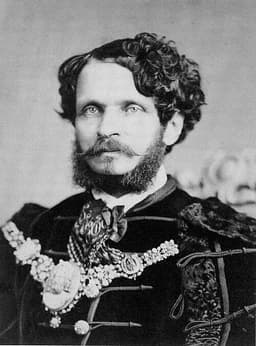
Count Andrassy
Politician · Modern
58.1Total

Hifikepunye Pohamba
Politician · Modern
51.1Total
Basic Information
Born
1823
1935
Died
1890
—
Era
Modern
Modern
Nationality
Austria
Namibia
Occupation
Politician
Politician
Civilization
Western
Other
Score Comparison
Military (10%)
48.9
32.7
Political (20%)
72.0
53.8
Influence (20%)
60.0
54.1
Legacy (20%)
49.2
45.0
Leadership (15%)
72.0
72.0
Strategy (15%)
43.2
41.5
TOTAL
58.1
51.1
Count Andrassy — Complete Timeline
1871 AD
Appointment as Foreign Minister of Austria-HungaryPolitical Action◆ Major
Andrassy was appointed Foreign Minister of Austria-Hungary by Emperor Franz Joseph. He was the first Hungarian to hold this position, reflecting the dual monarchy's structure.
AppointmentForeign PolicyDual Monarchy
Impact: national
1878 AD
Congress of BerlinPolitical Action◆ Major
Andrassy represented Austria-Hungary at the Congress of Berlin, which revised the Treaty of San Stefano. He secured the right to occupy and administer Bosnia and Herzegovina, expanding Habsburg influence in the Balkans.
CongressBalkansTerritorial Expansion
Impact: regionalconstructive
1879 AD
Dual Alliance with GermanyPolitical Action
Andrassy negotiated the Dual Alliance between Austria-Hungary and Germany. This defensive treaty committed both powers to mutual support in case of a Russian attack, forming the core of the Central Powers in World War I.
AllianceGermanyCentral Powers
Impact: regionalconstructive
Resignation as Foreign MinisterPolitical Action◆ Major
Andrassy resigned as Foreign Minister after the Dual Alliance was signed. He cited health reasons and a desire to return to Hungarian politics, but his resignation also reflected tensions within the empire.
ResignationHungaryPolitics
Impact: national
Hifikepunye Pohamba — Complete Timeline
1989 AD
Elected to the Constituent Assembly of NamibiaPolitical Action◆ Major
Pohamba was elected to the Constituent Assembly in the 1989 elections, which drafted Namibia's constitution. He was a key figure in SWAPO's transition from liberation movement to political party.
Constituent AssemblyConstitution Drafting
Impact: nationalconstructive
1990 AD
Appointed Minister of Home AffairsPolitical Action◆ Major
Pohamba was appointed Minister of Home Affairs in Namibia's first independent government under President Sam Nujoma. He oversaw the establishment of a national identity system and immigration control.
Ministerial RoleState Building
Impact: nationalconstructive
2005 AD
Became President of NamibiaPolitical Action
Pohamba became President of Namibia on March 21, 2005, succeeding Sam Nujoma. He pledged to continue Nujoma's policies of reconciliation and development.
PresidencySuccession
Impact: nationalconstructive
2007 AD
Launched the National Development Plan 3Reform◆ Major
Pohamba launched the third National Development Plan (NDP3), focusing on poverty reduction, education, and infrastructure. The plan aimed to achieve Vision 2030 goals for a prosperous Namibia.
Development PlanEconomic Policy
Impact: nationalconstructive
2009 AD
Re-elected President (2009)Political Action◆ Major
Pohamba was re-elected in the 2009 general election with 76.4% of the vote. His second term focused on land reform and addressing inequality.
Re-electionLand Reform
Impact: national
2015 AD
Retired as PresidentPolitical Action◆ Major
Pohamba retired as President in March 2015, handing power to Hage Geingob. His retirement was peaceful and constitutional, maintaining Namibia's democratic tradition.
RetirementDemocratic Transition
Impact: nationalconstructive
Expert Analysis
Origins
Count Gyula Andrassy was born on March 8, 1823, in Oláhpatak, Hungary (then part of the Austrian Empire), into a wealthy Calvinist noble family. His father, Count Károly Andrassy, was a liberal politician. Andrassy studied law and philosophy at the University of Pest, and later traveled extensively in Western Europe, absorbing liberal ideas. He participated in the Hungarian Revolution of 1848, serving as a diplomat for the revolutionary government. After the revolution's defeat, he fled into exile, returning in 1858 after a pardon.
Hifikepunye Pohamba was born on August 18, 1935, in Okanghudi, South West Africa (now Namibia), into a farming family. He attended the St. Mary's Mission School, but his education was limited due to the apartheid system. Drawn to politics early, he joined the South West Africa People's Organisation (SWAPO) in 1960 and went into exile in 1961, living in Tanzania, the Soviet Union, and Zambia. He received military training in the Soviet Union and later worked in SWAPO's administrative wing.
Rise to Power
Andrassy's rise began after his return from exile. He was elected to the Hungarian Diet in 1861 and became a leading figure in the negotiations leading to the Austro-Hungarian Compromise of 1867, which transformed the Austrian Empire into the dual monarchy of Austria-Hungary. As a reward, he served as the first Prime Minister of Hungary (1867-1871), implementing liberal reforms. In 1871, Emperor Franz Joseph appointed him Foreign Minister of Austria-Hungary, making him the first Hungarian to hold that post. He held this position until 1879.
Pohamba's rise was gradual within SWAPO. He served as SWAPO's representative in East Africa and later as its secretary for finance. After Namibia's independence in 1990, he was elected to the Constituent Assembly and appointed Minister of Home Affairs (1990-1995), then Minister of Lands, Resettlement and Rehabilitation (1995-2001). He became SWAPO's vice president in 2002 and was elected President of Namibia on March 21, 2005, succeeding Sam Nujoma.
Leadership & Governance
Andrassy's leadership was characterized by pragmatism and a focus on strengthening Austria-Hungary's position in Europe. As Foreign Minister, he pursued a cautious foreign policy, avoiding confrontations with Russia while maintaining the alliance with Germany. His signature achievement was the Dual Alliance of 1879, a defensive pact with Germany that shaped European alliances until World War I. Domestically, as Hungarian Prime Minister, he supported liberal reforms including judicial independence and press freedom, but also faced criticism for suppressing Slavic nationalities.
Pohamba's governance emphasized national reconciliation and continuity with Nujoma's policies. He maintained SWAPO's dominance while promoting stability. His administration focused on poverty reduction, infrastructure development, and land reform. He launched the National Development Plan 3 (NDP3) in 2008, aiming to reduce poverty and improve education. However, critics argued that land reform was slow and inequality persisted. Pohamba's leadership style was consensus-building and low-key.
Triumph & Tragedy
Andrassy's greatest triumph was negotiating the Dual Alliance, which ensured Germany's support for Austria-Hungary and created a powerful bloc in Central Europe. He also secured the right to occupy and administer Bosnia-Herzegovina at the Congress of Berlin (1878), expanding Austro-Hungarian influence in the Balkans. His tragedy came from the same alliance system: it contributed to the rigid alliance structure that escalated World War I. Additionally, his occupation of Bosnia-Herzegovina fueled Slavic nationalism and tensions with Russia.
Pohamba's triumphs include maintaining peace and stability in Namibia, overseeing peaceful elections, and being re-elected with 76.4% of the vote in 2009. He also presided over economic growth and improved infrastructure. His failures include slow progress on land reform, persistent inequality (Namibia remains one of the most unequal countries), and criticism of media freedom under his tenure. He was also criticized for not doing enough to address corruption.
Character & Destiny
Andrassy was known as a skilled diplomat, charming and intelligent, but also stubborn and proud. His Hungarian nationalism and distrust of Russia shaped his foreign policy. He believed in a strong, centralized monarchy but also respected constitutionalism. His character led him to prioritize the alliance with Germany, which ultimately tied Austria-Hungary's fate to Germany's aggressive policies.
Pohamba was described as humble, calm, and dedicated to service. He avoided the cult of personality that surrounded his predecessor. His destiny was to lead Namibia in a period of consolidation after independence. His low-key style helped maintain stability but also meant less ambitious reforms.
Legacy
Andrassy's legacy is mixed. He is credited with strengthening Austria-Hungary's international position and creating the Dual Alliance, but also blamed for contributing to the alliance system that led to World War I. In Hungary, he is remembered as a statesman who secured Hungarian interests within the monarchy. His total score of 58.1 reflects modest long-term impact.
Pohamba's legacy in Namibia is as a peacemaker who continued the reconciliation process. He is respected for his humility and dedication to development, but not seen as transformative. His total score of 51.1 indicates a moderate impact, primarily within Namibia.
Conclusion
While both leaders scored similarly in leadership (both 72.0), Count Andrassy had a broader impact on European history through the Dual Alliance and the Congress of Berlin, which shaped the geopolitics of the early 20th century. Pohamba's impact was largely confined to Namibia's domestic development and stability. Andrassy's political score of 72.0 and influence of 60.0 outpace Pohamba's 53.8 and 54.1. Therefore, Count Andrassy had a greater historical impact, despite his legacy being more controversial.
Rankings
🥇
Count AndrassyLeader
Mil: 48.9Pol: 72.0Inf: 60.0
58.1
🥈
Hifikepunye Pohamba
Mil: 32.7Pol: 53.8Inf: 54.1
51.1
+7.0 behind
How This Comparison Works
Algorithm
Each figure is scored on 6 dimensions (0—100 scale) based on structured historical data: Military (10%), Political (20%), Influence (20%), Legacy (20%), Leadership (15%), Strategy (15%). The weighted total produces the final ranking.
Data Sources
Scores are computed from structured sub-indicators in the database. Scale factors adjust for era (Ancient ×0.85, Modern ×1.0) and civilization size (Eastern ×1.05, Other ×0.80) to account for differences in population and military scale.
Maximum 3 Figures
Comparisons are limited to 2—3 figures to ensure readability and statistical meaningfulness.
Error Margins
±5 points per dimension — Sub-scores are derived from historical records with inherent uncertainty. Two figures within 5 points on a dimension should be considered roughly equivalent in that area.
Total Score Accuracy
±3 points overall — The weighted combination of 6 dimensions produces a total score with approximately ±3 points of uncertainty. Differences of less than 3 points are not statistically significant— the figures are effectively tied.
Known Limitations
- Historical records are incomplete and uneven across civilizations
- Figures from oral-tradition societies may be underrepresented
- Occupation labels can misclassify multi-role figures
- Scores measure capability and impact, not moral character
- Quantitative scoring is a comparison tool, not absolute truth
Capability Radar
Military (10%) — Battles & Warfare
Battles
26
24
Win Rate
34
22
Expansion
37
25
Political (20%) — Governance & Reform
Reform
60
60
Diplomacy
75
65
Economy
55
50
Influence (20%) — Cultural & Global Reach
Cultural
40
30
Global
50
35
Legacy (20%) — Historical Impact
Historical
55
40
Longevity
40
30
Leadership (15%) — Power & Stability
Tenure
65
55
Stability
60
70
Strategy (15%) — Tactics & Innovation
Strategy
40
28
Tactics
41
34
Reform
43
34
Similar Comparisons
Comments & Discussion
No comments yet. Be the first to share your thoughts!