Loading...
Count Andrassy vs Napoleon Bonaparte
Napoleon Bonaparte leads by 12.8 pts · 2 figures compared
…
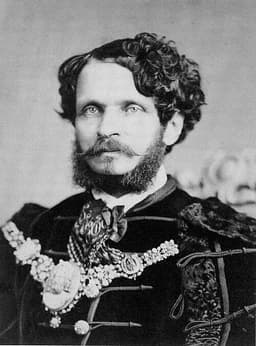
Count Andrassy
Politician · Modern
58.1Total

Napoleon Bonaparte
General · Modern
70.9Total
Basic Information
Born
1823
1769
Died
1890
1821
Era
Modern
Modern
Nationality
Austria
France
Occupation
Politician
General
Civilization
Western
Western
Score Comparison
Military (10%)
48.9
94.0
Political (20%)
72.0
72.0
Influence (20%)
60.0
40.0
Legacy (20%)
49.2
80.0
Leadership (15%)
72.0
78.0
Strategy (15%)
43.2
90.0
TOTAL
58.1
70.9
Count Andrassy — Complete Timeline
1871 AD
Appointment as Foreign Minister of Austria-HungaryPolitical Action◆ Major
Andrassy was appointed Foreign Minister of Austria-Hungary by Emperor Franz Joseph. He was the first Hungarian to hold this position, reflecting the dual monarchy's structure.
AppointmentForeign PolicyDual Monarchy
Impact: national
1878 AD
Congress of BerlinPolitical Action◆ Major
Andrassy represented Austria-Hungary at the Congress of Berlin, which revised the Treaty of San Stefano. He secured the right to occupy and administer Bosnia and Herzegovina, expanding Habsburg influence in the Balkans.
CongressBalkansTerritorial Expansion
Impact: regionalconstructive
1879 AD
Dual Alliance with GermanyPolitical Action
Andrassy negotiated the Dual Alliance between Austria-Hungary and Germany. This defensive treaty committed both powers to mutual support in case of a Russian attack, forming the core of the Central Powers in World War I.
AllianceGermanyCentral Powers
Impact: regionalconstructive
Resignation as Foreign MinisterPolitical Action◆ Major
Andrassy resigned as Foreign Minister after the Dual Alliance was signed. He cited health reasons and a desire to return to Hungarian politics, but his resignation also reflected tensions within the empire.
ResignationHungaryPolitics
Impact: national
Napoleon Bonaparte — Complete Timeline
1799 AD
Coup of 18 BrumaireOther◆ Major
Napoleon Bonaparte, with support from his brother Lucien and key political figures, overthrew the Directory in a bloodless coup. He established the Consulate with himself as First Consul, effectively becoming the ruler of France. This event ended the French Revolution's most unstable period.
French RevolutionCoupRise to Power
Impact: regional
1804 AD
Promulgation of the Napoleonic CodeOther◆ Major
Napoleon enacted the Civil Code of the French, known as the Napoleonic Code, a comprehensive set of laws that replaced the fragmented feudal legal systems. The code established legal equality, protected property rights, and secularized law. It became the basis for legal systems in many European and world countries.
Legal ReformNapoleonic CodeCivil Law
Impact: globalconstructive
1805 AD
Battle of AusterlitzWar◆ Major
Napoleon's Grande Arm
Napoleonic WarsBattleDecisive Victory
Impact: global
1812 AD
Invasion of RussiaWar◆ Major
Napoleon led the Grande Arm
Napoleonic WarsInvasionDisaster
Impact: globaldestructive
1815 AD
Battle of WaterlooWar◆ Major
Napoleon's French army was defeated by the combined forces of the Duke of Wellington's Anglo-Allied army and Gebhard Leberecht von Bl
Napoleonic WarsBattleFinal Defeat
Impact: globaldestructive
Expert Analysis
count-andrassy-vs-napoleon-bonaparte
# The Emperor and the Diplomat: Two Faces of Power in Modern Europe
On a June morning in 1815, Napoleon Bonaparte watched his Imperial Guard march toward the ridge of Mont-Saint-Jean, their blue coats a final, defiant splash of color against the green Belgian fields. Forty-six years later, in a gilded salon in Vienna, Count Gyula Andrássy would bow before Emperor Franz Joseph, a Hungarian rebel turned Habsburg minister, his path to power paved not with cannon fire but with patient negotiation. Both men sought to shape Europe, yet one did so with the sword, the other with the quill. Why did Napoleon’s Europe crumble in a single day, while Andrássy’s alliances outlasted his own lifetime? The answer lies not in their ambitions—both were immense—but in the worlds that made them.
Origins
Napoleon was born in 1769 on the island of Corsica, a place recently annexed by France, where the air smelled of olive groves and resentment. His family, minor nobility in a land that felt conquered, raised him with a burning sense of grievance and ambition. At nine, he entered a French military academy, a short, intense boy speaking French with an Italian accent, mocked by his wealthier classmates. The French Revolution of 1789 shattered the old order, and for a young artillery officer of modest means, it was a door flung open. Merit, not birth, now determined destiny—and Napoleon had merit to spare.
Count Gyula Andrássy, born in 1823, grew up in a very different storm. Hungary was then a kingdom within the Austrian Empire, a land of Magyar nobles who chafed under Habsburg rule. His father was a liberal reformer, and young Andrássy inherited both his title and his politics. Educated in law and diplomacy, he was shaped by the Revolutions of 1848—that year of fire when liberal dreams swept Europe. Andrássy joined the Hungarian uprising, served as a diplomat for the rebel government, and when it failed, fled into exile, a price on his head. He spent a decade in London and Paris, watching, learning, waiting. Where Napoleon’s youth taught him that power was something to be seized, Andrássy’s taught him that power was something to be endured, and then managed.
Rise to Power
Napoleon’s ascent was a miracle of speed and violence. In 1793, at just twenty-four, he drove the British from Toulon with a brilliant artillery plan. By 1796, he commanded the Italian army, a ragged force he turned into a conquering machine, winning battles like Lodi and Arcola in a blur of audacious marches. He was not just a soldier; he was a master of propaganda, sending dispatches to Paris that made him a hero. The coup of 18 Brumaire in 1799 placed him at the head of France as First Consul. In five years, he had gone from an unknown Corsican to the ruler of the most powerful nation in Europe.
Andrássy’s rise was slower, a chess game played over decades. He returned from exile in 1858, pardoned by the Habsburgs, and entered politics as a moderate. He understood something Napoleon never fully grasped: that defeat could be turned into a negotiating position. The Austrian Empire’s disastrous war with Prussia in 1866 forced Vienna to compromise with its Hungarian nobles. Andrássy became a key architect of the 1867 Compromise, creating the dual monarchy of Austria-Hungary. In 1871, Emperor Franz Joseph appointed him Foreign Minister—the first Hungarian to hold that post. His path was not a conquest but a reconciliation.
Leadership & Governance
As ruler of France, Napoleon was a whirlwind of reform. He centralized the state, created the Bank of France, and, most enduringly, codified French law with the Napoleonic Code of 1804—a system of civil law based on reason and equality before the law, not aristocratic privilege. He built roads, canals, and a system of elite schools. His military genius was staggering: at Austerlitz in 1805, he destroyed a combined Russian and Austrian army with a feigned retreat and a devastating flank attack. He won 70 battles, his strategy a blend of speed, deception, and the ruthless concentration of force. But his governance had a fatal flaw: he could not stop. Peace was a foreign concept. He needed war to feed his glory, and glory to feed his legitimacy.
Andrássy governed by balance, not force. As Foreign Minister, he faced a Europe of rising nationalism and crumbling empires. At the Congress of Berlin in 1878, he secured Austria-Hungary the administration of Bosnia-Herzegovina—not through conquest, but through diplomacy, trading Russia’s ambitions against British fears. His greatest achievement was the Dual Alliance with Germany in 1879, a defensive treaty that bound the two empires together. It was a masterpiece of realpolitik: it isolated Russia, stabilized the Balkans, and gave Austria-Hungary a powerful backer. Where Napoleon’s alliances were built on fear and conquest, Andrássy’s were built on mutual interest. He had a political score of 81, higher than Napoleon’s 75—a telling number.
Triumph & Tragedy
Napoleon’s greatest moment was Austerlitz, the “Battle of the Three Emperors,” where he humiliated the monarchs of Europe. His greatest tragedy was the invasion of Russia in 1812, a colossal miscalculation. He led 600,000 men into the vastness of Russia; fewer than 100,000 returned. The Grand Army, once invincible, was broken. He was exiled to Elba in 1814, returned for a Hundred Days, and was finally defeated at Waterloo in 1815—a battle he might have won if his generals had been faster, or the ground less muddy. He died in 1821 on the remote island of Saint Helena, a prisoner of the British, dictating his memoirs.
Andrássy’s triumph was the Dual Alliance, a treaty that shaped European diplomacy until 1914. But his tragedy was subtler. He resigned in 1879, citing health reasons, but also sensing the limits of what diplomacy could achieve. The alliance system he built would, decades later, drag the continent into the First World War—a war that destroyed Austria-Hungary itself. His legacy was a stability that proved fragile.
Character & Destiny
Napoleon was driven by an insatiable will. “Impossible is a word to be found only in the dictionary of fools,” he once said. He trusted his star, his intellect, and his army. This self-belief made him invincible—until it made him blind. He could not delegate, could not compromise, could not imagine defeat. His character was his destiny: a man who rose by breaking rules and fell by breaking too many.
Andrássy was a realist. He had learned in exile that patience was a weapon. He knew when to push and when to yield. He was described as charming, elegant, and pragmatic—a diplomat who understood that power was not about winning every battle, but about surviving to fight another day. His strategy score of 35.3, far lower than Napoleon’s 93, reflects a different kind of strategy: not of war, but of statecraft.
Legacy
Napoleon left behind a legend. The Napoleonic Code influences law from France to Louisiana to Japan. His military tactics are still studied. He reshaped Europe, toppling old monarchies and spreading nationalism, even as he suppressed it. He is remembered as both a tyrant and a genius, a man who made the modern world possible, for better and worse.
Andrássy left behind a system. The Dual Alliance, the Congress of Berlin, the Compromise of 1867—these were not dramatic victories, but they were lasting. He is remembered in Hungary as a founding father of the modern state, in Austria as a wise minister, in history as a master of the possible. His legacy score of 67.7 is modest compared to Napoleon’s 78, but it is more stable.
Conclusion
Napoleon and Andrássy stand at opposite ends of power. One conquered nations; the other built alliances. One died in exile, the other in honor. Their differences are not just of talent but of era: Napoleon’s world was the age of revolution, where a single man could reshape history through force; Andrássy’s was the age of nationalism, where survival depended on balance and compromise. Napoleon asked, “What can I take?” Andrássy asked, “What can I keep?” In the end, the emperor’s empire crumbled, but the diplomat’s treaties shaped a century. Perhaps the most lasting power is not the one that wins battles, but the one that outlasts them.
Rankings
🥇
Napoleon BonaparteLeader
Mil: 94.0Pol: 72.0Inf: 40.0
70.9
🥈
Count Andrassy
Mil: 48.9Pol: 72.0Inf: 60.0
58.1
+12.8 behind
How This Comparison Works
Algorithm
Each figure is scored on 6 dimensions (0—100 scale) based on structured historical data: Military (10%), Political (20%), Influence (20%), Legacy (20%), Leadership (15%), Strategy (15%). The weighted total produces the final ranking.
Data Sources
Scores are computed from structured sub-indicators in the database. Scale factors adjust for era (Ancient ×0.85, Modern ×1.0) and civilization size (Eastern ×1.05, Other ×0.80) to account for differences in population and military scale.
Maximum 3 Figures
Comparisons are limited to 2—3 figures to ensure readability and statistical meaningfulness.
Error Margins
±5 points per dimension — Sub-scores are derived from historical records with inherent uncertainty. Two figures within 5 points on a dimension should be considered roughly equivalent in that area.
Total Score Accuracy
±3 points overall — The weighted combination of 6 dimensions produces a total score with approximately ±3 points of uncertainty. Differences of less than 3 points are not statistically significant— the figures are effectively tied.
Known Limitations
- Historical records are incomplete and uneven across civilizations
- Figures from oral-tradition societies may be underrepresented
- Occupation labels can misclassify multi-role figures
- Scores measure capability and impact, not moral character
- Quantitative scoring is a comparison tool, not absolute truth
Capability Radar
Military (10%) — Battles & Warfare
Battles
26
95
Win Rate
34
90
Expansion
37
95
Political (20%) — Governance & Reform
Reform
60
95
Diplomacy
75
80
Economy
55
85
Influence (20%) — Cultural & Global Reach
Cultural
40
85
Global
50
90
Legacy (20%) — Historical Impact
Historical
55
95
Longevity
40
90
Leadership (15%) — Power & Stability
Tenure
65
85
Stability
60
70
Strategy (15%) — Tactics & Innovation
Strategy
40
95
Tactics
41
98
Reform
43
92
Similar Comparisons
Comments & Discussion
Bonaparte's Bayonet6/17/2026
Napoleon's empire died at Waterloo because he built it on personal glory, not institutions. Andrássy understood power sharing—he was literally a rebel who reconciled with the Habsburgs to create the Dual Monarchy. Napoleon's Napoleonic Code was brilliant, but his rule was a one-man show. When he fell, so did everything. Andrássy left behind a system that lasted until 1918. Charisma burns; diplomacy endures.
历史账本先生6/17/2026
数据会说话:拿破仑统治法国15年,打了7场大战,最终耗尽了法国整整一代男人——1815年法国军队伤亡超30万。而安德拉希在1867年达成奥匈折衷方案,让匈牙利获得完全自治权,却没流一滴血。但别忘了,安德拉希的和平建立在奥地利刚被普鲁士打败的基础上,妥协容易,征服难。谁更伟大?得看你问的是统计员还是老兵。
Corsican Meteor's Shadow6/17/2026
Classics scholar here: Napoleon was Caesar reborn, a dictator who remade law, religion, and borders in a decade. Andrássy was Cicero—a brilliant negotiator who saved his nation through compromise, but never created anything ex nihilo. Read the Treaty of Berlin (1878): Andrássy expanded Austria's influence in the Balkans by a single diplomatic stroke. Napoleon conquered half of Europe and lost it all. Which legacy truly outlasts? The diplomat's, if you value endurance over spectacle.
东欧棋手6/17/2026
我是个历史爱好者,必须站安德拉希。拿破仑是天才,但他的战略是杀敌一千自损八百——远征俄国损失了50万人,这数字太疯狂了。安德拉希在1878年柏林会议上用一个微笑和几场酒会,就让奥匈帝国“合法”占领了波黑,没死一个人。现代国际政治像下棋,不是拳击赛。拿破仑是个拳王,安德拉希是棋圣。你猜谁最后赢了?