Loading...
Crassus vs Julius Caesar
Julius Caesar leads by 27.3 pts · 2 figures compared
…
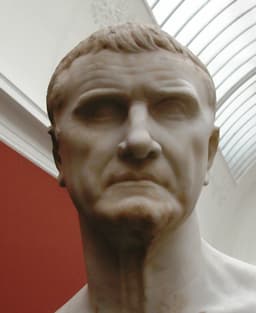
Crassus
General · Ancient
55.5Total

Julius Caesar
General · Ancient
82.8Total
Basic Information
Born
-115
-100
Died
-53
-44
Era
Ancient
Ancient
Nationality
Roman Republic
Roman Republic
Occupation
General
General
Civilization
Western
Western
Score Comparison
Military (10%)
65.0
88.0
Political (20%)
46.6
78.0
Influence (20%)
57.2
85.0
Legacy (20%)
50.0
82.0
Leadership (15%)
61.1
80.0
Strategy (15%)
60.0
85.0
TOTAL
55.5
82.8
Crassus — Complete Timeline
71 BC
Suppression of Spartacus's RevoltWar◆ Major
Crassus raised and commanded six legions to crush the slave rebellion led by Spartacus. After cornering and defeating the rebels in Lucania, he crucified 6,000 survivors along the Appian Way, ending the Third Servile War.
Slave RevoltSpartacusCrucifixionThird Servile War
Impact: nationaldestructive
60 BC
Formation of the First TriumviratePolitical Action
Crassus allied with Julius Caesar and Pompey the Great to form an informal political coalition known as the First Triumvirate. This alliance dominated Roman politics, advancing each member's interests against the Senate.
Political AllianceCaesarPompeySenate
Impact: global
53 BC
Battle of CarrhaeWar◆ Major
Crassus invaded Parthia without proper support and was defeated at Carrhae. His army was annihilated by Parthian cavalry, and Crassus was killed during negotiations. This disaster marked a major Roman defeat and ended the Triumvirate.
Parthian WarDefeatDeath
Impact: regionaltragic
Julius Caesar — Complete Timeline
58 BC
Gallic WarsWar◆ Major
Caesar, as proconsul of Gaul, launched a series of campaigns that conquered all of Gaul (modern France, Belgium, and parts of Switzerland). He fought numerous battles, including against the Helvetii, the Belgae, and the Gallic chieftain Vercingetorix. The wars brought immense wealth and a loyal army to Caesar.
Gallic WarsConquestRoman Expansion
Impact: regional
49 BC
Crossing the RubiconPolitical Action◆ Major
Caesar led Legio XIII across the Rubicon River into Italy, defying the Roman Senate's order to disband his army. This act triggered a civil war against Pompey and the Optimates, ultimately leading to Caesar's dictatorship and the end of the Roman Republic.
Roman Civil WarEnd of RepublicPower Struggle
Impact: global
48 BC
Battle of PharsalusWar◆ Major
Caesar's outnumbered army defeated the larger forces of Pompey the Great at Pharsalus in Greece. Caesar's tactical use of a reserve line to counter Pompey's cavalry charge proved decisive. Pompey fled to Egypt, where he was assassinated, leaving Caesar as the undisputed master of the Roman world.
Roman Civil WarBattleDecisive Victory
Impact: regional
44 BC
Appointment as Dictator for LifePolitical Action◆ Major
The Roman Senate appointed Caesar dictator perpetuo (dictator for life), granting him unprecedented personal power. This move concentrated military, legislative, and judicial authority in one person, effectively ending the Roman Republic's traditional system of checks and balances and alarming many senators.
DictatorshipEnd of RepublicPower Consolidation
Impact: regionaldestructive
Assassination on the Ides of MarchPolitical Action◆ Major
A group of Roman senators, led by Marcus Junius Brutus and Gaius Cassius Longinus, stabbed Caesar to death at a meeting of the Senate in the Theatre of Pompey. The assassination was intended to restore the Republic, but instead triggered another civil war that led to the rise of the Roman Empire.
AssassinationRoman PoliticsEnd of Republic
Impact: globaldestructive
Expert Analysis
crassus-vs-julius-caesar
The Two Faces of Ambition
In the summer of 53 BCE, on the dusty plains of Carrhae in what is now modern-day Turkey, a Roman army of some 40,000 men was being systematically destroyed. The commander, Marcus Licinius Crassus, the richest man in Rome, watched in horror as his legions were cut down by Parthian horse archers who seemed to appear from every direction. It was a death that would define his legacy forever. Just eleven years earlier, in 64 BCE, another Roman general had been captured by pirates and, instead of begging for his life, laughed at them, demanded a higher ransom, and later returned to crucify them all. That man was Gaius Julius Caesar. One died in humiliation, the other in a hail of senatorial daggers on the Ides of March. Both were ambitious. Both wanted ultimate power. Only one understood what it really required.
Origins
Crassus was born in 115 BCE into one of Rome's oldest and most prestigious families, the Licinii. His father and brother were both killed in the political purges of Gaius Marius, leaving him to inherit not only a fortune but also a burning need for security through wealth. He built his empire shrewdly: buying up properties of proscribed citizens at fire-sale prices, investing in silver mines, and assembling a private fire brigade that would negotiate payment before extinguishing a blaze. Money was his armor against a world that had taught him how quickly power could vanish.
Caesar, born fifteen years later in 100 BCE, came from the patrician Julian clan, but his family was not wealthy. His aunt had married Marius, and his father died when Caesar was only sixteen, leaving him to navigate a Rome torn between populists and optimates. Where Crassus saw danger and sought to insulate himself, Caesar saw opportunity and sought to engage. The difference in their formative years—Crassus watching his father's head displayed on the Rostra, Caesar watching his uncle's veterans rewarded with land—shaped two very different strategies for survival.
Rise to Power
Crassus rose through the ranks of Roman politics by leveraging his enormous wealth. He lent money to ambitious senators, financed military campaigns, and bought influence with the casual ease of a man who could afford any price. His great military moment came in 71 BCE when he suppressed the slave revolt of Spartacus. But even this was tinged with rivalry: Pompey, arriving late, claimed credit for the final victory, and Crassus had to share the triumph. He never forgave Pompey for stealing his glory.
Caesar's path was more dangerous and more direct. He climbed the political ladder with breathtaking speed—quaestor, aedile, pontifex maximus, praetor, consul—but always on borrowed money. He was deeply in debt to Crassus himself at one point, a fact that would later bind them together. Where Crassus bought loyalty, Caesar earned it. When he was captured by pirates in 75 BCE, he treated them as subordinates, ordering them to be quiet while he slept and joking that he would crucify them all. They thought him mad. When he returned and did exactly that, they realized they had misjudged the depth of his certainty.
The turning point came in 60 BCE with the formation of the First Triumvirate: Caesar, Pompey, and Crassus. It was an alliance of convenience—Pompey had the soldiers, Crassus had the money, and Caesar had the political cunning. But the partnership was fundamentally unstable. Crassus wanted military glory to match his wealth. Pompey wanted recognition. Caesar wanted everything.
Leadership & Governance
As a general, Caesar was revolutionary. He led from the front, ate the same food as his soldiers, and remembered their names. His conquest of Gaul (58–50 BCE) was not just a military campaign but a political masterpiece: he wrote about it himself in *Commentarii de Bello Gallico*, shaping his own legend in real time. His reforms as dictator—reorganizing the calendar, granting citizenship to provincials, initiating public works—showed a vision for Rome that extended beyond personal ambition.
Crassus, by contrast, was a competent but uninspired commander. His suppression of Spartacus was brutal and effective, but it revealed a man who relied on discipline and numbers rather than tactical brilliance. His political wisdom was limited to the counting house: he could calculate interests but not intentions. When he finally sought military glory in Parthia, he ignored all advice, refused to scout the terrain, and marched his army into a desert trap. His strategy score of 47.0 reflects a man who could manage a legion but not a campaign.
Triumph & Tragedy
Caesar's greatest moment was perhaps the crossing of the Rubicon in 49 BCE, when he committed treason for the sake of his destiny. "The die is cast," he said, and within five years he was dictator for life. His tragedy was that he could not imagine a world where others did not share his vision. On the Ides of March, 44 BCE, sixty senators stabbed him to death. He died not as a tyrant but as a man who had forgotten that his equals might resent his superiority.
Crassus's tragedy was more complete. At Carrhae, his army was annihilated, his standards captured, and he himself was killed—according to legend, by having molten gold poured down his throat. It was a fitting end for a man who had measured everything in money. He had wanted glory but had no talent for it. He had wanted respect but had no generosity to earn it.
Character & Destiny
Caesar believed in his own luck. He took risks that would have destroyed anyone else, and they paid off because he inspired absolute loyalty. His soldiers adored him; his enemies feared him; his allies could never quite predict him. He was generous to a fault—pardoning enemies, promoting talent, forgiving debts—but this generosity was also a form of control. He gave so that others would owe him.
Crassus believed in his own money. He was cautious, calculating, and ultimately limited by his inability to trust anyone who was not indebted to him. He could not inspire loyalty because he never gave anything without expecting a return. When he needed his allies most, they were not there. Pompey stayed in Rome. Caesar was in Gaul. Crassus died alone in the desert, surrounded by men who fought for pay, not for love.
Legacy
Caesar's legacy is the Roman Empire itself. His name became a title—*Kaiser* in German, *Tsar* in Russian—and his reforms outlived the Republic he destroyed. He is remembered as a genius, a tyrant, and the man who proved that one individual could change history.
Crassus is remembered as a cautionary tale. His name survives in the word "crass." He is the man who had everything and lost it all because he never understood that power is not bought—it is earned. His wealth could buy an army, but it could not buy victory. His influence could buy an alliance, but it could not buy loyalty.
Conclusion
Standing on the ruins of the Republic, it is tempting to see Caesar and Crassus as opposites: the visionary versus the miser, the gambler versus the accountant. But they were more alike than either would have admitted. Both wanted to be first in Rome. Both believed that the old rules no longer applied. The difference was that Caesar understood that to break the rules, you must first master them—while Crassus thought that money could simply rewrite them. In the end, history remembers those who change the game, not those who try to buy the table. The Ides of March claimed Caesar, but Carrhae claimed Crassus's very soul. And that is the harsher judgment.
Rankings
🥇
Julius CaesarLeader
Mil: 88.0Pol: 78.0Inf: 85.0
82.8
🥈
Crassus
Mil: 65.0Pol: 46.6Inf: 57.2
55.5
+27.3 behind
How This Comparison Works
Algorithm
Each figure is scored on 6 dimensions (0—100 scale) based on structured historical data: Military (10%), Political (20%), Influence (20%), Legacy (20%), Leadership (15%), Strategy (15%). The weighted total produces the final ranking.
Data Sources
Scores are computed from structured sub-indicators in the database. Scale factors adjust for era (Ancient ×0.85, Modern ×1.0) and civilization size (Eastern ×1.05, Other ×0.80) to account for differences in population and military scale.
Maximum 3 Figures
Comparisons are limited to 2—3 figures to ensure readability and statistical meaningfulness.
Error Margins
±5 points per dimension — Sub-scores are derived from historical records with inherent uncertainty. Two figures within 5 points on a dimension should be considered roughly equivalent in that area.
Total Score Accuracy
±3 points overall — The weighted combination of 6 dimensions produces a total score with approximately ±3 points of uncertainty. Differences of less than 3 points are not statistically significant— the figures are effectively tied.
Known Limitations
- Historical records are incomplete and uneven across civilizations
- Figures from oral-tradition societies may be underrepresented
- Occupation labels can misclassify multi-role figures
- Scores measure capability and impact, not moral character
- Quantitative scoring is a comparison tool, not absolute truth
Capability Radar
Military (10%) — Battles & Warfare
Battles
55
95
Win Rate
60
92
Expansion
30
97
Political (20%) — Governance & Reform
Reform
30
90
Diplomacy
60
85
Economy
85
82
Influence (20%) — Cultural & Global Reach
Cultural
40
88
Global
45
94
Legacy (20%) — Historical Impact
Historical
55
95
Longevity
50
96
Leadership (15%) — Power & Stability
Tenure
65
75
Stability
40
60
Strategy (15%) — Tactics & Innovation
Strategy
40
94
Tactics
45
96
Reform
10
88
Similar Comparisons
Comments & Discussion
CRASSUSVSBANKFAIL6/17/2026
Crassus didn't just die at Carrhae—he proved that money can't buy tactical genius. Sure, he had 40,000 legionaries and endless gold, but he ignored the desert terrain and Parthian composite bows. Caesar would've scouted ahead, built siege engines, or bribed locals for intel. Crassus relied on his wallet; Caesar relied on his mind. The Battle of Carrhae wasn't a military defeat—it was a tuition payment for every rich fool who thinks wealth equals wisdom.
财富与智慧老爷6/17/2026
有人说克拉苏的财富能买下半个罗马,但卡莱战役证明了他的金币比帕提亚人的弓箭还脆弱。凯撒在高卢打仗时,每征服一个部落就学他们的战术;克拉苏呢?他连幼发拉底河的水源都没控制住,就敢深入沙漠。我的观点很简单:钱可以买来军队,但买不来战略直觉。克拉苏不是输给帕提亚人,是输给自己的傲慢——这跟凯撒在元老院被刺杀时犯的错一样致命。
NUMBERSGUY6/17/2026
The comparison is flawed because it cherry-picks outcomes. Carrhae had 40,000 Romans killed or captured, sure, but Caesar lost 30,000 at Gergovia in 52 BCE. That's a 75% loss ratio for Caesar's worst battle. Crassus was unlucky—his Parthian enemy used feigned retreats and horse archers, a counter Roman tactics couldn't handle yet. Caesar faced Gauls with similar weapons and won. Different enemies, different results. Stop using Carrhae as Crassus's only epitaph; it's lazy historical boxing.
克拉苏的银行家6/17/2026
你们吹凯撒贬克拉苏,可别忘了克拉苏在斯巴达克斯起义中的表现。他组建了六个新军团,用钱收买了海盗封锁逃路,最后在公元前71年把起义军钉死在十字架上。凯撒在高卢杀了一百万多人,但那是外战;克拉苏镇住的是国内奴隶叛乱,这需要更精细的政治手腕。一个能用火灾谈判赚钱的人,懂得权力不只是刀剑。