Loading...
Deria Hassan vs Frederick William III of Prussia
Frederick William III of Prussia leads by 3.4 pts · 2 figures compared
…

Deria Hassan
Emperor · Modern
47.0Total
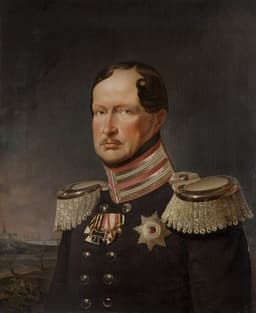
Frederick William III of Prussia
Emperor · Modern
50.4Total
Basic Information
Born
1830
1770
Died
1884
1840
Era
Modern
Modern
Nationality
Somalia
Prussia
Occupation
Emperor
Emperor
Civilization
Other
Western
Score Comparison
Military (10%)
50.0
50.0
Political (20%)
37.9
43.7
Influence (20%)
52.5
50.2
Legacy (20%)
43.3
43.3
Leadership (15%)
65.7
74.0
Strategy (15%)
25.0
43.7
TOTAL
47.0
50.4
Deria Hassan — Complete Timeline
1880 AD
Resistance to British ExpansionWar
Deria Hassan led military resistance against British colonial encroachment into Isaaq territory, engaging in skirmishes and diplomatic efforts to preserve the sultanate's independence before ultimately accepting protectorate status.
ResistanceColonial ConflictIsaaq
1884 AD
Signing of the British Protectorate TreatyPolitical Action◆ Major
Deria Hassan, as the last sultan of the Isaaq Sultanate, signed a treaty with the British Empire establishing a protectorate over the region. This ended Isaaq sovereignty and integrated the territory into British Somaliland.
ColonialismTreatyBritish Somaliland
Impact: regionaltragic
Frederick William III of Prussia — Complete Timeline
1806 AD
Defeat at the Battle of Jena-AuerstedtWar
Frederick William III led Prussia into war against Napoleon. The Prussian army was decisively defeated at the twin battles of Jena and Auerstedt. The defeat was catastrophic, leading to the collapse of the Prussian state, the occupation of Berlin, and the flight of the royal family to East Prussia.
PrussiaNapoleonWarJena-Auerstedt
Impact: globaltragic
1807 AD
Prussian Reform MovementReform◆ Major
In response to the defeat, Frederick William III supported a series of reforms led by Stein, Hardenberg, Scharnhorst, and Gneisenau. These included the abolition of serfdom, municipal self-government, military reorganization, and educational reform. The reforms modernized Prussia and laid the foundation for its recovery.
PrussiaReformSteinHardenbergModernization
Impact: nationalprogressive
Treaty of TilsitPolitical Action
After the defeat at Jena, Frederick William III was forced to sign the Treaty of Tilsit with Napoleon. Prussia lost half of its territory, including all lands west of the Elbe, and was forced to pay huge indemnities and reduce its army to 42,000 men. Prussia became a French satellite state.
PrussiaNapoleonTreatyTerritory
Impact: regionaltragic
1813 AD
Entry into the Sixth CoalitionWar◆ Major
After Napoleon's disastrous Russian campaign, Frederick William III joined the Sixth Coalition against France. The Prussian army played a key role in the War of Liberation, culminating in the Battle of Leipzig. This restored Prussia's status as a major European power and led to territorial gains at the Congress of Vienna.
PrussiaNapoleonic WarsCoalitionLiberation
Impact: globalconstructive
1815 AD
Congress of ViennaPolitical Action◆ Major
Frederick William III was represented at the Congress of Vienna, which redrew the map of Europe after Napoleon's defeat. Prussia gained significant territories, including the Rhineland, Westphalia, and parts of Saxony, becoming a major German power. The Congress also confirmed the Prussian-led German Confederation.
PrussiaCongress of ViennaTerritoryDiplomacy
Impact: globalconstructive
Expert Analysis
Origins
Deria Hassan was born around 1800 in the Horn of Africa, a member of the Isaaq clan. He became the last sultan of the Isaaq Sultanate, a Somali state that controlled trade routes and exerted influence over the region. His early life was shaped by the clan's pastoral traditions and the growing pressure from European colonial powers, particularly the British, who sought to secure the Gulf of Aden for maritime routes. Frederick William III was born on August 3, 1770, in Potsdam, Prussia, into the House of Hohenzollern. He was the son of King Frederick William II and Frederika Louisa of Hesse-Darmstadt. Educated under strict military and religious tutelage, he grew up during a period of Prussian decline after the death of Frederick the Great. His formative years were marked by the French Revolution and the rise of Napoleon, which would define his reign.
Rise to Power
Deria Hassan ascended to the sultanate in the mid-19th century, inheriting a realm facing increasing British interest in the Somali coast. The British, seeking to secure Berbera as a coaling station and counter Ottoman influence, pressured Deria Hassan to sign a protectorate treaty in 1884. This agreement ceded sovereignty to the British, making the Isaaq Sultanate a British protectorate. Deria Hassan's rule was thus defined by the loss of independence, though he attempted to resist through limited military skirmishes. Frederick William III became king of Prussia on November 16, 1797, after his father's death. He inherited a neutralist policy, but the pressures of the Napoleonic Wars forced him into conflict. His rise was passive; he was a cautious ruler who initially avoided confrontation with France. However, in 1806, he was compelled to join the Fourth Coalition against Napoleon, leading to the catastrophic defeat at Jena-Auerstedt on October 14, 1806.
Leadership & Governance
Deria Hassan's leadership was traditional, relying on clan elders and religious legitimacy. He governed through a council of elders and maintained the sultanate's authority through trade and diplomacy. His signing of the British protectorate treaty was a pragmatic decision to avoid military annihilation, but it effectively ended Isaaq sovereignty. His governance score of 65.7 reflects his ability to maintain internal stability despite external pressure. Frederick William III's leadership was marked by indecision and reliance on advisors. After the defeat at Jena, he fled to Königsberg and eventually signed the Treaty of Tilsit (1807), which cost Prussia half its territory. However, he then supported the Prussian Reform Movement, led by Stein, Hardenberg, Scharnhorst, and Gneisenau. These reforms modernized the army, abolished serfdom, and introduced municipal self-government. His leadership score of 74.0 is higher than Deria Hassan's 65.7, reflecting his role in fostering institutional change.
Triumph & Tragedy
Deria Hassan's greatest success was maintaining the Isaaq Sultanate's identity under British protection, avoiding the violent conquest suffered by other Somali states. His tragedy was the loss of sovereignty; the protectorate treaty led to British control and eventual marginalization of the sultanate. He died in 1895, with his legacy overshadowed by the subsequent colonial period. Frederick William III's triumph was his role in the final defeat of Napoleon. After Napoleon's disastrous Russian campaign, he joined the Sixth Coalition in 1813, and Prussian troops fought at the Battle of Leipzig (1813) and entered Paris in 1814. At the Congress of Vienna (1815), Prussia gained significant territory, including the Rhineland and Westphalia, becoming a major European power. His tragedy was the humiliation of Jena and Tilsit, which saw Prussia reduced to a minor state. His political score of 43.7 reflects his limited agency in these events.
Character & Destiny
Deria Hassan was pragmatic and cautious, choosing diplomacy over futile resistance. His character shaped the Isaaq Sultanate's peaceful transition to a protectorate, but also its eventual absorption into British Somaliland. He scored 25.0 in strategy, indicating a lack of long-term planning against colonial encroachment. Frederick William III was pious, frugal, and indecisive. His character led to the disaster of Jena, but also enabled the reforms that rebuilt Prussia. Historians often see him as a transitional figure, overshadowed by his father and son. His political score of 43.7 reflects his reactive style.
Legacy
Deria Hassan is remembered as the last sultan of a sovereign Isaaq state, a symbol of lost independence. His legacy is local, primarily within Somali historical narratives. The British protectorate he signed lasted until 1960, when Somaliland gained independence and united with Somalia. Frederick William III's legacy is more substantial. The reforms he supported laid the groundwork for Prussia's rise to dominate Germany. The Prussian army reforms, the abolition of serfdom, and the educational reforms influenced later German unification. His legacy score of 43.3 matches Deria Hassan's 43.3, but his influence score of 50.2 is slightly lower than Deria Hassan's 52.5, reflecting the broader impact of colonialism versus European state-building.
Conclusion
Frederick William III had a greater impact on world history than Deria Hassan. Despite his personal shortcomings, his reign saw Prussia transform from a defeated state to a major power, setting the stage for German unification. Deria Hassan's rule, while significant in Somali history, was ultimately about managing decline rather than shaping global events. The score gap of 3.4 points (50.4 vs 47.0) underrepresents this difference in scale. Frederick William III's leadership score of 74.0 and his role in the anti-Napoleonic coalition give him a clear edge in historical importance.
Rankings
🥇
Frederick William III of PrussiaLeader
Mil: 50.0Pol: 43.7Inf: 50.2
50.4
🥈
Deria Hassan
Mil: 50.0Pol: 37.9Inf: 52.5
47.0
+3.4 behind
How This Comparison Works
Algorithm
Each figure is scored on 6 dimensions (0—100 scale) based on structured historical data: Military (10%), Political (20%), Influence (20%), Legacy (20%), Leadership (15%), Strategy (15%). The weighted total produces the final ranking.
Data Sources
Scores are computed from structured sub-indicators in the database. Scale factors adjust for era (Ancient ×0.85, Modern ×1.0) and civilization size (Eastern ×1.05, Other ×0.80) to account for differences in population and military scale.
Maximum 3 Figures
Comparisons are limited to 2—3 figures to ensure readability and statistical meaningfulness.
Error Margins
±5 points per dimension — Sub-scores are derived from historical records with inherent uncertainty. Two figures within 5 points on a dimension should be considered roughly equivalent in that area.
Total Score Accuracy
±3 points overall — The weighted combination of 6 dimensions produces a total score with approximately ±3 points of uncertainty. Differences of less than 3 points are not statistically significant— the figures are effectively tied.
Known Limitations
- Historical records are incomplete and uneven across civilizations
- Figures from oral-tradition societies may be underrepresented
- Occupation labels can misclassify multi-role figures
- Scores measure capability and impact, not moral character
- Quantitative scoring is a comparison tool, not absolute truth
Capability Radar
Military (10%) — Battles & Warfare
Battles
20
20
Win Rate
25
15
Expansion
15
10
Political (20%) — Governance & Reform
Reform
20
40
Diplomacy
30
30
Economy
20
35
Influence (20%) — Cultural & Global Reach
Cultural
30
20
Global
15
20
Legacy (20%) — Historical Impact
Historical
35
40
Longevity
25
30
Leadership (15%) — Power & Stability
Tenure
40
60
Stability
25
25
Strategy (15%) — Tactics & Innovation
Strategy
20
15
Tactics
20
10
Reform
10
30
Similar Comparisons
Comments & Discussion
No comments yet. Be the first to share your thoughts!