Loading...
Frederick William III of Prussia vs Napoleon Bonaparte
Napoleon Bonaparte leads by 20.5 pts · 2 figures compared
…
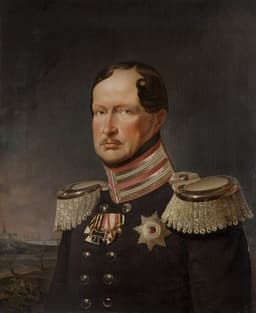
Frederick William III of Prussia
Emperor · Modern
50.4Total

Napoleon Bonaparte
General · Modern
70.9Total
Basic Information
Born
1770
1769
Died
1840
1821
Era
Modern
Modern
Nationality
Prussia
France
Occupation
Emperor
General
Civilization
Western
Western
Score Comparison
Military (10%)
50.0
94.0
Political (20%)
43.7
72.0
Influence (20%)
50.2
40.0
Legacy (20%)
43.3
80.0
Leadership (15%)
74.0
78.0
Strategy (15%)
43.7
90.0
TOTAL
50.4
70.9
Frederick William III of Prussia — Complete Timeline
1806 AD
Defeat at the Battle of Jena-AuerstedtWar
Frederick William III led Prussia into war against Napoleon. The Prussian army was decisively defeated at the twin battles of Jena and Auerstedt. The defeat was catastrophic, leading to the collapse of the Prussian state, the occupation of Berlin, and the flight of the royal family to East Prussia.
PrussiaNapoleonWarJena-Auerstedt
Impact: globaltragic
1807 AD
Prussian Reform MovementReform◆ Major
In response to the defeat, Frederick William III supported a series of reforms led by Stein, Hardenberg, Scharnhorst, and Gneisenau. These included the abolition of serfdom, municipal self-government, military reorganization, and educational reform. The reforms modernized Prussia and laid the foundation for its recovery.
PrussiaReformSteinHardenbergModernization
Impact: nationalprogressive
Treaty of TilsitPolitical Action
After the defeat at Jena, Frederick William III was forced to sign the Treaty of Tilsit with Napoleon. Prussia lost half of its territory, including all lands west of the Elbe, and was forced to pay huge indemnities and reduce its army to 42,000 men. Prussia became a French satellite state.
PrussiaNapoleonTreatyTerritory
Impact: regionaltragic
1813 AD
Entry into the Sixth CoalitionWar◆ Major
After Napoleon's disastrous Russian campaign, Frederick William III joined the Sixth Coalition against France. The Prussian army played a key role in the War of Liberation, culminating in the Battle of Leipzig. This restored Prussia's status as a major European power and led to territorial gains at the Congress of Vienna.
PrussiaNapoleonic WarsCoalitionLiberation
Impact: globalconstructive
1815 AD
Congress of ViennaPolitical Action◆ Major
Frederick William III was represented at the Congress of Vienna, which redrew the map of Europe after Napoleon's defeat. Prussia gained significant territories, including the Rhineland, Westphalia, and parts of Saxony, becoming a major German power. The Congress also confirmed the Prussian-led German Confederation.
PrussiaCongress of ViennaTerritoryDiplomacy
Impact: globalconstructive
Napoleon Bonaparte — Complete Timeline
1799 AD
Coup of 18 BrumaireOther◆ Major
Napoleon Bonaparte, with support from his brother Lucien and key political figures, overthrew the Directory in a bloodless coup. He established the Consulate with himself as First Consul, effectively becoming the ruler of France. This event ended the French Revolution's most unstable period.
French RevolutionCoupRise to Power
Impact: regional
1804 AD
Promulgation of the Napoleonic CodeOther◆ Major
Napoleon enacted the Civil Code of the French, known as the Napoleonic Code, a comprehensive set of laws that replaced the fragmented feudal legal systems. The code established legal equality, protected property rights, and secularized law. It became the basis for legal systems in many European and world countries.
Legal ReformNapoleonic CodeCivil Law
Impact: globalconstructive
1805 AD
Battle of AusterlitzWar◆ Major
Napoleon's Grande Arm
Napoleonic WarsBattleDecisive Victory
Impact: global
1812 AD
Invasion of RussiaWar◆ Major
Napoleon led the Grande Arm
Napoleonic WarsInvasionDisaster
Impact: globaldestructive
1815 AD
Battle of WaterlooWar◆ Major
Napoleon's French army was defeated by the combined forces of the Duke of Wellington's Anglo-Allied army and Gebhard Leberecht von Bl
Napoleonic WarsBattleFinal Defeat
Impact: globaldestructive
Expert Analysis
frederick-william-iii-of-prussia-vs-napoleon-bonaparte
# The Emperor and the King: Two Fates at the Dawn of Modern Europe
On a cold October morning in 1806, two monarchs faced each other across a battlefield in Thuringia. One was a short, intense Corsican in his mid-thirties, already crowned Emperor of the French, whose armies had swept across Europe like a tidal wave. The other was a tall, melancholic Prussian king, a man who would rather have been tending his gardens than commanding an army. Within hours, the Prussian state would be shattered, its capital occupied, and its king reduced to a fugitive. Yet fifteen years later, when the Corsican lay dying on a remote Atlantic island, the Prussian king still sat on his throne, his kingdom enlarged and respected. How did these two contemporaries—born just one year apart—travel such radically different arcs?
Origins
Napoleon Bonaparte entered the world in 1769 on the Mediterranean island of Corsica, a territory only recently acquired by France. His family belonged to the minor nobility, but they were poor, proud, and resentful of French rule. Young Napoleon spoke Italian before French, and his childhood was soaked in tales of Corsican resistance. He was an outsider, a fact that would both wound and drive him.
Frederick William III of Prussia, born in 1770, could not have been more different. He was the grandson of Frederick the Great, the legendary warrior-king who had elevated Prussia from a sandy backwater into a European power. But the grandson inherited none of the grandfather's fire. Quiet, pious, and deeply conservative, young Frederick William preferred the rhythms of domestic life to the clatter of court and camp. His tutors noted his diligence but also his indecisiveness—a trait that would prove catastrophic.
The French Revolution erupted when Napoleon was twenty and Frederick William nineteen. For Napoleon, it was a ladder. For Frederick William, it was a nightmare.
Rise to Power
Napoleon's ascent was a masterpiece of timing and talent. The Revolution had decimated France's aristocratic officer corps, leaving room for ambitious commoners. By 1793, at age twenty-four, he had driven British forces from Toulon. By 1796, he commanded the Army of Italy and proceeded to shatter Austrian rule in northern Italy with a campaign of such speed and brilliance that it stunned Europe. Each victory fed the next. By 1799, he was First Consul; by 1804, Emperor.
Frederick William's path was quieter and more passive. He inherited the throne in 1797 at age twenty-seven, determined to maintain Prussia's neutrality in the wars consuming Europe. He watched Napoleon's rise with growing unease but hoped that caution and diplomacy would spare his kingdom. When Prussia finally declared war in 1806, it was less a strategic decision than a desperate lurch—goaded by a war party that mocked the king's hesitation. Frederick William rode to war not as a conqueror but as a man being dragged.
Leadership & Governance
Napoleon's leadership was a fusion of genius and tyranny. He reorganized France's legal system with the Napoleonic Code, establishing principles of equality before the law and merit-based advancement that survive to this day. He centralized the state, created a modern bureaucracy, and reformed education. But his greatest talent was war. His campaigns are still studied in military academies: the use of speed, the concentration of force, the exploitation of interior lines. He led from the front, sharing the soldier's mud and danger, which earned him a devotion that no Prussian king could command.
Frederick William, by contrast, was almost pathologically cautious. After the disaster of Jena-Auerstedt in 1806—where Napoleon's forces destroyed the Prussian army in a single day—the king fled to Königsberg and signed the humiliating Treaty of Tilsit in 1807. Prussia lost half its territory and was forced to pay crushing indemnities. Yet this defeat produced something unexpected: reform. Frederick William, to his credit, appointed brilliant ministers—Stein, Hardenberg, Scharnhorst, Gneisenau—who modernized the Prussian state. The army was reorganized, serfdom abolished, and municipal self-government introduced. The king supported these reforms, but he did not initiate them. He was a reluctant modernizer, pushed by events rather than vision.
Triumph & Tragedy
Napoleon's greatest moment came in December 1805 at Austerlitz, where he crushed the combined armies of Russia and Austria in what many consider his masterpiece. "I have fought sixty battles," he later said, "and I have learned nothing that I did not know at Austerlitz." His empire stretched from Spain to Poland, and he placed his brothers on thrones across Europe.
His tragedy was the invasion of Russia in 1812. With 600,000 men, he marched into the vastness, won battles, reached Moscow—and then watched his army disintegrate in the winter retreat. He returned to France with barely 40,000. The disaster emboldened his enemies. In 1813, at Leipzig, the "Battle of Nations," his army was crushed. Exiled to Elba, he escaped and returned for one final, desperate campaign that ended at Waterloo in 1815.
Frederick William's triumph was more modest but more enduring. After Napoleon's Russian disaster, Prussia joined the Sixth Coalition. At the Battle of Leipzig, Prussian troops fought alongside Russians and Austrians to defeat the Emperor. At the Congress of Vienna in 1815, Prussia regained its lost territories and more. The king returned to Berlin not as a conqueror but as a survivor—and in the long game of European politics, survival counted for much.
Character & Destiny
Napoleon's character was his destiny. His boundless ambition, his faith in his own star, his inability to stop—these drove him to unparalleled heights and then over the cliff. "Power is my mistress," he once admitted. He could not share it, could not delegate, could not rest. His fall was baked into his rise.
Frederick William's character was equally defining. His caution, his reluctance, his preference for peace—these saved Prussia when bolder kings might have been destroyed. He was not a great man, but he was a necessary one. He held the kingdom together through its darkest hour, accepted the humiliation of reform, and waited for the tide to turn. His contemporaries often mocked him as weak, but there is a strength in endurance that victories alone cannot measure.
Legacy
Napoleon's legacy is monumental and contradictory. He spread the ideals of the French Revolution—legal equality, secular administration, the end of feudalism—across Europe, even as he enslaved nations and crowned himself emperor. The Napoleonic Code influences legal systems from Louisiana to Lebanon. His military innovations shaped warfare for a century. He is remembered as a genius, a tyrant, and a romantic figure of tragic ambition.
Frederick William's legacy is quieter but no less real. The reforms he permitted created the modern Prussian state that would, under his son and Bismarck, unify Germany. The army Scharnhorst rebuilt became the instrument of German power. The Congress of Vienna system he helped establish kept Europe largely at peace for forty years. He is remembered, if at all, as the dour king who lost to Napoleon but outlasted him.
Conclusion
Standing at the end of their lives, one cannot help but reflect on the strange symmetry. Napoleon died at fifty-one, exiled and defeated, his empire in ruins. Frederick William died at seventy, still king, his kingdom restored. Yet which man shaped the world more? Napoleon's shadow stretches across two centuries; Frederick William's is barely visible. But perhaps the deeper lesson is this: genius burns bright and fast, while endurance builds slowly. Napoleon conquered Europe in a decade; Prussia rebuilt itself in a generation. In the long arithmetic of history, both methods have their place—but only the patient survive to write the final chapter.
Rankings
🥇
Napoleon BonaparteLeader
Mil: 94.0Pol: 72.0Inf: 40.0
70.9
🥈
Frederick William III of Prussia
Mil: 50.0Pol: 43.7Inf: 50.2
50.4
+20.5 behind
How This Comparison Works
Algorithm
Each figure is scored on 6 dimensions (0—100 scale) based on structured historical data: Military (10%), Political (20%), Influence (20%), Legacy (20%), Leadership (15%), Strategy (15%). The weighted total produces the final ranking.
Data Sources
Scores are computed from structured sub-indicators in the database. Scale factors adjust for era (Ancient ×0.85, Modern ×1.0) and civilization size (Eastern ×1.05, Other ×0.80) to account for differences in population and military scale.
Maximum 3 Figures
Comparisons are limited to 2—3 figures to ensure readability and statistical meaningfulness.
Error Margins
±5 points per dimension — Sub-scores are derived from historical records with inherent uncertainty. Two figures within 5 points on a dimension should be considered roughly equivalent in that area.
Total Score Accuracy
±3 points overall — The weighted combination of 6 dimensions produces a total score with approximately ±3 points of uncertainty. Differences of less than 3 points are not statistically significant— the figures are effectively tied.
Known Limitations
- Historical records are incomplete and uneven across civilizations
- Figures from oral-tradition societies may be underrepresented
- Occupation labels can misclassify multi-role figures
- Scores measure capability and impact, not moral character
- Quantitative scoring is a comparison tool, not absolute truth
Capability Radar
Military (10%) — Battles & Warfare
Battles
20
95
Win Rate
15
90
Expansion
10
95
Political (20%) — Governance & Reform
Reform
40
95
Diplomacy
30
80
Economy
35
85
Influence (20%) — Cultural & Global Reach
Cultural
20
85
Global
20
90
Legacy (20%) — Historical Impact
Historical
40
95
Longevity
30
90
Leadership (15%) — Power & Stability
Tenure
60
85
Stability
25
70
Strategy (15%) — Tactics & Innovation
Strategy
15
95
Tactics
10
98
Reform
30
92
Similar Comparisons
Comments & Discussion
The_Prussian_Skeptic6/17/2026
You people romanticize Napoleon like he's some tragic hero, but read the Memoirs of General von Müffling. Frederick William III's "weakness" in 1806 was actually strategic restraint—he knew his army was still using 1750s tactics while Napoleon had revolutionized corps command. However, that caution nearly destroyed Prussia permanently. The King's real failure was refusing to embrace the reforms Scharnhorst begged for before Jena. Nice tomb-tending, Freddy.
战史墨客6/17/2026
少拿普鲁士的复仇叙事糊弄人。拿破仑在弗里德兰战役打到第三次俄普联军溃散时,弗里德里希·威廉三世还在为tlil西特条约丢掉的易北河以西土地掉眼泪呢。普鲁士的所谓"1813年复兴"本质是沙皇的恩赐而非国王的觉醒——他本想继续跪着,是被俄国人硬扯上反法战车的。一个连立宪都不肯的君主,装什么民族英雄?