Loading...
Frederick William III of Prussia vs John III Sobieski
John III Sobieski leads by 16.8 pts · 2 figures compared
…
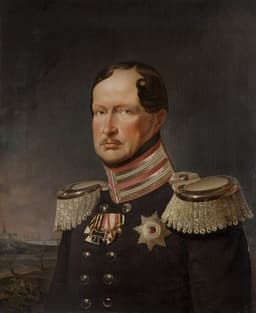
Frederick William III of Prussia
Emperor · Modern
50.4Total

John III Sobieski
Emperor · Modern
67.2Total
Basic Information
Born
1770
1629
Died
1840
1696
Era
Modern
Modern
Nationality
Prussia
Poland
Occupation
Emperor
Emperor
Civilization
Western
Western
Score Comparison
Military (10%)
50.0
60.0
Political (20%)
43.7
67.2
Influence (20%)
50.2
68.0
Legacy (20%)
43.3
69.3
Leadership (15%)
74.0
66.0
Strategy (15%)
43.7
68.5
TOTAL
50.4
67.2
Frederick William III of Prussia — Complete Timeline
1806 AD
Defeat at the Battle of Jena-AuerstedtWar
Frederick William III led Prussia into war against Napoleon. The Prussian army was decisively defeated at the twin battles of Jena and Auerstedt. The defeat was catastrophic, leading to the collapse of the Prussian state, the occupation of Berlin, and the flight of the royal family to East Prussia.
PrussiaNapoleonWarJena-Auerstedt
Impact: globaltragic
1807 AD
Prussian Reform MovementReform◆ Major
In response to the defeat, Frederick William III supported a series of reforms led by Stein, Hardenberg, Scharnhorst, and Gneisenau. These included the abolition of serfdom, municipal self-government, military reorganization, and educational reform. The reforms modernized Prussia and laid the foundation for its recovery.
PrussiaReformSteinHardenbergModernization
Impact: nationalprogressive
Treaty of TilsitPolitical Action
After the defeat at Jena, Frederick William III was forced to sign the Treaty of Tilsit with Napoleon. Prussia lost half of its territory, including all lands west of the Elbe, and was forced to pay huge indemnities and reduce its army to 42,000 men. Prussia became a French satellite state.
PrussiaNapoleonTreatyTerritory
Impact: regionaltragic
1813 AD
Entry into the Sixth CoalitionWar◆ Major
After Napoleon's disastrous Russian campaign, Frederick William III joined the Sixth Coalition against France. The Prussian army played a key role in the War of Liberation, culminating in the Battle of Leipzig. This restored Prussia's status as a major European power and led to territorial gains at the Congress of Vienna.
PrussiaNapoleonic WarsCoalitionLiberation
Impact: globalconstructive
1815 AD
Congress of ViennaPolitical Action◆ Major
Frederick William III was represented at the Congress of Vienna, which redrew the map of Europe after Napoleon's defeat. Prussia gained significant territories, including the Rhineland, Westphalia, and parts of Saxony, becoming a major German power. The Congress also confirmed the Prussian-led German Confederation.
PrussiaCongress of ViennaTerritoryDiplomacy
Impact: globalconstructive
John III Sobieski — Complete Timeline
1673 AD
Battle of Khotyn (1673)War◆ Major
As a hetman, John Sobieski led Polish-Lithuanian forces to a decisive victory over the Ottoman Empire at the Battle of Khotyn. This victory, before his kingship, established his reputation as a military commander and contributed to his election as king the following year.
BattleOttoman WarsMilitary Career
Impact: regional
1674 AD
Elected King of PolandPolitical Action◆ Major
John Sobieski was elected King of Poland and Grand Duke of Lithuania by the nobility. His election came after the abdication of Michael Korybut Wi
ElectionMonarchyPoland
Impact: nationalconstructive
1683 AD
Battle of ViennaWar
John III Sobieski led the Polish-Lithuanian army and the Holy League to a decisive victory over the Ottoman Empire at the Battle of Vienna. He personally commanded the largest cavalry charge in history, breaking the Ottoman siege and halting their expansion into Europe.
BattleOttoman WarsHoly League
Impact: globalconstructive
Expert Analysis
Origins
Frederick William III of Prussia (born 3 August 1770) was the son of King Frederick William II and Frederika Louisa of Hesse-Darmstadt. He received a military education and was deeply influenced by the Enlightenment ideals of his tutor, but his character was cautious and indecisive. He ascended the throne in 1797 after the death of his father.
John III Sobieski (born 17 August 1629) was the son of Jakub Sobieski, a Polish nobleman and castellan, and Zofia Teofillia Daniłowicz. He was educated in Kraków and later traveled across Europe, studying military tactics. He served as a commander in the Polish-Lithuanian Commonwealth's wars against Cossacks and Tatars, gaining experience that would define his career.
Rise to Power
Frederick William III inherited a Prussia weakened by the partitions of Poland and the financial strain of his father's reign. He initially attempted to maintain neutrality in the Napoleonic Wars but was pressured into joining the Fourth Coalition in 1806. The disastrous defeat at the Battle of Jena-Auerstedt (14 October 1806) shattered the Prussian army and forced the royal family to flee to Königsberg. His rise was marked not by conquest but by survival and eventual reform.
John III Sobieski rose through military prowess. As a hetman, he defeated the Ottomans at the Battle of Khotyn in 1673, a victory that made him a national hero. Following the abdication of King Michael Korybut Wiśniowiecki, Sobieski was elected King of Poland on 19 May 1674. His coronation marked the beginning of a reign focused on defending the Commonwealth from Ottoman expansion.
Leadership & Governance
Frederick William III's leadership style was cautious and indecisive, scoring 74.0 in leadership but only 43.7 in strategy. He relied heavily on his ministers, such as Stein and Hardenberg, to implement reforms after the Treaty of Tilsit (9 July 1807). These reforms included the abolition of serfdom (1807), municipal self-government, and military reorganization by Scharnhorst and Gneisenau. However, the king often resisted radical change, and the reforms were implemented slowly.
John III Sobieski, by contrast, scored 66.0 in leadership and 68.5 in strategy. He was a hands-on commander who personally led troops at Vienna. His governance focused on strengthening the monarchy and securing allies. He negotiated the Holy League with Emperor Leopold I and Pope Innocent XI, forming a coalition that would break Ottoman power. However, his domestic policies were hampered by the Polish-Lithuanian Commonwealth's weak central government and the liberum veto, which limited his ability to enact lasting reforms.
Triumph & Tragedy
Frederick William III's greatest triumph was his role in the eventual defeat of Napoleon. After joining the Sixth Coalition in 1813, Prussian forces fought at Leipzig (16-19 October 1813) and Waterloo (18 June 1815). At the Congress of Vienna (1815), Prussia gained the Rhineland, Westphalia, and parts of Saxony, restoring its great-power status. His tragedy was the humiliation of Jena and Tilsit, where Prussia lost half its territory and was forced to pay massive indemnities. He also failed to unify Germany, leaving that task to his successors.
John III Sobieski's triumph was the Battle of Vienna on 12 September 1683. Leading a combined force of 81,000 men, he decisively defeated the Ottoman army of 150,000, breaking the siege and saving Habsburg Austria. His personal charge at the head of the Polish cavalry became legendary. The Treaty of Karlowitz (1699), signed after his death, ceded large territories to the Habsburgs and Poland, ending Ottoman expansion into Europe. His tragedy was the failure to capitalize on the victory: the Commonwealth did not regain its former strength, and internal divisions continued to weaken the state. He died on 17 June 1696, with his reforms incomplete.
Character & Destiny
Frederick William III was known for his piety, frugality, and caution. He disliked war and preferred diplomacy, but his indecisiveness often led to missed opportunities. His character shaped his fate: he was a reluctant reformer who only acted under duress. Historians rate his military score at 50.0 and political at 43.7, reflecting his reactive style.
John III Sobieski was charismatic, bold, and strategically astute. His decisiveness on the battlefield earned him a military score of 60.0 and political score of 67.2. However, his ambition sometimes led to conflicts with the nobility, and his inability to secure a strong succession (his sons were ineffective) left the Commonwealth vulnerable. His character was suited to crisis but not to long-term governance.
Legacy
Frederick William III's legacy is mixed. He is remembered for the Prussian reforms that modernized the state and laid the groundwork for German unification under his son, William I. However, his own reign was marked by defeat and subservience. His legacy score of 43.3 reflects his overshadowed role.
John III Sobieski's legacy is that of a savior of Christendom. The victory at Vienna is celebrated as a turning point in European history. He is a national hero in Poland, with numerous monuments and place names. His influence score of 68.0 and legacy of 69.3 underscore his enduring fame. The Treaty of Karlowitz reshaped the Balkans, and his coalition-building set a precedent for collective security.
Conclusion
While Frederick William III's reforms were crucial for Prussia's future, his personal impact was limited by his caution and the scale of his defeats. John III Sobieski, with a total score of 67.2 against 50.4, had a greater immediate and lasting impact. His victory at Vienna changed the course of European history, halting Ottoman expansion and inspiring future coalitions. Sobieski's military and strategic achievements, combined with his decisive leadership, outweigh Frederick William III's administrative reforms. Therefore, John III Sobieski had the greater impact.
Rankings
🥇
John III SobieskiLeader
Mil: 60.0Pol: 67.2Inf: 68.0
67.2
🥈
Frederick William III of Prussia
Mil: 50.0Pol: 43.7Inf: 50.2
50.4
+16.8 behind
How This Comparison Works
Algorithm
Each figure is scored on 6 dimensions (0—100 scale) based on structured historical data: Military (10%), Political (20%), Influence (20%), Legacy (20%), Leadership (15%), Strategy (15%). The weighted total produces the final ranking.
Data Sources
Scores are computed from structured sub-indicators in the database. Scale factors adjust for era (Ancient ×0.85, Modern ×1.0) and civilization size (Eastern ×1.05, Other ×0.80) to account for differences in population and military scale.
Maximum 3 Figures
Comparisons are limited to 2—3 figures to ensure readability and statistical meaningfulness.
Error Margins
±5 points per dimension — Sub-scores are derived from historical records with inherent uncertainty. Two figures within 5 points on a dimension should be considered roughly equivalent in that area.
Total Score Accuracy
±3 points overall — The weighted combination of 6 dimensions produces a total score with approximately ±3 points of uncertainty. Differences of less than 3 points are not statistically significant— the figures are effectively tied.
Known Limitations
- Historical records are incomplete and uneven across civilizations
- Figures from oral-tradition societies may be underrepresented
- Occupation labels can misclassify multi-role figures
- Scores measure capability and impact, not moral character
- Quantitative scoring is a comparison tool, not absolute truth
Capability Radar
Military (10%) — Battles & Warfare
Battles
20
75
Win Rate
15
80
Expansion
10
55
Political (20%) — Governance & Reform
Reform
40
50
Diplomacy
30
72
Economy
35
55
Influence (20%) — Cultural & Global Reach
Cultural
20
65
Global
20
68
Legacy (20%) — Historical Impact
Historical
40
78
Longevity
30
70
Leadership (15%) — Power & Stability
Tenure
60
70
Stability
25
45
Strategy (15%) — Tactics & Innovation
Strategy
15
82
Tactics
10
85
Reform
30
60
Similar Comparisons
Comments & Discussion
No comments yet. Be the first to share your thoughts!