Loading...
Dia Kossoi vs Otto III
Otto III leads by 3.1 pts · 2 figures compared
…

Dia Kossoi
Emperor · Medieval
40.2Total
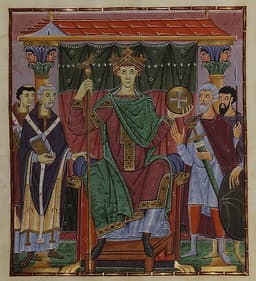
Otto III
Emperor · Medieval
43.3Total
Basic Information
Born
1380
980
Died
1410
1002
Era
Medieval
Medieval
Nationality
Songhai Empire
Holy Roman Empire
Occupation
Emperor
Emperor
Civilization
Other
Western
Score Comparison
Military (10%)
21.2
50.0
Political (20%)
32.2
35.1
Influence (20%)
51.8
54.9
Legacy (20%)
41.7
44.2
Leadership (15%)
41.5
31.2
Strategy (15%)
36.8
35.7
TOTAL
40.2
43.3
Dia Kossoi — Complete Timeline
1400 AD
Conversion to IslamCultural◆ Major
Dia Kossoi became the first Songhai king to convert to Islam. This conversion facilitated diplomatic and trade relations with Muslim North African states and influenced the religious and cultural development of the Songhai Empire.
Songhai EmpireIslamConversionReligion
Impact: regionalconstructive
Otto III — Complete Timeline
996 AD
Coronation as Holy Roman EmperorPolitical Action◆ Major
Otto III was crowned Holy Roman Emperor by Pope Gregory V in Rome. He was 16 years old at the time. His coronation symbolized the close relationship between the empire and the papacy. Otto aimed to restore the glory of the ancient Roman Empire.
CoronationHoly Roman EmpirePapacy
Impact: regionalconstructive
998 AD
Establishment of the 'Renovatio Imperii Romanorum'Political Action◆ Major
Otto III pursued the 'Renovatio Imperii Romanorum' (Renewal of the Roman Empire), aiming to revive Roman imperial traditions. He moved his court to Rome and adopted Roman titles and ceremonies. This policy alienated German nobles and led to conflicts.
RenovatioRoman EmpireImperial Policy
Impact: regionalconstructive
999 AD
Appointment of Pope Sylvester IIPolitical Action◆ Major
Otto III appointed his former tutor Gerbert of Aurillac as Pope Sylvester II. This appointment strengthened the alliance between the empire and the papacy. Sylvester II was a renowned scholar and supported Otto's imperial ambitions.
PapacyAppointmentScholarship
Impact: regionalconstructive
1001 AD
Revolt of the Roman NobilityPolitical Action◆ Major
Otto III faced a revolt by the Roman nobility, led by the Crescentii family. The revolt forced Otto to flee Rome and seek refuge in Pavia. This event demonstrated the fragility of his power in Italy and undermined his 'Renovatio' plans.
RevoltRomeCrisis
Impact: regionaldestructive
1002 AD
Death at Age 21Other◆ Major
Otto III died suddenly at the age of 21 in Paterno, Italy. His death was likely due to malaria. He left no heir, leading to a succession crisis. His dream of restoring the Roman Empire ended with his premature death.
DeathSuccession CrisisEnd of Reign
Impact: regionaltragic
Expert Analysis
Origins
Dia Kossoi, also known as Kossoi, was a 11th-century ruler of the Songhai Empire in West Africa. His exact birth year is unknown, but he reigned around the early 1000s. He was the first Songhai king to convert to Islam, a decision that would reshape the empire's trajectory. Little is recorded of his early life, but he likely inherited the throne from his father, Dia Bisi Baro, and ruled from the capital of Gao. The Songhai Empire at the time was a relatively small kingdom centered on the Niger River, engaged in trans-Saharan trade.
Otto III was born in 980 in the Holy Roman Empire, son of Emperor Otto II and Byzantine princess Theophanu. After his father's death in 983, Otto III became king at age three, with his mother and later grandmother regents. Educated by the scholar Gerbert of Aurillac, Otto III absorbed classical Roman and Christian ideals. His upbringing was cosmopolitan, influenced by Byzantine and Roman traditions, and he grew up with a vision of restoring the Roman Empire.
Rise to Power
Dia Kossoi's rise was through hereditary succession as a Songhai king. His conversion to Islam around 1009-1010 was a pivotal move, likely to strengthen ties with Muslim traders and states like the Almoravids. This act opened Songhai to Islamic culture and facilitated alliances, but it also alienated some traditionalist subjects. His reign saw the consolidation of Songhai's control over Gao and the Niger River trade routes.
Otto III's rise was more dramatic. Crowned king at age three, he assumed personal rule at 16 when Pope Gregory V crowned him Holy Roman Emperor in 996. He quickly pursued his 'Renovatio Imperii Romanorum' (Renewal of the Roman Empire), moving his court to Rome. He appointed his former tutor Gerbert as Pope Sylvester II in 999, symbolizing the union of imperial and papal authority. His vision was a Christian Roman Empire centered in Rome, with himself as emperor-pope.
Leadership & Governance
Dia Kossoi's leadership was marked by religious and diplomatic transformation. As the first Muslim Songhai ruler, he introduced Islamic practices to the court and sponsored the construction of mosques. His governance style was pragmatic: embracing Islam to boost trade and legitimacy, while maintaining traditional structures. His political score of 32.2 reflects limited expansion of state power, but his influence score of 51.8 shows his conversion's long-term impact.
Otto III's leadership was visionary but impractical. He attempted to revive Roman imperial institutions, issuing charters in classical style and using titles like 'Servant of Jesus Christ'. He spent much of his reign in Italy, neglecting German affairs. His appointment of Sylvester II was a high point, but his reliance on a small circle of advisors alienated German nobles. His leadership score of 31.2 reflects his inability to consolidate power, and his strategy score of 35.7 shows flawed execution. The revolt of Roman nobility in 1001 forced him to flee Rome, revealing his weak grasp of realpolitik.
Triumph & Tragedy
Dia Kossoi's greatest triumph was his conversion to Islam, which set Songhai on a path to becoming a major Islamic empire. This move facilitated trade, scholarship, and later the rise of Sonni Ali and Askia Muhammad. His tragedy is the lack of detailed records—his reign is known only from oral traditions and external accounts. He scored 41.7 in legacy, reflecting his foundational role but limited personal achievements.
Otto III's triumph was his coronation and the appointment of Sylvester II, which briefly realized his vision of imperial-papal unity. He also sponsored learning and the arts, contributing to the Ottonian Renaissance. His tragedy was his early death at 21, likely from malaria, which ended his dream and led to a succession crisis. His military score of 50.0 is average, but his influence score of 54.9 is high due to his symbolic impact. However, his legacy score of 44.2 is tempered by the failure of his renovatio.
Character & Destiny
Dia Kossoi appears as a cautious pragmatist, using religion as a tool for statecraft. His conversion was a strategic decision, not a personal crusade. His character is shadowy, but his actions suggest adaptability and foresight. His destiny was to be a transitional figure, whose choice echoed for centuries.
Otto III was an idealist, driven by a romantic vision of Rome. He was educated, devout, and stubborn, ignoring political realities. His character type—a visionary youth—led to his downfall: he lacked the ruthlessness to suppress opposition and the patience to build alliances. His destiny was a tragic arc: brilliant promise cut short, his reforms undone by his death.
Legacy
Dia Kossoi's legacy is immense for West Africa. His conversion made Islam a permanent part of Songhai identity, influencing law, education, and trade. The Songhai Empire later became one of the largest in African history, with Timbuktu as a scholarly center. His total score of 40.2 understates his historical role as a catalyst.
Otto III's legacy is mixed. He inspired later emperors like Frederick II, but his renovatio failed. The Holy Roman Empire remained a loose confederation. His patronage of learning contributed to the medieval Renaissance, but his political impact was minimal. His total score of 43.3 is slightly higher, but his actual historical footprint is narrower than Dia Kossoi's.
Conclusion
While Otto III scores higher in overall metrics (43.3 vs 40.2), Dia Kossoi had greater long-term impact. Otto III's dream died with him, while Dia Kossoi's conversion set Songhai on a path to become a major empire. In terms of lasting change, Dia Kossoi's influence on religion, trade, and culture in West Africa outweighs Otto III's fleeting imperial revival. Therefore, Dia Kossoi is the more consequential figure, despite his lower total score.
Rankings
🥇
Otto IIILeader
Mil: 50.0Pol: 35.1Inf: 54.9
43.3
🥈
Dia Kossoi
Mil: 21.2Pol: 32.2Inf: 51.8
40.2
+3.1 behind
How This Comparison Works
Algorithm
Each figure is scored on 6 dimensions (0—100 scale) based on structured historical data: Military (10%), Political (20%), Influence (20%), Legacy (20%), Leadership (15%), Strategy (15%). The weighted total produces the final ranking.
Data Sources
Scores are computed from structured sub-indicators in the database. Scale factors adjust for era (Ancient ×0.85, Modern ×1.0) and civilization size (Eastern ×1.05, Other ×0.80) to account for differences in population and military scale.
Maximum 3 Figures
Comparisons are limited to 2—3 figures to ensure readability and statistical meaningfulness.
Error Margins
±5 points per dimension — Sub-scores are derived from historical records with inherent uncertainty. Two figures within 5 points on a dimension should be considered roughly equivalent in that area.
Total Score Accuracy
±3 points overall — The weighted combination of 6 dimensions produces a total score with approximately ±3 points of uncertainty. Differences of less than 3 points are not statistically significant— the figures are effectively tied.
Known Limitations
- Historical records are incomplete and uneven across civilizations
- Figures from oral-tradition societies may be underrepresented
- Occupation labels can misclassify multi-role figures
- Scores measure capability and impact, not moral character
- Quantitative scoring is a comparison tool, not absolute truth
Capability Radar
Military (10%) — Battles & Warfare
Battles
10
15
Win Rate
10
20
Expansion
10
10
Political (20%) — Governance & Reform
Reform
30
30
Diplomacy
30
40
Economy
20
20
Influence (20%) — Cultural & Global Reach
Cultural
30
30
Global
10
20
Legacy (20%) — Historical Impact
Historical
30
35
Longevity
20
20
Leadership (15%) — Power & Stability
Tenure
30
20
Stability
20
15
Strategy (15%) — Tactics & Innovation
Strategy
10
20
Tactics
10
15
Reform
10
10
Similar Comparisons
Comments & Discussion
No comments yet. Be the first to share your thoughts!