Loading...
Diodotus I vs Julius Caesar
Julius Caesar leads by 34.2 pts · 2 figures compared
…
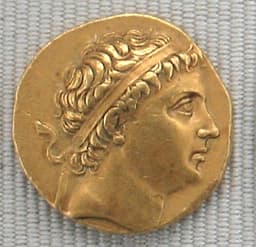
Diodotus I
Emperor · Ancient
48.6Total

Julius Caesar
General · Ancient
82.8Total
Basic Information
Born
-285
-100
Died
-239
-44
Era
Ancient
Ancient
Nationality
Greco-Bactrian Kingdom
Roman Republic
Occupation
Emperor
General
Civilization
Eastern
Western
Score Comparison
Military (10%)
30.0
88.0
Political (20%)
48.0
78.0
Influence (20%)
50.2
85.0
Legacy (20%)
44.2
82.0
Leadership (15%)
64.0
80.0
Strategy (15%)
51.7
85.0
TOTAL
48.6
82.8
Diodotus I — Complete Timeline
256 BC
Revolt Against the Seleucid EmpirePolitical Action
Diodotus I, the Seleucid satrap of Bactria, declared independence from the Seleucid Empire. This revolt established the Greco-Bactrian Kingdom, a Hellenistic state in Central Asia.
IndependenceSeleucid EmpireGreco-Bactrian Kingdom
Impact: regionalconstructive
Foundation of the Greco-Bactrian KingdomPolitical Action◆ Major
Diodotus I established himself as the first king of the Greco-Bactrian Kingdom. He consolidated control over Bactria and Sogdiana, creating a powerful Hellenistic state.
FoundationHellenistic StateCentral Asia
Impact: regionalconstructive
250 BC
Defense Against Seleucid ReconquestWar◆ Major
Diodotus I successfully defended his new kingdom against attempts by the Seleucid king Antiochus II to reconquer Bactria. This secured the independence of the Greco-Bactrian Kingdom.
WarSeleucid EmpireIndependence
Impact: regional
Julius Caesar — Complete Timeline
58 BC
Gallic WarsWar◆ Major
Caesar, as proconsul of Gaul, launched a series of campaigns that conquered all of Gaul (modern France, Belgium, and parts of Switzerland). He fought numerous battles, including against the Helvetii, the Belgae, and the Gallic chieftain Vercingetorix. The wars brought immense wealth and a loyal army to Caesar.
Gallic WarsConquestRoman Expansion
Impact: regional
49 BC
Crossing the RubiconPolitical Action◆ Major
Caesar led Legio XIII across the Rubicon River into Italy, defying the Roman Senate's order to disband his army. This act triggered a civil war against Pompey and the Optimates, ultimately leading to Caesar's dictatorship and the end of the Roman Republic.
Roman Civil WarEnd of RepublicPower Struggle
Impact: global
48 BC
Battle of PharsalusWar◆ Major
Caesar's outnumbered army defeated the larger forces of Pompey the Great at Pharsalus in Greece. Caesar's tactical use of a reserve line to counter Pompey's cavalry charge proved decisive. Pompey fled to Egypt, where he was assassinated, leaving Caesar as the undisputed master of the Roman world.
Roman Civil WarBattleDecisive Victory
Impact: regional
44 BC
Appointment as Dictator for LifePolitical Action◆ Major
The Roman Senate appointed Caesar dictator perpetuo (dictator for life), granting him unprecedented personal power. This move concentrated military, legislative, and judicial authority in one person, effectively ending the Roman Republic's traditional system of checks and balances and alarming many senators.
DictatorshipEnd of RepublicPower Consolidation
Impact: regionaldestructive
Assassination on the Ides of MarchPolitical Action◆ Major
A group of Roman senators, led by Marcus Junius Brutus and Gaius Cassius Longinus, stabbed Caesar to death at a meeting of the Senate in the Theatre of Pompey. The assassination was intended to restore the Republic, but instead triggered another civil war that led to the rise of the Roman Empire.
AssassinationRoman PoliticsEnd of Republic
Impact: globaldestructive
Expert Analysis
diodotus-i-vs-julius-caesar
# The General and the Satrap: Two Paths to Power in the Ancient World
On a winter day in 49 BCE, Julius Caesar stood on the banks of a small river in northern Italy. The Rubicon was little more than a stream, but crossing it meant civil war—an act of treason against the Roman Republic. He paused, then uttered a phrase that would echo through millennia: *"Alea iacta est"*—the die is cast. Nearly two centuries earlier, another man had faced a similar choice, but in a dusty province thousands of miles east. Diodotus I, the Greek satrap of Bactria, looked out over the Hindu Kush mountains and decided to tear his kingdom away from the Seleucid Empire. Unlike Caesar, he would not die by the dagger of his peers. He would vanish into the obscurity of history, remembered only by coins and fragments of text. Why did one man become a legend and the other a footnote? The answer lies not merely in their actions, but in the worlds they inhabited.
Origins
Julius Caesar was born into the patrician Julian clan in 100 BCE, a time when the Roman Republic was already cracking under the weight of its own expansion. His family was ancient but not wealthy, and young Caesar grew up in a Rome where political power was bought, married, and murdered into existence. He learned early that survival meant audacity. By contrast, Diodotus I emerged from the Hellenistic melting pot of the Seleucid Empire around 285 BCE. He was a Greek administrator in a land of Persians, Sogdians, and nomads—a man who governed Bactria, a region so rich in gold and grain that the Greeks called it "the pearl of the East." Where Caesar’s Rome was a cauldron of ambition and violence, Diodotus’s world was one of fragile empires and distant kings. The Seleucid throne in Antioch was months away by foot, and its authority dissolved in the dust of the Silk Road. These different soils grew different men: one a predator of opportunity, the other a caretaker of isolation.
Rise to Power
Caesar’s ascent was a masterclass in political theater. He borrowed fortunes to stage games, bribed consuls, and formed the First Triumvirate with Pompey and Crassus. His military career began late but exploded with the conquest of Gaul from 58 to 50 BCE—a campaign that slaughtered a million people and brought him wealth, loyalty, and an army that worshipped him. When the Senate ordered him to disband, he crossed the Rubicon instead. Diodotus I rose in a quieter fashion. As satrap of Bactria, he watched the Seleucid Empire weaken under dynastic squabbles and the rising threat of the Parthians. In 256 BCE, he simply stopped sending tribute. He declared independence, not with a dramatic river crossing, but with a bureaucratic shrug. The revolt was less a thunderclap than a slow drift. Where Caesar seized power by force of will, Diodotus inherited it by force of geography—the Seleucids were too far away to stop him.
Leadership & Governance
Caesar governed as he conquered: with speed, clarity, and terror. As dictator, he reformed the calendar, granted citizenship to Gauls, and packed the Senate with his supporters. His military genius was tactical—the siege of Alesia and the lightning war at Pharsalus showed a mind that thought three moves ahead. But his political wisdom was flawed. He pardoned his enemies, but never earned their trust. Diodotus I ruled a hybrid kingdom. He minted coins with his own face wearing a Greek diadem, but he also adopted Persian administrative methods. He defended his realm against Antiochus II’s reconquest attempt around 250 BCE, but the details are lost—no dramatic battles survive in the record. His score for military leadership (49.4) reflects a man who was a competent defender, not a conqueror. Where Caesar expanded, Diodotus consolidated. One built an empire; the other built a shelter.
Triumph & Tragedy
Caesar’s greatest triumph was the Gallic Wars, which gave him a legend and an army. His greatest tragedy was his own success: by making himself dictator for life in 44 BCE, he made his assassination inevitable. On the Ides of March, sixty senators stabbed him to death in the Pompey Theatre. He fell at the feet of his enemy’s statue, bleeding out into history. Diodotus I’s triumph was quieter: he founded the Greco-Bactrian Kingdom, which would survive for over a century and become a bridge between East and West, transmitting Greek art to India. His tragedy is that we know almost nothing about him. No dramatic death, no famous last words. He died around 239 BCE, probably in bed, and his son took the throne. One man’s tragedy was a spectacle; the other’s was silence.
Character & Destiny
Caesar was a man of boundless ambition and calculated charm. He could weep at the death of a political ally and order the massacre of a Gallic tribe in the same week. His personality was a weapon—he used his own image, his clemency, his very name as tools of rule. This made him brilliant but brittle: he could not imagine that his generosity might breed contempt. Diodotus I, by contrast, seems to have been a pragmatist. He did not seek glory; he sought survival. His character is invisible to us, but his choices suggest a man who understood limits. He did not march on Antioch. He did not declare himself a god. He simply ruled his corner of the world until it was safe to pass on. Destiny favored Caesar with a stage of marble and blood; it gave Diodotus a stage of sand and silence.
Legacy
Julius Caesar’s legacy is the Roman Empire itself. His name became a title—*Kaiser*, *Tsar*—and his writings taught generals for two thousand years. He is remembered as a genius and a tyrant, a man who destroyed a republic and built a world. Diodotus I’s legacy is more fragile. The Greco-Bactrian Kingdom he founded would later produce the famous King Menander, a patron of Buddhism, and its art would influence the Buddha statues of Gandhara. But Diodotus himself is known only to specialists. His score for influence (72.5) and legacy (63.4) reflect a man whose impact was real but diffuse—a ripple, not a wave.
Conclusion
Standing on the banks of the Rubicon, Caesar knew he was making history. Diodotus I, signing a document in a Bactrian palace, probably did not. And yet both men faced the same question: when the old order weakens, do you tear it down or build something new? Caesar tore down the Republic and built an empire on its ashes. Diodotus tore down Seleucid authority and built a kingdom that would outlast him. One became a god; the other became a ghost. Perhaps the difference is not in what they did, but in what we choose to remember. The die is cast—but whose die, and for whom, is a question that history never stops asking.
Rankings
🥇
Julius CaesarLeader
Mil: 88.0Pol: 78.0Inf: 85.0
82.8
🥈
Diodotus I
Mil: 30.0Pol: 48.0Inf: 50.2
48.6
+34.2 behind
How This Comparison Works
Algorithm
Each figure is scored on 6 dimensions (0—100 scale) based on structured historical data: Military (10%), Political (20%), Influence (20%), Legacy (20%), Leadership (15%), Strategy (15%). The weighted total produces the final ranking.
Data Sources
Scores are computed from structured sub-indicators in the database. Scale factors adjust for era (Ancient ×0.85, Modern ×1.0) and civilization size (Eastern ×1.05, Other ×0.80) to account for differences in population and military scale.
Maximum 3 Figures
Comparisons are limited to 2—3 figures to ensure readability and statistical meaningfulness.
Error Margins
±5 points per dimension — Sub-scores are derived from historical records with inherent uncertainty. Two figures within 5 points on a dimension should be considered roughly equivalent in that area.
Total Score Accuracy
±3 points overall — The weighted combination of 6 dimensions produces a total score with approximately ±3 points of uncertainty. Differences of less than 3 points are not statistically significant— the figures are effectively tied.
Known Limitations
- Historical records are incomplete and uneven across civilizations
- Figures from oral-tradition societies may be underrepresented
- Occupation labels can misclassify multi-role figures
- Scores measure capability and impact, not moral character
- Quantitative scoring is a comparison tool, not absolute truth
Capability Radar
Military (10%) — Battles & Warfare
Battles
30
95
Win Rate
40
92
Expansion
50
97
Political (20%) — Governance & Reform
Reform
35
90
Diplomacy
45
85
Economy
40
82
Influence (20%) — Cultural & Global Reach
Cultural
30
88
Global
30
94
Legacy (20%) — Historical Impact
Historical
40
95
Longevity
35
96
Leadership (15%) — Power & Stability
Tenure
40
75
Stability
35
60
Strategy (15%) — Tactics & Innovation
Strategy
45
94
Tactics
35
96
Reform
30
88
Similar Comparisons
Comments & Discussion
No comments yet. Be the first to share your thoughts!