Loading...
This comparison has not been analyzed yet.
One-time AI generation (~1 minute). Scores and timeline are already available below.
Diodotus I vs Kavad I
Kavad I leads by 7.9 pts · 2 figures compared
…
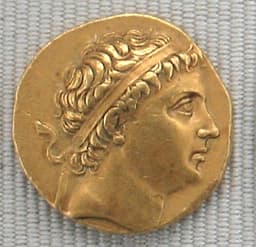
Diodotus I
Emperor · Ancient
48.6Total

Kavad I
Emperor · Ancient
56.5Total
Basic Information
Born
-285
449
Died
-239
531
Era
Ancient
Ancient
Nationality
Greco-Bactrian Kingdom
Sasanian Empire
Occupation
Emperor
Emperor
Civilization
Eastern
Middle Eastern
Score Comparison
Military (10%)
30.0
47.5
Political (20%)
48.0
60.0
Influence (20%)
50.2
56.4
Legacy (20%)
44.2
49.2
Leadership (15%)
64.0
74.0
Strategy (15%)
51.7
52.5
TOTAL
48.6
56.5
Diodotus I — Complete Timeline
256 BC
Revolt Against the Seleucid EmpirePolitical Action
Diodotus I, the Seleucid satrap of Bactria, declared independence from the Seleucid Empire. This revolt established the Greco-Bactrian Kingdom, a Hellenistic state in Central Asia.
IndependenceSeleucid EmpireGreco-Bactrian Kingdom
Impact: regionalconstructive
Foundation of the Greco-Bactrian KingdomPolitical Action◆ Major
Diodotus I established himself as the first king of the Greco-Bactrian Kingdom. He consolidated control over Bactria and Sogdiana, creating a powerful Hellenistic state.
FoundationHellenistic StateCentral Asia
Impact: regionalconstructive
250 BC
Defense Against Seleucid ReconquestWar◆ Major
Diodotus I successfully defended his new kingdom against attempts by the Seleucid king Antiochus II to reconquer Bactria. This secured the independence of the Greco-Bactrian Kingdom.
WarSeleucid EmpireIndependence
Impact: regional
Kavad I — Complete Timeline
488 AD
Support for the Mazdakite movementPolitical Action◆ Major
Kavad I embraced the Mazdakite movement, a religious and social reformist sect that advocated for communal property and egalitarianism. This support alienated the Zoroastrian clergy and nobility, leading to political instability.
MazdakismReligious ReformSocial Movement
Impact: nationalprogressive
496 AD
Deposition and imprisonment by the nobilityPolitical Action◆ Major
The Sasanian nobility and Zoroastrian clergy, opposed to Kavad's Mazdakite policies, deposed him and imprisoned him in the 'Castle of Oblivion'. His brother Jamasp was placed on the throne as a puppet ruler.
CoupImprisonmentNobility
Impact: nationaldestructive
498 AD
Escape and restoration to the throne with Hephthalite aidPolitical Action◆ Major
Kavad escaped from prison with the help of his supporters and fled to the Hephthalite Huns. With their military backing, he returned to Persia, defeated Jamasp, and was restored as king, now indebted to the Hephthalites.
EscapeRestorationHephthalites
Impact: national
500 AD
Implementation of tax and administrative reformsReform◆ Major
After his restoration, Kavad I implemented significant tax and administrative reforms to strengthen the central government. He introduced a fixed land tax and reorganized the bureaucracy, reducing the power of the nobility.
Tax ReformAdministrationCentralization
Impact: nationalconstructive
This comparison has not been analyzed yet.
One-time AI generation (~1 minute). Scores and timeline are already available below.
Rankings
🥇
Kavad ILeader
Mil: 47.5Pol: 60.0Inf: 56.4
56.5
🥈
Diodotus I
Mil: 30.0Pol: 48.0Inf: 50.2
48.6
+7.9 behind
How This Comparison Works
Algorithm
Each figure is scored on 6 dimensions (0—100 scale) based on structured historical data: Military (10%), Political (20%), Influence (20%), Legacy (20%), Leadership (15%), Strategy (15%). The weighted total produces the final ranking.
Data Sources
Scores are computed from structured sub-indicators in the database. Scale factors adjust for era (Ancient ×0.85, Modern ×1.0) and civilization size (Eastern ×1.05, Other ×0.80) to account for differences in population and military scale.
Maximum 3 Figures
Comparisons are limited to 2—3 figures to ensure readability and statistical meaningfulness.
Error Margins
±5 points per dimension — Sub-scores are derived from historical records with inherent uncertainty. Two figures within 5 points on a dimension should be considered roughly equivalent in that area.
Total Score Accuracy
±3 points overall — The weighted combination of 6 dimensions produces a total score with approximately ±3 points of uncertainty. Differences of less than 3 points are not statistically significant— the figures are effectively tied.
Known Limitations
- Historical records are incomplete and uneven across civilizations
- Figures from oral-tradition societies may be underrepresented
- Occupation labels can misclassify multi-role figures
- Scores measure capability and impact, not moral character
- Quantitative scoring is a comparison tool, not absolute truth
Capability Radar
Military (10%) — Battles & Warfare
Battles
30
55
Win Rate
40
50
Expansion
50
40
Political (20%) — Governance & Reform
Reform
35
85
Diplomacy
45
60
Economy
40
65
Influence (20%) — Cultural & Global Reach
Cultural
30
55
Global
30
45
Legacy (20%) — Historical Impact
Historical
40
65
Longevity
35
50
Leadership (15%) — Power & Stability
Tenure
40
70
Stability
35
40
Strategy (15%) — Tactics & Innovation
Strategy
45
50
Tactics
35
45
Reform
30
60
Similar Comparisons
Comments & Discussion
No comments yet. Be the first to share your thoughts!