Loading...
Diodotus I vs Napoleon Bonaparte
Napoleon Bonaparte leads by 22.3 pts · 2 figures compared
…
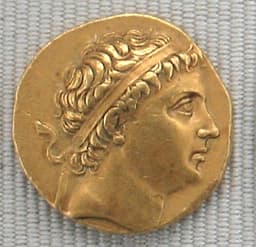
Diodotus I
Emperor · Ancient
48.6Total

Napoleon Bonaparte
General · Modern
70.9Total
Basic Information
Born
-285
1769
Died
-239
1821
Era
Ancient
Modern
Nationality
Greco-Bactrian Kingdom
France
Occupation
Emperor
General
Civilization
Eastern
Western
Score Comparison
Military (10%)
30.0
94.0
Political (20%)
48.0
72.0
Influence (20%)
50.2
40.0
Legacy (20%)
44.2
80.0
Leadership (15%)
64.0
78.0
Strategy (15%)
51.7
90.0
TOTAL
48.6
70.9
Diodotus I — Complete Timeline
256 BC
Revolt Against the Seleucid EmpirePolitical Action
Diodotus I, the Seleucid satrap of Bactria, declared independence from the Seleucid Empire. This revolt established the Greco-Bactrian Kingdom, a Hellenistic state in Central Asia.
IndependenceSeleucid EmpireGreco-Bactrian Kingdom
Impact: regionalconstructive
Foundation of the Greco-Bactrian KingdomPolitical Action◆ Major
Diodotus I established himself as the first king of the Greco-Bactrian Kingdom. He consolidated control over Bactria and Sogdiana, creating a powerful Hellenistic state.
FoundationHellenistic StateCentral Asia
Impact: regionalconstructive
250 BC
Defense Against Seleucid ReconquestWar◆ Major
Diodotus I successfully defended his new kingdom against attempts by the Seleucid king Antiochus II to reconquer Bactria. This secured the independence of the Greco-Bactrian Kingdom.
WarSeleucid EmpireIndependence
Impact: regional
Napoleon Bonaparte — Complete Timeline
1799 AD
Coup of 18 BrumaireOther◆ Major
Napoleon Bonaparte, with support from his brother Lucien and key political figures, overthrew the Directory in a bloodless coup. He established the Consulate with himself as First Consul, effectively becoming the ruler of France. This event ended the French Revolution's most unstable period.
French RevolutionCoupRise to Power
Impact: regional
1804 AD
Promulgation of the Napoleonic CodeOther◆ Major
Napoleon enacted the Civil Code of the French, known as the Napoleonic Code, a comprehensive set of laws that replaced the fragmented feudal legal systems. The code established legal equality, protected property rights, and secularized law. It became the basis for legal systems in many European and world countries.
Legal ReformNapoleonic CodeCivil Law
Impact: globalconstructive
1805 AD
Battle of AusterlitzWar◆ Major
Napoleon's Grande Arm
Napoleonic WarsBattleDecisive Victory
Impact: global
1812 AD
Invasion of RussiaWar◆ Major
Napoleon led the Grande Arm
Napoleonic WarsInvasionDisaster
Impact: globaldestructive
1815 AD
Battle of WaterlooWar◆ Major
Napoleon's French army was defeated by the combined forces of the Duke of Wellington's Anglo-Allied army and Gebhard Leberecht von Bl
Napoleonic WarsBattleFinal Defeat
Impact: globaldestructive
Expert Analysis
diodotus-i-vs-napoleon-bonaparte
The Conqueror and the Secessionist
In the winter of 1812, Napoleon Bonaparte watched his Grand Army burn Moscow, only to watch it freeze on the retreat from Russia. In the spring of 256 BCE, Diodotus I, a provincial governor in distant Bactria, quietly declared himself king and never looked back. One man set out to conquer the world and lost everything; the other carved out a kingdom and let history forget his name. Why did Napoleon’s ambition end in exile on Saint Helena, while Diodotus’s rebellion founded a dynasty that outlasted its overlords? The answer lies not in their talents—both were formidable—but in the worlds they inhabited and the limits they understood.
Origins
Napoleon Bonaparte was born in 1769 on Corsica, an island newly French, into a minor noble family. His education at French military academies drilled him in the Enlightenment’s rationalism and the ancien régime’s rigid hierarchies. The French Revolution, erupting when he was twenty, shattered those hierarchies and opened a path for talent over birth. He was a child of chaos, trained to exploit it.
Diodotus I, born around 285 BCE, emerged from a different crucible. He was a Greek, likely from Ionia or mainland Greece, who served as satrap—governor—of Bactria under the Seleucid Empire, the sprawling Hellenistic state that succeeded Alexander the Great’s conquests. Bactria, modern Afghanistan and Tajikistan, was a frontier: a land of Greek colonies, Persian nobles, and Central Asian steppe nomads. Diodotus grew up in a world where empire was a given, but loyalty was negotiable. His era was one of consolidation, not revolution; his ambition had to be patient.
Rise to Power
Napoleon’s ascent was meteoric. In 1793, at twenty-four, he drove the British from Toulon, winning promotion to brigadier general. By 1796, he commanded the Italian campaign, crushing Austrian armies with speed and audacity. His 1798 Egyptian expedition was a gamble—he lost his fleet at Aboukir Bay but cemented his legend. In 1799, he returned to a France in crisis, overthrew the Directory in the Coup of 18 Brumaire, and installed himself as First Consul. He was thirty. His path was one of military genius harnessed to political revolution.
Diodotus’s rise was slower, more deliberate. As satrap of Bactria, he governed a wealthy province at the edge of the Seleucid realm. The empire was weakening under internal strife—the Third Syrian War (246-241 BCE) drained its resources. In 256 BCE, Diodotus made his move: he declared Bactria independent, minting coins with his own image and the title *Basileus*—king. There was no dramatic coup, no battlefield triumph. He simply stopped obeying, and the Seleucids, distracted by wars in the west, could not stop him. His turning point was not a battle but a decision.
Leadership & Governance
Napoleon ruled as a military dictator with a reformer’s zeal. He centralized the French state, created the Bank of France, and established the Napoleonic Code—a legal framework that enshrined equality before the law, property rights, and secular administration. His military genius was unmatched: he won sixty battles, from Austerlitz in 1805 to Wagram in 1809, using speed, deception, and massed artillery. But he governed as a conqueror, imposing his will on defeated nations, appointing his brothers as puppet kings, and bleeding Europe for soldiers and treasure. His political wisdom was tactical, not strategic; he could win a war but not a peace.
Diodotus I ruled as a pragmatist. He did not seek to conquer the Seleucid heartland but to secure a viable kingdom. He defended Bactria against Antiochus II’s attempted reconquest around 250 BCE, likely through a combination of diplomacy and local alliances. He adopted Persian administrative practices, minted coins that blended Greek and local motifs, and tolerated Buddhism and Zoroastrianism alongside Greek cults. His military score of 49.4 reflects no great campaigns, but his political score of 54.7 and leadership of 74.6 suggest a governor who understood that survival required compromise, not conquest.
Triumph & Tragedy
Napoleon’s greatest moment was Austerlitz, where he crushed the combined armies of Austria and Russia, ending the Holy Roman Empire. His greatest failure was the 1812 invasion of Russia: he lost over 400,000 men to winter, disease, and guerrilla attacks, and never recovered. His final tragedy came at Waterloo in 1815, where a combination of Prussian reinforcements and his own tactical errors ended his hundred-day return from exile. He died in 1821 on Saint Helena, a prisoner of the British.
Diodotus’s triumph was subtler: founding a kingdom that lasted nearly two centuries, producing rulers like Demetrius I and Menander I, who expanded into India. His tragedy is that we know almost nothing about him. No epic poems, no memoirs, no monuments survive. His coins are his only voice. He died around 239 BCE, probably in peace, succeeded by his son Diodotus II. His failure was not defeat but obscurity.
Character & Destiny
Napoleon was driven by an insatiable hunger for glory. “I live only for posterity,” he once said, and he acted as if history’s judgment was the only one that mattered. This hubris led him to overreach: he could not stop at the Rhine or the Alps, but pushed to Moscow and Madrid. His personality—brilliant, restless, paranoid—shaped his decisions, and ultimately, his downfall.
Diodotus was a survivor. He saw an opportunity and took it, but he knew his limits. He did not try to march on Antioch or Alexandria. He built a kingdom that could endure, not one that would awe. His personality—cautious, adaptive, realistic—shaped a different destiny: a quiet legacy that lasted, while Napoleon’s empire crumbled in a decade.
Legacy
Napoleon’s legacy is colossal. The Napoleonic Code influenced civil law across Europe, Latin America, and beyond. His military tactics are still studied. He reshaped nationalism, inspired revolutions, and left a shadow that looms over modern France. His scores—Military 94, Influence 82, Legacy 78—reflect a figure who changed the world, for better and worse.
Diodotus I’s legacy is niche but significant. He created the Greco-Bactrian kingdom, a unique fusion of Greek and Central Asian cultures that produced Buddhist art, Indo-Greek coinage, and a bridge between East and West. His scores—Influence 72.5, Legacy 63.4—underscore a quieter impact: he proved that Hellenism could thrive beyond Alexander’s shadow, in lands where Greeks were a minority.
Conclusion
Napoleon and Diodotus I were both empire-builders, but they built for different audiences. Napoleon built for history, for glory, for the ages—and history remembers him, but his empire is dust. Diodotus built for survival, for his people, for the present—and his kingdom is forgotten, but it endured. Perhaps the deepest lesson is this: the greatest conquerors often leave the most ruin, while the quiet founders leave a foundation. In the end, Napoleon’s ambition consumed him, while Diodotus’s caution preserved a world. Which is the wiser path? The reader must decide.
Rankings
🥇
Napoleon BonaparteLeader
Mil: 94.0Pol: 72.0Inf: 40.0
70.9
🥈
Diodotus I
Mil: 30.0Pol: 48.0Inf: 50.2
48.6
+22.3 behind
How This Comparison Works
Algorithm
Each figure is scored on 6 dimensions (0—100 scale) based on structured historical data: Military (10%), Political (20%), Influence (20%), Legacy (20%), Leadership (15%), Strategy (15%). The weighted total produces the final ranking.
Data Sources
Scores are computed from structured sub-indicators in the database. Scale factors adjust for era (Ancient ×0.85, Modern ×1.0) and civilization size (Eastern ×1.05, Other ×0.80) to account for differences in population and military scale.
Maximum 3 Figures
Comparisons are limited to 2—3 figures to ensure readability and statistical meaningfulness.
Error Margins
±5 points per dimension — Sub-scores are derived from historical records with inherent uncertainty. Two figures within 5 points on a dimension should be considered roughly equivalent in that area.
Total Score Accuracy
±3 points overall — The weighted combination of 6 dimensions produces a total score with approximately ±3 points of uncertainty. Differences of less than 3 points are not statistically significant— the figures are effectively tied.
Known Limitations
- Historical records are incomplete and uneven across civilizations
- Figures from oral-tradition societies may be underrepresented
- Occupation labels can misclassify multi-role figures
- Scores measure capability and impact, not moral character
- Quantitative scoring is a comparison tool, not absolute truth
Capability Radar
Military (10%) — Battles & Warfare
Battles
30
95
Win Rate
40
90
Expansion
50
95
Political (20%) — Governance & Reform
Reform
35
95
Diplomacy
45
80
Economy
40
85
Influence (20%) — Cultural & Global Reach
Cultural
30
85
Global
30
90
Legacy (20%) — Historical Impact
Historical
40
95
Longevity
35
90
Leadership (15%) — Power & Stability
Tenure
40
85
Stability
35
70
Strategy (15%) — Tactics & Innovation
Strategy
45
95
Tactics
35
98
Reform
30
92
Similar Comparisons
Comments & Discussion
No comments yet. Be the first to share your thoughts!