Loading...
Du Yu vs Julius Caesar
Julius Caesar leads by 26.0 pts · 2 figures compared
…
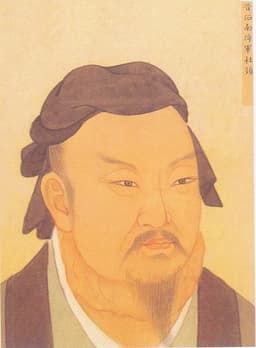
Du Yu
General · Ancient
56.8Total

Julius Caesar
General · Ancient
82.8Total
Basic Information
Born
222
-100
Died
285
-44
Era
Ancient
Ancient
Nationality
China
Roman Republic
Occupation
General
General
Civilization
Eastern
Western
Score Comparison
Military (10%)
77.5
88.0
Political (20%)
43.7
78.0
Influence (20%)
53.3
85.0
Legacy (20%)
47.5
82.0
Leadership (15%)
65.0
80.0
Strategy (15%)
75.0
85.0
TOTAL
56.8
82.8
Du Yu — Complete Timeline
279 AD
Appointed as commander of the Jin invasion of WuPolitical Action◆ Major
Du Yu was appointed as the overall commander of the Jin forces for the invasion of Eastern Wu, following Yang Hu's recommendation. He was given command of the central army group.
Jin DynastyEastern WuMilitary Command
Impact: nationalconstructive
280 AD
Led the conquest of Eastern WuWar
Du Yu's forces captured key Wu cities, including Jiangling, and advanced toward the Wu capital Jianye. The campaign culminated in the surrender of Wu's emperor Sun Hao, ending the Three Kingdoms period.
Conquest of WuJin DynastyUnification
Impact: globalconstructive
Authored the 'Commentary on the Spring and Autumn Annals'Cultural◆ Major
Du Yu wrote a comprehensive commentary on the Confucian classic 'Spring and Autumn Annals', which became a standard reference for later scholars. His work influenced Chinese historiography.
ScholarshipConfucianismHistoriography
Impact: nationalconstructive
Julius Caesar — Complete Timeline
58 BC
Gallic WarsWar◆ Major
Caesar, as proconsul of Gaul, launched a series of campaigns that conquered all of Gaul (modern France, Belgium, and parts of Switzerland). He fought numerous battles, including against the Helvetii, the Belgae, and the Gallic chieftain Vercingetorix. The wars brought immense wealth and a loyal army to Caesar.
Gallic WarsConquestRoman Expansion
Impact: regional
49 BC
Crossing the RubiconPolitical Action◆ Major
Caesar led Legio XIII across the Rubicon River into Italy, defying the Roman Senate's order to disband his army. This act triggered a civil war against Pompey and the Optimates, ultimately leading to Caesar's dictatorship and the end of the Roman Republic.
Roman Civil WarEnd of RepublicPower Struggle
Impact: global
48 BC
Battle of PharsalusWar◆ Major
Caesar's outnumbered army defeated the larger forces of Pompey the Great at Pharsalus in Greece. Caesar's tactical use of a reserve line to counter Pompey's cavalry charge proved decisive. Pompey fled to Egypt, where he was assassinated, leaving Caesar as the undisputed master of the Roman world.
Roman Civil WarBattleDecisive Victory
Impact: regional
44 BC
Appointment as Dictator for LifePolitical Action◆ Major
The Roman Senate appointed Caesar dictator perpetuo (dictator for life), granting him unprecedented personal power. This move concentrated military, legislative, and judicial authority in one person, effectively ending the Roman Republic's traditional system of checks and balances and alarming many senators.
DictatorshipEnd of RepublicPower Consolidation
Impact: regionaldestructive
Assassination on the Ides of MarchPolitical Action◆ Major
A group of Roman senators, led by Marcus Junius Brutus and Gaius Cassius Longinus, stabbed Caesar to death at a meeting of the Senate in the Theatre of Pompey. The assassination was intended to restore the Republic, but instead triggered another civil war that led to the rise of the Roman Empire.
AssassinationRoman PoliticsEnd of Republic
Impact: globaldestructive
Expert Analysis
du-yu-vs-julius-caesar
# The Conqueror and the Scholar: Two Paths to Power
On a winter day in January 49 BCE, Julius Caesar stood at the banks of the Rubicon, a small river that marked the boundary of his legal command. To cross it with his army was treason. To stay was political oblivion. He crossed, uttering words that would echo through millennia: *“Alea iacta est”* — the die is cast. Five centuries later and half a world away, another general, Du Yu, faced no such dramatic choice. When he took command of the Jin invasion of Eastern Wu in 279 CE, he did so with the full backing of an emperor, a clear strategic plan, and a Confucian scholar’s meticulous attention to detail. One man’s gamble redefined the Western world; the other’s methodical campaign reunified China. Their stories reveal how character, circumstance, and the very nature of power shaped two vastly different destinies.
Origins
Julius Caesar was born into the patrician Julian clan, but his family was not wealthy. Rome in the first century BCE was a cauldron of civil strife, where ambitious men could rise through military glory and popular support. Caesar’s uncle by marriage, Gaius Marius, had been a populist reformer, and his father-in-law, Cinna, a leading democrat. From youth, Caesar breathed the air of factional politics and learned that survival meant alliances, debts, and calculated risk. His early life was marked by exile, piracy, and a relentless pursuit of military command.
Du Yu, born in 222 CE, entered a very different world. China’s Han dynasty had collapsed, and the land was divided into the Three Kingdoms — Wei, Shu, and Wu. Du Yu came from a family of officials and scholars; his grandfather had served under the Han, and his father under the Cao Wei regime. Confucian learning was his foundation. He grew up not on battlefields but in libraries, absorbing the classics that would later shape his commentary on the *Spring and Autumn Annals*. While Caesar learned to manipulate crowds, Du Yu learned to interpret texts. Their eras demanded different skills: Rome rewarded audacity; China, in its fractured state, rewarded patience and intellectual rigor.
Rise to Power
Caesar’s path was a masterclass in political theater. He climbed the *cursus honorum* — the ladder of Roman offices — through bribes, marriages, and military commands. His conquest of Gaul (58–50 BCE) was both a military triumph and a personal power base. He wrote his own *Commentaries* to shape public opinion, turning war into propaganda. When the Senate ordered him to disband his army, he refused. The Rubicon was the culmination of a lifetime of calculated defiance.
Du Yu’s rise was quieter but no less strategic. He served as a civil official under the Jin dynasty, which had already conquered the kingdom of Shu. The final prize was Eastern Wu, the last of the Three Kingdoms. Du Yu did not seek command; it was thrust upon him. In 279 CE, following the death of the veteran general Yang Hu, Emperor Wu of Jin appointed Du Yu as overall commander of the invasion. Unlike Caesar, who seized power, Du Yu received it. His authority came not from personal ambition but from imperial trust — a crucial difference that would define his actions.
Leadership & Governance
Caesar’s leadership was charismatic, ruthless, and transformative. He led from the front, sharing hardships with his soldiers, and they adored him. His military strategy — at Alesia, at Pharsalus — combined speed, surprise, and psychological warfare. Politically, he centralized power, reformed the calendar, extended citizenship, and initiated public works. Yet his governance was autocratic. He accepted a dictatorship for life, accumulating titles that erased the Republic’s traditions. His genius was in conquest; his flaw was in failing to build a system that could survive him.
Du Yu was the opposite. His conquest of Eastern Wu in 280 CE was a model of logistical planning. He launched a simultaneous land and river campaign, coordinating multiple armies across vast distances. His forces captured Jiangling and advanced on the capital Jianye. The Wu emperor surrendered without a final battle — a triumph of strategy over bloodshed. But Du Yu’s greatest achievement may have been his *Commentary on the Spring and Autumn Annals*, written after the war. He did not seek to rule; he sought to understand. Where Caesar consolidated power, Du Yu consolidated knowledge. His governance was that of a scholar-official: cautious, moral, and focused on stability.
Triumph & Tragedy
Caesar’s greatest moment was his victory at the Battle of Pharsalus in 48 BCE, where he defeated his rival Pompey despite being outnumbered. His tragedy came five years later, on the Ides of March, 44 BCE, when senators stabbed him 23 times in the Theatre of Pompey. His death plunged Rome into another civil war, proving that one man’s ambition could not substitute for institutional legitimacy.
Du Yu’s triumph was the peaceful submission of Eastern Wu in 280 CE. He had achieved in months what others had failed to do for decades. There was no tragedy — no assassination, no betrayal. He returned to court, completed his scholarly work, and died naturally in 285 CE. His tragedy, if it can be called one, is that he is largely forgotten outside of China, while Caesar’s name is known to every schoolchild.
Character & Destiny
Caesar was driven by an insatiable desire for glory. He believed in his own destiny, and he was largely right — but his arrogance blinded him to the resentment he created. He once said, *“It is easier to find men who will volunteer to die than to find those who are willing to endure pain with patience.”* He himself could endure pain, but not patience. Du Yu, by contrast, was a man of patience. He wrote, *“The scholar who understands the past can see the future.”* His character was molded by Confucian ideals of harmony and duty. He did not seek immortality; he sought order.
Legacy
Caesar’s legacy is monumental. His name became synonymous with power — *Kaiser* in German, *Tsar* in Russian. He ended the Roman Republic and created the template for imperial rule. His writings remain classics of military literature. Yet his legacy is also ambiguous: he destroyed a political system and replaced it with autocracy.
Du Yu’s legacy is quieter but enduring. His *Commentary on the Spring and Autumn Annals* became a standard reference for Confucian scholarship, influencing Chinese historiography for centuries. His conquest reunified China under the Jin dynasty, ending the Three Kingdoms period. In China, he is remembered as a model of the scholar-general — a man who could wield both sword and brush.
Conclusion
Caesar and Du Yu faced the same fundamental question: how to impose order on chaos. Caesar answered with fire, ambition, and personal glory. Du Yu answered with water, patience, and institutional wisdom. One built an empire that collapsed within a generation; the other helped restore a civilization that endured for centuries. Their different outcomes were not accidents of fate but expressions of deeper truths about their cultures and their souls. Rome demanded a hero who would burn brightly and die young. China demanded a sage who would serve quietly and live long. In the end, both gave their worlds exactly what they needed — and what they deserved.
Rankings
🥇
Julius CaesarLeader
Mil: 88.0Pol: 78.0Inf: 85.0
82.8
🥈
Du Yu
Mil: 77.5Pol: 43.7Inf: 53.3
56.8
+26.0 behind
How This Comparison Works
Algorithm
Each figure is scored on 6 dimensions (0—100 scale) based on structured historical data: Military (10%), Political (20%), Influence (20%), Legacy (20%), Leadership (15%), Strategy (15%). The weighted total produces the final ranking.
Data Sources
Scores are computed from structured sub-indicators in the database. Scale factors adjust for era (Ancient ×0.85, Modern ×1.0) and civilization size (Eastern ×1.05, Other ×0.80) to account for differences in population and military scale.
Maximum 3 Figures
Comparisons are limited to 2—3 figures to ensure readability and statistical meaningfulness.
Error Margins
±5 points per dimension — Sub-scores are derived from historical records with inherent uncertainty. Two figures within 5 points on a dimension should be considered roughly equivalent in that area.
Total Score Accuracy
±3 points overall — The weighted combination of 6 dimensions produces a total score with approximately ±3 points of uncertainty. Differences of less than 3 points are not statistically significant— the figures are effectively tied.
Known Limitations
- Historical records are incomplete and uneven across civilizations
- Figures from oral-tradition societies may be underrepresented
- Occupation labels can misclassify multi-role figures
- Scores measure capability and impact, not moral character
- Quantitative scoring is a comparison tool, not absolute truth
Capability Radar
Military (10%) — Battles & Warfare
Battles
70
95
Win Rate
85
92
Expansion
75
97
Political (20%) — Governance & Reform
Reform
55
90
Diplomacy
60
85
Economy
50
82
Influence (20%) — Cultural & Global Reach
Cultural
40
88
Global
30
94
Legacy (20%) — Historical Impact
Historical
55
95
Longevity
40
96
Leadership (15%) — Power & Stability
Tenure
65
75
Stability
55
60
Strategy (15%) — Tactics & Innovation
Strategy
80
94
Tactics
75
96
Reform
60
88
Similar Comparisons
Comments & Discussion
No comments yet. Be the first to share your thoughts!