Loading...
Duke Zhuang of Zheng vs Julius Caesar
Julius Caesar leads by 25.7 pts · 2 figures compared
…
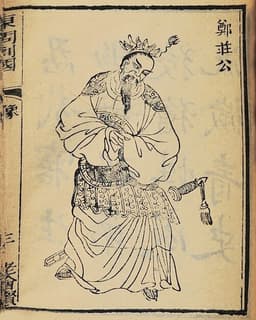
Duke Zhuang of Zheng
Emperor · Ancient
57.1Total

Julius Caesar
General · Ancient
82.8Total
Basic Information
Born
-757
-100
Died
-701
-44
Era
Ancient
Ancient
Nationality
Zheng
Roman Republic
Occupation
Emperor
General
Civilization
Eastern
Western
Score Comparison
Military (10%)
74.7
88.0
Political (20%)
53.8
78.0
Influence (20%)
54.1
85.0
Legacy (20%)
48.3
82.0
Leadership (15%)
66.0
80.0
Strategy (15%)
60.7
85.0
TOTAL
57.1
82.8
Duke Zhuang of Zheng — Complete Timeline
707 BC
Battle of XugeWar
Duke Zhuang of Zheng defeated the Zhou royal army led by King Huan at Xuge. This battle shattered the prestige of the Zhou king, as a feudal lord openly defeated the Son of Heaven. Duke Zhuang became the first hegemon of the Spring and Autumn period.
Spring and AutumnZhengZhou Defeat
Impact: national
701 BC
Zheng succession crisisPolitical Action◆ Major
After Duke Zhuang's death, his sons fought over the succession, plunging Zheng into civil war. The state's power declined rapidly as internal strife allowed other states like Qi to rise as hegemons.
ZhengSuccession WarDecline
Impact: regionaldestructive
Julius Caesar — Complete Timeline
58 BC
Gallic WarsWar◆ Major
Caesar, as proconsul of Gaul, launched a series of campaigns that conquered all of Gaul (modern France, Belgium, and parts of Switzerland). He fought numerous battles, including against the Helvetii, the Belgae, and the Gallic chieftain Vercingetorix. The wars brought immense wealth and a loyal army to Caesar.
Gallic WarsConquestRoman Expansion
Impact: regional
49 BC
Crossing the RubiconPolitical Action◆ Major
Caesar led Legio XIII across the Rubicon River into Italy, defying the Roman Senate's order to disband his army. This act triggered a civil war against Pompey and the Optimates, ultimately leading to Caesar's dictatorship and the end of the Roman Republic.
Roman Civil WarEnd of RepublicPower Struggle
Impact: global
48 BC
Battle of PharsalusWar◆ Major
Caesar's outnumbered army defeated the larger forces of Pompey the Great at Pharsalus in Greece. Caesar's tactical use of a reserve line to counter Pompey's cavalry charge proved decisive. Pompey fled to Egypt, where he was assassinated, leaving Caesar as the undisputed master of the Roman world.
Roman Civil WarBattleDecisive Victory
Impact: regional
44 BC
Appointment as Dictator for LifePolitical Action◆ Major
The Roman Senate appointed Caesar dictator perpetuo (dictator for life), granting him unprecedented personal power. This move concentrated military, legislative, and judicial authority in one person, effectively ending the Roman Republic's traditional system of checks and balances and alarming many senators.
DictatorshipEnd of RepublicPower Consolidation
Impact: regionaldestructive
Assassination on the Ides of MarchPolitical Action◆ Major
A group of Roman senators, led by Marcus Junius Brutus and Gaius Cassius Longinus, stabbed Caesar to death at a meeting of the Senate in the Theatre of Pompey. The assassination was intended to restore the Republic, but instead triggered another civil war that led to the rise of the Roman Empire.
AssassinationRoman PoliticsEnd of Republic
Impact: globaldestructive
Expert Analysis
duke-zhuang-of-zheng-vs-julius-caesar
# The Crossing of the Rubicon and the Arrow at Xuge
On a winter day in 49 BCE, Julius Caesar stood at the banks of a small river in northern Italy, the Rubicon, and made a decision that would echo through millennia. He crossed it with his legions, defying the Roman Senate and setting the Republic on a path toward empire. Nearly six centuries earlier and half a world away, another ruler faced his own moment of defiance. In 707 BCE, Duke Zhuang of Zheng, a vassal of the Zhou dynasty, drew his bow against the very king he was bound to serve. Both men shattered the old order. But while Caesar’s story ends with daggers on the Senate floor and a legacy that shaped the West, Duke Zhuang’s triumph dissolved into civil war and obscurity. Why did one become a legend and the other a footnote?
Origins
Julius Caesar was born into the patrician Julian clan, an ancient but politically marginal family in the Roman Republic. His uncle by marriage, Gaius Marius, was a populist general who had reformed the army, and Caesar grew up amid the violent factionalism of the late Republic. He was a child of crisis—Rome was bleeding from civil wars, slave revolts, and the collapse of its traditional institutions. From his earliest years, Caesar learned that power came not from birth but from ambition, military glory, and the loyalty of soldiers.
Duke Zhuang of Zheng emerged from a different world. The Zhou dynasty had ruled China for four centuries by the time of his birth in 757 BCE, but its authority was already fraying. Zheng was a medium-sized state in the central plains, surrounded by larger powers. Duke Zhuang inherited a precarious throne at a young age, with his mother favoring his younger brother over him. He grew up in a court rife with intrigue, where legitimacy was everything and the emperor in Luoyang was still nominally the supreme authority. His world was one of ritual, hierarchy, and the delicate balance of feudal bonds.
The contrast is stark: Caesar’s Rome was a republic in violent decay, where individual ambition could rewrite the rules. Duke Zhuang’s China was a crumbling feudal order, where power was still wrapped in the language of loyalty to a higher king.
Rise to Power
Caesar’s path was long and calculated. He served as a military tribune, then quaestor in Spain, where he reportedly wept before a statue of Alexander the Great, lamenting that he had achieved nothing at an age when Alexander had conquered the world. He climbed the political ladder—aedile, praetor, consul—using borrowed money and populist alliances. His true breakthrough came in 58 BCE, when he secured command of Gaul. Over eight years, he conquered the entire region, winning immense wealth and a veteran army loyal to him alone. When the Senate ordered him to disband his legions, he crossed the Rubicon instead, triggering a civil war that made him master of Rome.
Duke Zhuang’s rise was more constrained. He came to power as a young duke, and his first challenge was internal: his mother and brother plotted to overthrow him. He crushed the rebellion with ruthless efficiency, executing his brother and imprisoning his mother. But he could not simply conquer his neighbors. In the Spring and Autumn period, war was governed by codes of honor—armies fought for tribute, not annihilation. Duke Zhuang’s genius was in manipulating these rules. He played the role of a loyal vassal while secretly building Zheng’s strength, waiting for the moment when the Zhou king’s weakness would become undeniable.
Leadership & Governance
Caesar governed as a revolutionary. As dictator, he reformed the calendar, extended citizenship to provincials, launched public works, and centralized authority in his own hands. He was a master of clemency—pardoning former enemies like Brutus and Cassius—but also a consummate politician who understood that power flowed from the army and the people, not the Senate. His military genius was unparalleled: at Alesia in 52 BCE, he besieged a Gallic stronghold while simultaneously fighting off a relief army, a feat of logistics and tactics that still stuns historians.
Duke Zhuang ruled as a hegemon, not a conqueror. His greatest achievement was the Battle of Xuge in 707 BCE, where he faced King Huan of Zhou in open battle. The Zhou royal army, despite its symbolic authority, was outmatched by Zheng’s disciplined troops. Duke Zhuang’s victory was decisive—he even wounded the king with an arrow. But he did not press his advantage. He let the king retreat, sent gifts to the court, and maintained the fiction of loyalty. This was not mercy but strategy: he understood that outright destruction of the Zhou would invite chaos, not glory. His political score of 81.0 reflects this nuanced wisdom.
Triumph & Tragedy
Caesar’s triumph was the conquest of Gaul and the defeat of his rivals, Pompey and the Senate. His tragedy was the Ides of March, 44 BCE, when sixty senators stabbed him to death in the Senate chamber. He had centralized power so completely that his assassination threw Rome into another civil war, from which his adopted heir, Octavian, emerged as the first emperor. Caesar’s death was the price of his ambition—he had destroyed the Republic but failed to secure his own safety.
Duke Zhuang’s triumph was Xuge, where he proved that the Zhou dynasty’s military power was a hollow shell. His tragedy came after his death in 701 BCE. He had failed to establish a stable succession. His sons fought a bitter civil war, and Zheng descended into chaos. Within a generation, the state that had humbled the Zhou king was a second-rate power, eventually absorbed by its neighbors. Duke Zhuang’s legacy was a single battle, not a dynasty.
Character & Destiny
Caesar was driven by an insatiable need for glory. He wrote his own commentaries, shaped his own image, and gambled everything on his genius. His personality—charming, ruthless, calculating—made him both loved and feared. He believed in his own destiny, and history has largely agreed.
Duke Zhuang was cautious and pragmatic. He knew the limits of his power and never overreached. He was a master of the possible, not the visionary. His personality suited his era, where survival depended on knowing when to strike and when to bow. But that same caution prevented him from building something lasting.
Legacy
Caesar’s legacy is the Roman Empire, the Latin language, the Julian calendar, and the very concept of “Caesar” as a title for emperors. He is remembered as a military genius, a political reformer, and a tragic hero—Shakespeare’s “noblest man that ever lived in the tide of times.” His influence score of 85.0 and legacy of 82.0 reflect his enduring grip on the Western imagination.
Duke Zhuang’s legacy is more modest. He is remembered as the first hegemon of the Spring and Autumn period, a model of cunning statecraft. But his influence score of 73.6 and legacy of 69.6 show that he is a figure for specialists, not the popular imagination. The arrow at Xuge was a turning point in Chinese history, but it did not create a new order—it merely hastened the old one’s decline.
Conclusion
Julius Caesar and Duke Zhuang of Zheng both defied the highest authority of their worlds. Both won stunning victories. But Caesar’s ambition was boundless, his canvas the entire Mediterranean; Duke Zhuang’s was constrained by the rituals of a dying age. One became the father of an empire; the other, a warning that even the most brilliant victory can be undone by a single succession crisis. In the end, the difference between them is the difference between a man who wanted to change the world and a man who only wanted to survive it.
Rankings
🥇
Julius CaesarLeader
Mil: 88.0Pol: 78.0Inf: 85.0
82.8
🥈
Duke Zhuang of Zheng
Mil: 74.7Pol: 53.8Inf: 54.1
57.1
+25.7 behind
How This Comparison Works
Algorithm
Each figure is scored on 6 dimensions (0—100 scale) based on structured historical data: Military (10%), Political (20%), Influence (20%), Legacy (20%), Leadership (15%), Strategy (15%). The weighted total produces the final ranking.
Data Sources
Scores are computed from structured sub-indicators in the database. Scale factors adjust for era (Ancient ×0.85, Modern ×1.0) and civilization size (Eastern ×1.05, Other ×0.80) to account for differences in population and military scale.
Maximum 3 Figures
Comparisons are limited to 2—3 figures to ensure readability and statistical meaningfulness.
Error Margins
±5 points per dimension — Sub-scores are derived from historical records with inherent uncertainty. Two figures within 5 points on a dimension should be considered roughly equivalent in that area.
Total Score Accuracy
±3 points overall — The weighted combination of 6 dimensions produces a total score with approximately ±3 points of uncertainty. Differences of less than 3 points are not statistically significant— the figures are effectively tied.
Known Limitations
- Historical records are incomplete and uneven across civilizations
- Figures from oral-tradition societies may be underrepresented
- Occupation labels can misclassify multi-role figures
- Scores measure capability and impact, not moral character
- Quantitative scoring is a comparison tool, not absolute truth
Capability Radar
Military (10%) — Battles & Warfare
Battles
65
95
Win Rate
70
92
Expansion
55
97
Political (20%) — Governance & Reform
Reform
55
90
Diplomacy
75
85
Economy
60
82
Influence (20%) — Cultural & Global Reach
Cultural
45
88
Global
40
94
Legacy (20%) — Historical Impact
Historical
60
95
Longevity
50
96
Leadership (15%) — Power & Stability
Tenure
70
75
Stability
65
60
Strategy (15%) — Tactics & Innovation
Strategy
65
94
Tactics
60
96
Reform
40
88
Similar Comparisons
Comments & Discussion
RubiconRambler6/17/2026
Caesar wins this comparison not because he was a better rebel, but because he understood propaganda. Duke Zhuang shot a king and then... did nothing to control the narrative. No memoirs, no dramatic letters to the Senate, no coins minted with his face striking poses. Caesar wrote his own history while still alive. Duke Zhuang let others write his into irrelevance. The pen isn't mightier than the sword—it's the delivery system for the story the sword writes.
春秋兵谏王6/17/2026
拿郑庄公跟凯撒比?这简直是把地方霸主跟世界征服者强行拉郎配。庄公射王是中原地缘政治的博弈——郑国要生存,周室要面子,最后双方默契地各退一步。凯撒跨过卢比孔河是要掀翻整个共和体制。一个是周朝权力体系的内部摩擦,一个是摧毁千年共和国的大地震。根本不是一个量级的历史事件。说庄公是"中国版凯撒",那是低估了凯撒的野心,也高估了庄公的格局。
DataMancer6/17/2026
The timeline difference alone makes this comparison dubious. 707 BCE to 49 BCE is 658 years—roughly the distance from the Magna Carta to now. Duke Zhuang operated in a world of chariot warfare and bronze ritual vessels, where political power was measured in tributary relationships and ancestral legitimacy. Caesar commanded professional legions in a cash economy with coinage, written law, and memoir publication. These aren't two versions of the same story; they're entirely different political ope
大争之世6/17/2026
庄公真正的悲剧在于他太成功了——成功到让后人觉得理所当然。他小霸中原三十年,克共、灭许、败宋、服陈,让郑国成为春秋初期头号强国。但正因为他把礼崩乐坏玩得太自然,后世眼中他不过是个"会玩权力的地方诸侯"。凯撒是突然撕破脸,戏剧性十足;庄公是一步步把周王的威信蚕食掉,润物细无声。前者是革命,后者是侵蚀。历史更爱革命的戏剧性,却忘了侵蚀才是更持久的颠覆。
SkepticSamurai6/17/2026
The comparison fundamentally misreads Duke Zhuang's aims. He wasn't trying to overthrow the Zhou order—he was trying to control it from within. Shooting King Huan with an arrow was a calculated humiliation to demonstrate Zheng's power, not an attempt at regime change. Caesar's crossing of the Rubicon was an unambiguous declaration of war against the Senate and the Republic itself. One man wanted to be the power behind the throne; the other wanted to sit on it. Those are different ambitions with