Loading...
Ebana vs Julius Caesar
Julius Caesar leads by 39.8 pts · 2 figures compared
…
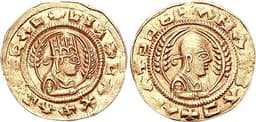
Ebana
Emperor · Ancient
43.0Total

Julius Caesar
General · Ancient
82.8Total
Basic Information
Born
430
-100
Died
460
-44
Era
Ancient
Ancient
Nationality
Ethiopia
Roman Republic
Occupation
Emperor
General
Civilization
Other
Western
Score Comparison
Military (10%)
25.9
88.0
Political (20%)
37.9
78.0
Influence (20%)
48.6
85.0
Legacy (20%)
38.3
82.0
Leadership (15%)
62.2
80.0
Strategy (15%)
36.8
85.0
TOTAL
43.0
82.8
Ebana — Complete Timeline
435 AD
Minted gold and silver coinsCultural
Ebana issued coins in both gold and silver, a practice that continued the Aksumite tradition of bimetallic currency. These coins bear his name and Christian symbols, reflecting the empire's religious identity.
CoinageBimetallismChristian Symbolism
Impact: national
450 AD
Maintained economic stability during declinePolitical Action
Ebana ruled during a period of gradual Aksumite decline, yet his coinage remained consistent in weight and purity. This suggests he managed to preserve monetary stability despite external pressures.
Economic StabilityDeclineMonetary Policy
Impact: national
Julius Caesar — Complete Timeline
58 BC
Gallic WarsWar◆ Major
Caesar, as proconsul of Gaul, launched a series of campaigns that conquered all of Gaul (modern France, Belgium, and parts of Switzerland). He fought numerous battles, including against the Helvetii, the Belgae, and the Gallic chieftain Vercingetorix. The wars brought immense wealth and a loyal army to Caesar.
Gallic WarsConquestRoman Expansion
Impact: regional
49 BC
Crossing the RubiconPolitical Action◆ Major
Caesar led Legio XIII across the Rubicon River into Italy, defying the Roman Senate's order to disband his army. This act triggered a civil war against Pompey and the Optimates, ultimately leading to Caesar's dictatorship and the end of the Roman Republic.
Roman Civil WarEnd of RepublicPower Struggle
Impact: global
48 BC
Battle of PharsalusWar◆ Major
Caesar's outnumbered army defeated the larger forces of Pompey the Great at Pharsalus in Greece. Caesar's tactical use of a reserve line to counter Pompey's cavalry charge proved decisive. Pompey fled to Egypt, where he was assassinated, leaving Caesar as the undisputed master of the Roman world.
Roman Civil WarBattleDecisive Victory
Impact: regional
44 BC
Appointment as Dictator for LifePolitical Action◆ Major
The Roman Senate appointed Caesar dictator perpetuo (dictator for life), granting him unprecedented personal power. This move concentrated military, legislative, and judicial authority in one person, effectively ending the Roman Republic's traditional system of checks and balances and alarming many senators.
DictatorshipEnd of RepublicPower Consolidation
Impact: regionaldestructive
Assassination on the Ides of MarchPolitical Action◆ Major
A group of Roman senators, led by Marcus Junius Brutus and Gaius Cassius Longinus, stabbed Caesar to death at a meeting of the Senate in the Theatre of Pompey. The assassination was intended to restore the Republic, but instead triggered another civil war that led to the rise of the Roman Empire.
AssassinationRoman PoliticsEnd of Republic
Impact: globaldestructive
Expert Analysis
ebana-vs-julius-caesar
# The Coin and the Sword
On the Ides of March, 44 BCE, a Roman senator named Casca struck the first blow. Within moments, Julius Caesar lay bleeding at the foot of Pompey's statue, stabbed twenty-three times by men he had called friends. Half a millennium later and three thousand miles away, in the highlands of Ethiopia, another ruler—Ebana of Aksum—died quietly, leaving behind little more than a handful of gold and silver coins. The contrast between these two fates is not merely a matter of violent ends versus peaceful ones. It is the difference between a man who reshaped the world through war and politics, and a ruler who held his civilization steady as it slowly faded. Why did one become a legend and the other a footnote? The answer lies not in their eras, but in the choices their circumstances demanded.
Origins
Julius Caesar was born into the chaos of the late Roman Republic, a world of civil wars, debt, and aristocratic rivalries. His family, the Julii, claimed descent from the goddess Venus, but they were politically marginal. Caesar grew up in a Rome where power belonged to men like Sulla and Marius, generals who had marched on the capital itself. He learned early that survival required ambition, and ambition required ruthlessness. By contrast, Ebana ascended to the throne of Aksum around 430 CE, inheriting a kingdom that had been a major trading power for centuries. Aksum’s wealth came not from conquest but from commerce—ivory, frankincense, and gold moving between Africa, Arabia, and the Mediterranean. Ebana’s world was one of stability, not upheaval. He did not need to fight for his throne; he needed to preserve it.
Rise to Power
Caesar’s path was forged in war. He served as a military tribune, then quaestor in Spain, then aedile in Rome, spending vast sums on games and buildings to win popular favor. His capture by pirates in 75 BCE—and his later crucifixion of them—became a parable of his character: audacity wrapped in calculation. The real turning point came when he secured command of Gaul in 58 BCE. Over eight years, he conquered a territory larger than Italy, writing his own commentaries to shape public opinion back home. The Gallic Wars made him rich, famous, and feared. Ebana’s rise left no such dramatic trace. He was likely the son of a previous king, and his accession was probably peaceful. The records are silent on battles, rebellions, or even a single speech. He did not seize power; he inherited it. Where Caesar’s story is a drumbeat of action, Ebana’s is a whisper.
Leadership & Governance
Caesar governed through personal magnetism and relentless innovation. As dictator, he reformed the calendar, granted citizenship to provincials, launched public works, and centralized state finances. His military genius was matched by his political instinct: he knew that clemency could win enemies as surely as force. After defeating his rival Pompey, Caesar pardoned many of his opponents—a decision that ultimately cost him his life, as some of those pardoned joined the conspiracy against him. Ebana’s governance is visible only through his coinage. He minted gold and silver coins with consistent weight and purity, a sign of economic stability during a period when Aksum’s power was waning. While Rome expanded, Aksum contracted. Ebana did not lead armies across new frontiers; he maintained the currency that kept trade alive. His leadership was not about conquest but continuity.
Triumph & Tragedy
Caesar’s greatest triumph was the conquest of Gaul, a feat that doubled Rome’s territory and made him the most powerful man in the Republic. His ultimate tragedy was the Ides of March—a death that proved he had miscalculated the depth of republican resentment. “Et tu, Brute?”—whether he spoke those words or not—captures the betrayal that ended his life. Ebana’s triumphs are harder to see. His coins survive, but no monument, no battle, no dramatic speech. His tragedy was that he ruled during decline. Aksum would fade into obscurity, its empire crumbling under pressure from Persian trade routes and the rise of Islam. Ebana’s efforts to maintain economic stability could not stop the tide. He was not killed by enemies; he was erased by history.
Character & Destiny
Caesar was driven by an insatiable desire for glory. He gambled constantly—crossing the Rubicon, fighting in Egypt, accepting the title of dictator for life. His personality was magnetic, his ambition boundless, his judgment occasionally blinded by pride. He believed he could control the forces he unleashed. Ebana’s character is opaque. The lack of records suggests a cautious, conservative ruler—a man who saw his duty as preservation, not transformation. If Caesar’s destiny was to break the Republic and create an empire, Ebana’s was to hold a kingdom together as it slipped away. One man shaped history; the other was shaped by it.
Legacy
Caesar’s legacy is immeasurable. His name became synonymous with imperial rule—kaiser, tsar. His reforms outlived him, and the Roman Empire he helped create lasted for centuries. Shakespeare, Dante, and countless others have told his story. Ebana’s legacy is the coins themselves—small, tangible remnants of a civilization that once rivaled Rome and Persia. His name appears in scholarly catalogs, not in epic poems. Yet those coins tell a story too: of a ruler who, in an age of decline, ensured that his people could still trade, still pay taxes, still trust the currency in their hands. That is not a small thing.
Conclusion
We remember Caesar because he changed the world. We forget Ebana because his world changed without him. But the comparison is not a judgment. Caesar’s ambition brought glory and chaos; Ebana’s steadiness brought stability and silence. One man crossed a river and changed history; the other minted a coin and held the line. Both were rulers. Both faced the challenges of their age. The difference is not in their ability, but in the scale of the stage they were given. Caesar’s Rome was rising; Ebana’s Aksum was falling. History writes its loudest chapters in times of upheaval. But the quiet work of preservation—of maintaining a currency, a kingdom, a civilization—deserves its own kind of remembrance. The sword and the coin are both tools of power. One leaves scars; the other leaves traces.
Rankings
🥇
Julius CaesarLeader
Mil: 88.0Pol: 78.0Inf: 85.0
82.8
🥈
Ebana
Mil: 25.9Pol: 37.9Inf: 48.6
43.0
+39.8 behind
How This Comparison Works
Algorithm
Each figure is scored on 6 dimensions (0—100 scale) based on structured historical data: Military (10%), Political (20%), Influence (20%), Legacy (20%), Leadership (15%), Strategy (15%). The weighted total produces the final ranking.
Data Sources
Scores are computed from structured sub-indicators in the database. Scale factors adjust for era (Ancient ×0.85, Modern ×1.0) and civilization size (Eastern ×1.05, Other ×0.80) to account for differences in population and military scale.
Maximum 3 Figures
Comparisons are limited to 2—3 figures to ensure readability and statistical meaningfulness.
Error Margins
±5 points per dimension — Sub-scores are derived from historical records with inherent uncertainty. Two figures within 5 points on a dimension should be considered roughly equivalent in that area.
Total Score Accuracy
±3 points overall — The weighted combination of 6 dimensions produces a total score with approximately ±3 points of uncertainty. Differences of less than 3 points are not statistically significant— the figures are effectively tied.
Known Limitations
- Historical records are incomplete and uneven across civilizations
- Figures from oral-tradition societies may be underrepresented
- Occupation labels can misclassify multi-role figures
- Scores measure capability and impact, not moral character
- Quantitative scoring is a comparison tool, not absolute truth
Capability Radar
Military (10%) — Battles & Warfare
Battles
10
95
Win Rate
10
92
Expansion
10
97
Political (20%) — Governance & Reform
Reform
30
90
Diplomacy
30
85
Economy
40
82
Influence (20%) — Cultural & Global Reach
Cultural
30
88
Global
20
94
Legacy (20%) — Historical Impact
Historical
30
95
Longevity
20
96
Leadership (15%) — Power & Stability
Tenure
40
75
Stability
40
60
Strategy (15%) — Tactics & Innovation
Strategy
10
94
Tactics
10
96
Reform
10
88
Similar Comparisons
Comments & Discussion
No comments yet. Be the first to share your thoughts!