Loading...
Eduard Shevardnadze vs Pen Sovan
Eduard Shevardnadze leads by 22.7 pts · 2 figures compared
…
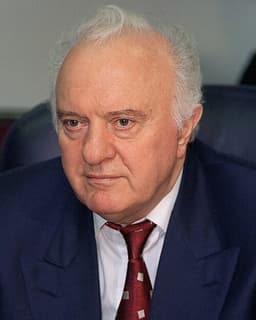
Eduard Shevardnadze
Politician · Modern
57.7Total

Pen Sovan
Politician · Modern
35.0Total
Basic Information
Born
1928
1936
Died
—
—
Era
Modern
Modern
Nationality
Georgia
Cambodia
Occupation
Politician
Politician
Civilization
Western
Eastern
Score Comparison
Military (10%)
50.0
11.1
Political (20%)
70.0
32.1
Influence (20%)
55.0
47.1
Legacy (20%)
56.0
35.8
Leadership (15%)
68.0
31.2
Strategy (15%)
42.1
36.4
TOTAL
57.7
35.0
Eduard Shevardnadze — Complete Timeline
1985 AD
Appointed Soviet Foreign MinisterPolitical Action◆ Major
Mikhail Gorbachev appointed Shevardnadze as Soviet Foreign Minister. Shevardnadze played a key role in shaping the 'New Thinking' foreign policy, which emphasized de-escalation of the Cold War, arms reduction agreements, and improved relations with the West.
Cold WarSoviet UnionDiplomacy
Impact: globalconstructive
1987 AD
Signed the Intermediate-Range Nuclear Forces TreatyPolitical Action
Shevardnadze, as Soviet Foreign Minister, signed the INF Treaty with U.S. Secretary of State George Shultz. The treaty eliminated an entire class of nuclear missiles (500-5,500 km range) from Europe, marking a major step in ending the Cold War.
Nuclear Arms ControlCold WarTreaty
Impact: globalconstructive
1990 AD
Resigned as Soviet Foreign MinisterPolitical Action◆ Major
Shevardnadze resigned as Soviet Foreign Minister, warning of an impending dictatorship under Gorbachev. His resignation was a dramatic protest against the conservative backlash and the slow pace of reforms, highlighting the internal crisis of the Soviet Union.
Soviet UnionResignationPolitical Crisis
Impact: nationaltragic
1992 AD
Elected Chairman of the Georgian ParliamentPolitical Action◆ Major
After the ouster of President Zviad Gamsakhurdia, Shevardnadze returned to Georgia and was elected Chairman of the Parliament, effectively becoming the head of state. He was tasked with stabilizing the country amid civil war and economic collapse.
GeorgiaPost-SovietLeadership
Impact: national
1995 AD
Survived Assassination AttemptPolitical Action◆ Major
Shevardnadze survived a car bomb assassination attempt in Tbilisi. The attack, which killed several people, was widely attributed to opponents of his policies. It underscored the violent political struggles in post-Soviet Georgia.
Assassination AttemptGeorgiaViolence
Impact: nationaltragic
2003 AD
Rose RevolutionPolitical Action
Shevardnadze was forced to resign as President of Georgia following the Rose Revolution, a peaceful protest against disputed parliamentary elections. The revolution, led by Mikheil Saakashvili, ended Shevardnadze's rule and ushered in a new pro-Western government.
RevolutionGeorgiaRegime Change
Impact: national
Pen Sovan — Complete Timeline
1979 AD
Became first Prime Minister of post-Khmer Rouge CambodiaPolitical Action◆ Major
After the Vietnamese invasion overthrew the Khmer Rouge, Pen Sovan became the first Prime Minister of the People's Republic of Kampuchea. He led the newly established government, tasked with rebuilding the country after the genocide.
Post-Khmer RougePrime MinisterRebuilding
Impact: nationalconstructive
1981 AD
Arrested and imprisoned by Vietnamese authoritiesPolitical Action◆ Major
Pen Sovan was arrested by the Vietnamese, who had installed his government, on charges of factionalism and nationalism. He was imprisoned in Vietnam for over a decade, removed from power due to his independent stance and perceived challenge to Vietnamese control.
ArrestImprisonmentVietnamese ControlPurge
Impact: nationaldestructive
1992 AD
Released from prison and returned to CambodiaPolitical Action
After 11 years in Vietnamese custody, Pen Sovan was released and allowed to return to Cambodia. He returned to a country undergoing a UN-led peace process, but his political influence had been severely diminished by his long absence.
ReleaseReturnPeace Process
Impact: national
Expert Analysis
Origins
Eduard Shevardnadze was born on January 25, 1928, in Mamati, Georgia, into a peasant family. He joined the Communist Party and rose through the ranks of the Komsomol, graduating from the Kutaisi Pedagogical Institute. Pen Sovan was born on May 13, 1936, in Takeo Province, Cambodia, to a peasant family. He joined the Khmer Rouge resistance against French colonialism and later became a senior figure in the Communist Party of Kampuchea.
Rise to Power
Shevardnadze became First Secretary of the Georgian Communist Party in 1972, a position he held until 1985. His efficient management caught the attention of Mikhail Gorbachev, who appointed him Soviet Foreign Minister in July 1985. Pen Sovan rose within the Khmer Rouge but fled to Vietnam in 1978 after purges. Following the Vietnamese invasion in 1979, he became the first Prime Minister of the People's Republic of Kampuchea in January 1979.
Leadership & Governance
As Soviet Foreign Minister, Shevardnadze championed 'New Thinking' – a foreign policy emphasizing disarmament and cooperation. He signed the Intermediate-Range Nuclear Forces Treaty in 1987, eliminating an entire class of missiles. He also oversaw the Soviet withdrawal from Afghanistan. Pen Sovan led a government rebuilding Cambodia after the Khmer Rouge's genocide. He sought to establish a pro-Vietnamese regime, but his nationalist tendencies clashed with Hanoi's control. His governance score of 31.2 reflects limited autonomy and effectiveness.
Triumph & Tragedy
Shevardnadze's greatest triumph was the INF Treaty, a landmark arms control agreement. He also helped end the Cold War. His tragedy came later as President of Georgia: corruption and electoral fraud led to the Rose Revolution in 2003, forcing his resignation. Pen Sovan's triumph was leading Cambodia's recovery from genocide, but his tragedy was being arrested by his Vietnamese allies in 1981 and imprisoned for 11 years on charges of factionalism.
Character & Destiny
Shevardnadze was pragmatic and reform-minded, earning a political score of 70.0. He warned against dictatorship by resigning in 1990 but later returned to Georgia. His leadership score of 68.0 reflects adaptability. Pen Sovan was a nationalist who underestimated Vietnamese control. His total score of 35.0 reflects his short tenure and imprisonment. His fate was sealed by geopolitical forces beyond his control.
Legacy
Shevardnadze's legacy includes the INF Treaty and a role in ending the Cold War. In Georgia, he is remembered for stabilizing the country after civil war but also for corruption. His influence score of 55.0 reflects his global impact. Pen Sovan is a footnote in Cambodian history; his legacy score of 35.8 is low. He is remembered as the first post-Khmer Rouge prime minister but overshadowed by Hun Sen.
Conclusion
Eduard Shevardnadze had greater impact, with a total score of 57.7 vs Pen Sovan's 35.0. Shevardnadze shaped global diplomacy, while Pen Sovan's influence was limited to a brief period. The 22.7-point gap reflects Shevardnadze's enduring legacy in international relations.
Rankings
🥇
Eduard ShevardnadzeLeader
Mil: 50.0Pol: 70.0Inf: 55.0
57.7
🥈
Pen Sovan
Mil: 11.1Pol: 32.1Inf: 47.1
35.0
+22.7 behind
How This Comparison Works
Algorithm
Each figure is scored on 6 dimensions (0—100 scale) based on structured historical data: Military (10%), Political (20%), Influence (20%), Legacy (20%), Leadership (15%), Strategy (15%). The weighted total produces the final ranking.
Data Sources
Scores are computed from structured sub-indicators in the database. Scale factors adjust for era (Ancient ×0.85, Modern ×1.0) and civilization size (Eastern ×1.05, Other ×0.80) to account for differences in population and military scale.
Maximum 3 Figures
Comparisons are limited to 2—3 figures to ensure readability and statistical meaningfulness.
Error Margins
±5 points per dimension — Sub-scores are derived from historical records with inherent uncertainty. Two figures within 5 points on a dimension should be considered roughly equivalent in that area.
Total Score Accuracy
±3 points overall — The weighted combination of 6 dimensions produces a total score with approximately ±3 points of uncertainty. Differences of less than 3 points are not statistically significant— the figures are effectively tied.
Known Limitations
- Historical records are incomplete and uneven across civilizations
- Figures from oral-tradition societies may be underrepresented
- Occupation labels can misclassify multi-role figures
- Scores measure capability and impact, not moral character
- Quantitative scoring is a comparison tool, not absolute truth
Capability Radar
Military (10%) — Battles & Warfare
Battles
26
16
Win Rate
31
15
Expansion
36
23
Political (20%) — Governance & Reform
Reform
80
5
Diplomacy
85
5
Economy
40
5
Influence (20%) — Cultural & Global Reach
Cultural
40
5
Global
65
5
Legacy (20%) — Historical Impact
Historical
70
10
Longevity
50
5
Leadership (15%) — Power & Stability
Tenure
75
10
Stability
30
5
Strategy (15%) — Tactics & Innovation
Strategy
35
20
Tactics
40
25
Reform
46
31
Similar Comparisons
Comments & Discussion
No comments yet. Be the first to share your thoughts!