Loading...
Emperor Gaozu of Han vs Julius Caesar
Julius Caesar leads by 13.1 pts · 2 figures compared
…
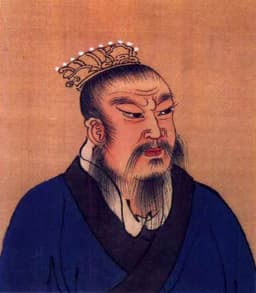
Emperor Gaozu of Han
Emperor · Ancient
69.7Total

Julius Caesar
General · Ancient
82.8Total
Basic Information
Born
-256
-100
Died
-195
-44
Era
Ancient
Ancient
Nationality
China
Roman Republic
Occupation
Emperor
General
Civilization
Eastern
Western
Score Comparison
Military (10%)
78.0
88.0
Political (20%)
72.0
78.0
Influence (20%)
65.0
85.0
Legacy (20%)
65.0
82.0
Leadership (15%)
79.8
80.0
Strategy (15%)
66.3
85.0
TOTAL
69.7
82.8
Emperor Gaozu of Han — Complete Timeline
209 BC
Rebellion Against the Qin DynastyWar◆ Major
Liu Bang, a minor Qin official, led a revolt after a group of convicts he was escorting escaped. He gathered followers and joined the broader rebellion against the Qin dynasty, eventually becoming a key rebel leader.
Qin RebellionPeasant RevoltCivil War
Impact: national
202 BC
Battle of GaixiaWar
Liu Bang's Han forces, commanded by Han Xin, defeated Xiang Yu's Chu army at Gaixia. Xiang Yu committed suicide after the battle. This victory ended the Chu-Han Contention and allowed Liu Bang to proclaim himself emperor.
Chu-Han ContentionDecisive BattleHan Dynasty Founding
Impact: national
Abolition of Harsh Qin LawsReform◆ Major
Emperor Gaozu repealed the severe legal codes of the Qin dynasty, including collective punishment and harsh corporal penalties. He replaced them with a simplified legal system that reduced punishments, aiming to win popular support and stabilize the realm.
Legal ReformQin LegacyPopular Support
Impact: nationalprogressive
Proclamation of the Han DynastyPolitical Action
After defeating Xiang Yu, Liu Bang declared himself Emperor Gaozu of Han, founding the Han dynasty. He established the capital at Chang'an and began consolidating power, marking the start of one of China's longest-lasting dynasties.
Dynasty FoundingImperial ChinaChang'an
Impact: globalconstructive
Enfeoffment of Vassal KingsPolitical Action
To secure loyalty, Gaozu granted large territories to allied generals and relatives, creating semi-autonomous kingdoms. This policy initially stabilized the empire but later led to rebellions, forcing his successors to centralize power more firmly.
Feudal SystemVassalagePolitical Strategy
Impact: national
Julius Caesar — Complete Timeline
58 BC
Gallic WarsWar◆ Major
Caesar, as proconsul of Gaul, launched a series of campaigns that conquered all of Gaul (modern France, Belgium, and parts of Switzerland). He fought numerous battles, including against the Helvetii, the Belgae, and the Gallic chieftain Vercingetorix. The wars brought immense wealth and a loyal army to Caesar.
Gallic WarsConquestRoman Expansion
Impact: regional
49 BC
Crossing the RubiconPolitical Action◆ Major
Caesar led Legio XIII across the Rubicon River into Italy, defying the Roman Senate's order to disband his army. This act triggered a civil war against Pompey and the Optimates, ultimately leading to Caesar's dictatorship and the end of the Roman Republic.
Roman Civil WarEnd of RepublicPower Struggle
Impact: global
48 BC
Battle of PharsalusWar◆ Major
Caesar's outnumbered army defeated the larger forces of Pompey the Great at Pharsalus in Greece. Caesar's tactical use of a reserve line to counter Pompey's cavalry charge proved decisive. Pompey fled to Egypt, where he was assassinated, leaving Caesar as the undisputed master of the Roman world.
Roman Civil WarBattleDecisive Victory
Impact: regional
44 BC
Appointment as Dictator for LifePolitical Action◆ Major
The Roman Senate appointed Caesar dictator perpetuo (dictator for life), granting him unprecedented personal power. This move concentrated military, legislative, and judicial authority in one person, effectively ending the Roman Republic's traditional system of checks and balances and alarming many senators.
DictatorshipEnd of RepublicPower Consolidation
Impact: regionaldestructive
Assassination on the Ides of MarchPolitical Action◆ Major
A group of Roman senators, led by Marcus Junius Brutus and Gaius Cassius Longinus, stabbed Caesar to death at a meeting of the Senate in the Theatre of Pompey. The assassination was intended to restore the Republic, but instead triggered another civil war that led to the rise of the Roman Empire.
AssassinationRoman PoliticsEnd of Republic
Impact: globaldestructive
Expert Analysis
emperor-gaozu-of-han-vs-julius-caesar
# The Two Founders: Caesar and Liu Bang
On a winter morning in 49 BCE, Julius Caesar stood at the bank of the Rubicon River, a small stream separating Gaul from Italy proper. He knew that crossing it with his legions meant civil war, the destruction of the Republic he had sworn to serve, and quite possibly his own death. He crossed anyway. Less than a century earlier and half a world away, a Chinese peasant named Liu Bang watched a group of convicts he was escorting escape into the night. Facing execution for his failure, he chose instead to lead the remaining men into rebellion against the Qin Empire. Both men broke the laws of their worlds. One would die by the dagger. The other would found a dynasty that lasted four hundred years. Why such different fates?
Origins
Caesar was born into the patrician Julian clan, one of Rome’s oldest families, in 100 BCE. Though his family had lost much of its wealth and influence, he was raised in the heart of Roman politics. His uncle was Gaius Marius, the great populist general. From childhood, Caesar breathed the air of senatorial ambition, military glory, and the endless struggle for power that defined the late Republic. He was educated by the finest Greek tutors, trained in rhetoric and law, and expected to climb the *cursus honorum*—the ladder of Roman public office.
Liu Bang was born in 256 BCE in the state of Chu, during the brutal final decades of the Warring States period. His family were farmers, not nobles. He received almost no formal education. As a young man, he drifted: a minor village official, a drinker, a man known more for his charm and generosity than any ambition. One ancient historian described him as having a "dragon countenance"—a face that seemed to promise greatness—but to his contemporaries, he was simply a peasant with a talent for making friends and avoiding hard work.
Rise to Power
Caesar’s path was that of an insider who became an outsider. He served as a military tribune, then quaestor, then aedile, spending enormous sums on games and buildings to win popularity. He formed the First Triumvirate with Pompey and Crassus in 60 BCE, a private alliance that controlled Rome. His conquest of Gaul from 58 to 50 BCE gave him a veteran army, immense wealth, and a reputation that threatened the Senate. When ordered to disband his legions, he chose war. The Rubicon crossing in 49 BCE was not a rebellion—it was a coup dressed as a defense of his honor.
Liu Bang’s path was that of an outsider who became an insider. In 209 BCE, after the convicts escaped, he gathered a ragged band of followers and joined the swelling rebellion against the Qin. He was not the most powerful rebel—that was Xiang Yu, a brilliant aristocrat-general. Liu Bang was a survivor. He lost battles, retreated, bribed enemies, and made alliances. At the Battle of Gaixia in 202 BCE, his general Han Xin encircled Xiang Yu’s forces. Xiang Yu, hearing songs from his own homeland sung by the enemy troops, realized his cause was lost and committed suicide. Liu Bang then declared himself Emperor Gaozu, founding the Han Dynasty.
Leadership & Governance
Caesar ruled as a military autocrat. As dictator for life, he reformed the calendar, granted citizenship to Gauls, launched public works, and centralized power in his own hands. He was a genius of speed and surprise in war—his siege of Alesia in 52 BCE remains a masterpiece of military engineering. But he never built a stable political system. He pardoned his enemies, but they did not forgive him. He tried to rule through the Senate, but he had already broken it. His governance was a brilliant improvisation, not a foundation.
Liu Bang ruled as a conciliator. He abolished the harsh Qin laws in 202 BCE, replacing collective punishment and corporal penalties with a simpler code. He enfeoffed vassal kings—granting territories to his allies and relatives—to secure loyalty, then gradually replaced them with his own family. He centralized tax collection but left local customs intact. He was not a great general; his military score of 66.2 reflects his reliance on Han Xin and other commanders. But he was a master of delegation and patience. Where Caesar trusted only himself, Liu Bang trusted his lieutenants—and they repaid him with victory.
Triumph & Tragedy
Caesar’s greatest triumph was Gaul—the conquest of a vast territory that enriched Rome and made him immortal. His greatest tragedy was the Ides of March, 44 BCE, when sixty senators stabbed him to death in the Pompeian theater. He had pardoned them, promoted them, and they killed him anyway. His last words, according to tradition, were to Brutus: "You too, my child?"
Liu Bang’s greatest triumph was the founding of the Han Dynasty. His greatest tragedy was the slow erosion of his health and the betrayal of his closest allies. He spent his final years suppressing rebellions, including one by Han Xin himself, whom he executed. He died in 195 BCE, wounded from an arrow, but he died in bed, a ruler still.
Character & Destiny
Caesar was driven by *dignitas*—personal honor and status. He could not accept being second to anyone. This made him bold, generous, and ruthless. He took risks that shocked his contemporaries: crossing the Rubicon, fighting in Africa during winter, dismissing his bodyguard. But his arrogance blinded him. He believed that his achievements would protect him. They did not.
Liu Bang was driven by survival. He was pragmatic, humble, and calculating. He could admit defeat, flee, and try again. He treated his generals as equals, not inferiors. He knew that power came from alliances, not from personal glory. "I am not as good at strategy as Zhang Liang," he once said, "nor as good at logistics as Xiao He, nor as good at war as Han Xin. But I can use them." That sentence contains the entire difference between him and Caesar.
Legacy
Caesar’s legacy is the Roman Empire. His adopted son Octavian became Augustus, the first emperor. The title "Caesar" became synonymous with ruler, surviving in the German *Kaiser* and Russian *Tsar*. His writings—the *Commentaries on the Gallic War*—are still read. But his life was a warning: a man who breaks the law to save the state may destroy both.
Liu Bang’s legacy is the Han Dynasty, which lasted from 202 BCE to 220 CE, and the Chinese identity itself. The word "Han" became the name for the ethnic majority of China. His policies of moderation, centralization, and local autonomy created a model that would be copied for two millennia. He was not a genius. He was a survivor who built a system that outlived him.
Conclusion
Standing at the Rubicon, Caesar saw only himself. Liu Bang, watching the convicts escape, saw only the next step. One man’s ambition destroyed a republic and built an empire. The other man’s patience built a civilization. Both were founders. But only one understood that true power is not crossing rivers—it is building bridges that last.
Rankings
🥇
Julius CaesarLeader
Mil: 88.0Pol: 78.0Inf: 85.0
82.8
🥈
Emperor Gaozu of Han
Mil: 78.0Pol: 72.0Inf: 65.0
69.7
+13.1 behind
How This Comparison Works
Algorithm
Each figure is scored on 6 dimensions (0—100 scale) based on structured historical data: Military (10%), Political (20%), Influence (20%), Legacy (20%), Leadership (15%), Strategy (15%). The weighted total produces the final ranking.
Data Sources
Scores are computed from structured sub-indicators in the database. Scale factors adjust for era (Ancient ×0.85, Modern ×1.0) and civilization size (Eastern ×1.05, Other ×0.80) to account for differences in population and military scale.
Maximum 3 Figures
Comparisons are limited to 2—3 figures to ensure readability and statistical meaningfulness.
Error Margins
±5 points per dimension — Sub-scores are derived from historical records with inherent uncertainty. Two figures within 5 points on a dimension should be considered roughly equivalent in that area.
Total Score Accuracy
±3 points overall — The weighted combination of 6 dimensions produces a total score with approximately ±3 points of uncertainty. Differences of less than 3 points are not statistically significant— the figures are effectively tied.
Known Limitations
- Historical records are incomplete and uneven across civilizations
- Figures from oral-tradition societies may be underrepresented
- Occupation labels can misclassify multi-role figures
- Scores measure capability and impact, not moral character
- Quantitative scoring is a comparison tool, not absolute truth
Capability Radar
Military (10%) — Battles & Warfare
Battles
75
95
Win Rate
70
92
Expansion
80
97
Political (20%) — Governance & Reform
Reform
85
90
Diplomacy
80
85
Economy
75
82
Influence (20%) — Cultural & Global Reach
Cultural
85
88
Global
85
94
Legacy (20%) — Historical Impact
Historical
90
95
Longevity
95
96
Leadership (15%) — Power & Stability
Tenure
70
75
Stability
72
60
Strategy (15%) — Tactics & Innovation
Strategy
78
94
Tactics
72
96
Reform
65
88
Similar Comparisons
Comments & Discussion
RUBICON_REVISIONIST6/17/2026
Caesar didn't die because he was a worse leader — he died because the Republic's political structure was already rotten beyond repair. The Senate didn't stab him out of principle; they stabbed him because his popularity made their own positions obsolete. Liu Bang succeeded because China's Warring States chaos left no entrenched aristocracy to oppose him. Both actions were illegal. Caesar's crime was being too good at the game. The dagger proved the Senate's fear, not his failure.
刘邦还是凯撒?6/17/2026
别老拿“结局”说事。凯撒被刺杀恰恰证明他不是凡人——一个能逼得六十多个元老密谋动手的人,那才叫真正的威胁。刘邦赢是因为他活得够久,也够低调,从不炫耀自己的野心。凯撒但凡有刘邦那点政治嗅觉,都不会穿着托加袍走进元老院那天。天才是不会寿终正寝的,平庸的人才配寿终正寝。
STATT_SKEPTIC6/17/2026
Everyone loves the "peasant vs. patrician" narrative, but it's misleading. Liu Bang was a petty official, not a dirt farmer, and he had the backing of local strongmen. Caesar started with debts, not armies. More importantly, survival rates for ancient founders are wildly skewed by selection bias — we only remember the ones who didn't get killed. Liu Bang's luck in avoiding assassination is statistically unremarkable; Caesar's death is actually the more common outcome for high-profile reformers a
逐鹿中原的农民6/17/2026
说到底是地盘和敌人不一样。凯撒面对的是庞培、克拉苏这些同样精明的对手,还有元老院那套几百年的官僚体系。刘邦打的是什么?秦朝那帮被折腾到崩溃的赵高走狗,以及项羽这种只会硬拼不会用脑子的莽夫。换了凯撒面对项羽,半个月就能收编他的军队;换了刘邦面对元老院,估计连渡河的勇气都没了。
CODEX_READER6/17/2026
The comparison misses a crucial textual difference: Caesar wrote his own history. His Commentaries shaped how we see him — decisive, brilliant, inevitable. Liu Bang's story was compiled by Han dynasty court historians with a vested interest in legitimizing his rule. Caesar appears more agentive because he authored his own legend. Liu Bang appears more reactive and "lucky" because that narrative served his successors better. We're not comparing men; we're comparing self-propaganda versus state-pr
江河遗民6/17/2026
凯撒是罗马的终结者,刘邦是华夏的重生者。两个人做的事本质上一样——用军事力量推翻旧秩序——但各自文明的记忆需要不同剧本。罗马人不能容忍终结者被美化,所以刺客成了英雄;中国人需要重生者被敬仰,所以刘邦的粗鄙都成了亲民的佳话。