Loading...
Emperor Go-Sanjo vs Harold Harefoot
Emperor Go-Sanjo leads by 7.9 pts · 2 figures compared
…
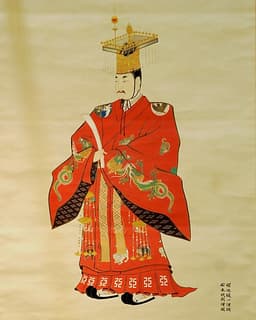
Emperor Go-Sanjo
Emperor · Medieval
44.5Total

Harold Harefoot
Emperor · Medieval
36.6Total
Basic Information
Born
1034
1015
Died
1073
1040
Era
Medieval
Medieval
Nationality
Japan
England
Occupation
Emperor
Emperor
Civilization
Eastern
Western
Score Comparison
Military (10%)
52.9
20.0
Political (20%)
35.1
27.9
Influence (20%)
47.9
47.1
Legacy (20%)
41.7
35.8
Leadership (15%)
31.2
39.0
Strategy (15%)
68.6
38.6
TOTAL
44.5
36.6
Emperor Go-Sanjo — Complete Timeline
1068 AD
Attempt to rule directly without Fujiwara regentsPolitical Action◆ Major
Upon ascending the throne, Go-Sanjo sought to govern without a Fujiwara regent, breaking the tradition of Fujiwara control over the imperial succession. He appointed non-Fujiwara officials and issued edicts directly, challenging the regency system.
Fujiwara RegencyImperial AuthorityHeian Period
Impact: nationalconstructive
1069 AD
Reform of land and tax policiesReform◆ Major
Go-Sanjo implemented policies to reclaim tax-exempt lands held by temples and aristocrats, aiming to strengthen imperial finances. These reforms reduced the economic power of the Fujiwara and other noble houses, though they faced resistance.
Land ReformTaxationEconomic Policy
Impact: nationalconstructive
1072 AD
Establishment of the Insei (cloistered government) precedentPolitical Action
Go-Sanjo abdicated in favor of his son Shirakawa but continued to exert influence from retirement, laying the groundwork for the cloistered government system. This allowed retired emperors to rule behind the scenes, bypassing Fujiwara regents.
Insei SystemImperial PoliticsHeian Period
Impact: nationalconstructive
Harold Harefoot — Complete Timeline
1035 AD
Regency for HarthacnutPolitical Action◆ Major
After Cnut's death, Harold Harefoot acted as regent for his half-brother Harthacnut, who was in Denmark. Harold controlled much of England, while Harthacnut's mother Emma held Wessex.
RegencySuccessionPower Struggle
Impact: national
1037 AD
Claim to the ThronePolitical Action◆ Major
Harold Harefoot was accepted as king of England by the Witan, the council of nobles. He ruled alone, while Harthacnut remained in Denmark unable to assert his claim.
CoronationSuccessionUsurpation
Impact: national
1040 AD
Death of Harold HarefootPolitical Action◆ Major
Harold died at Oxford on March 17, 1040. His death allowed Harthacnut to claim the English throne without opposition.
DeathSuccessionEnd of Reign
Impact: nationaltragic
Expert Analysis
Origins
Emperor Go-Sanjo was born in 1034 as the second son of Emperor Go-Suzaku. His mother was Princess Teishi, daughter of Emperor Sanjo, giving him a lineage distinct from the dominant Fujiwara clan. He received a traditional education in Chinese classics and court rituals, but his upbringing was marked by the political dominance of the Fujiwara regents, who controlled the imperial succession and reduced emperors to figureheads. Go-Sanjo's early life instilled a desire to restore imperial authority.
Harold Harefoot was born around 1016, the son of King Cnut of England and his first wife, Ælfgifu of Northampton. His early life was shaped by the complex politics of the North Sea Empire, as Cnut ruled England, Denmark, and Norway. Harold's mother was a powerful noblewoman, but his legitimacy was questioned because Cnut had married Emma of Normandy, who claimed her sons were the true heirs. Harold grew up in a court rife with rivalry between his mother's faction and Emma's.
Rise to Power
Go-Sanjo became emperor in 1068 upon the death of his half-brother Emperor Go-Reizei. Unlike previous emperors, Go-Sanjo was not a son of a Fujiwara regent's daughter; his mother was from the imperial line. This allowed him to rule without a Fujiwara regent, a break from tradition dating back to the 9th century. In 1072, he abdicated in favor of his son Shirakawa but continued to exert influence from retirement, establishing the precedent of cloistered government (insei).
Harold Harefoot's rise began after Cnut's death in 1035. Cnut had intended his son Harthacnut (from Emma) to inherit England, but Harthacnut was in Denmark. Harold's mother, Ælfgifu, pushed for Harold's claim. The Witan, the English council of nobles, split: the north supported Harold, while the south backed Harthacnut. By 1036, Harold controlled most of England, and Harthacnut's absence allowed Harold to be recognized as king in 1037. He ruled alone until his death in 1040.
Leadership & Governance
Go-Sanjo's governance focused on curbing Fujiwara power. He implemented land reforms, reclaiming tax-exempt lands (shōen) from temples and aristocrats to strengthen imperial finances. He also promoted capable officials outside the Fujiwara clan. His leadership style was assertive but cautious; he avoided direct confrontation by using abdication as a tool. His political score of 35.1 reflects limited success due to entrenched opposition.
Harold Harefoot's rule was brief and dominated by consolidation. He relied on his mother's faction and the support of northern earls. He did not implement significant reforms or military campaigns. His military score of 20.0 and leadership score of 39.0 indicate a passive style. He is often seen as a placeholder king, with no major legislative or cultural achievements.
Triumph & Tragedy
Go-Sanjo's greatest triumph was establishing the insei system, which allowed retired emperors to wield power without the constraints of court ritual. This system persisted for decades, enabling later emperors like Shirakawa to dominate. His tragedy was the limited scope of his reforms; many land policies were reversed after his death. His total score of 44.5 reflects a mixed legacy.
Harold Harefoot's triumph was securing the throne against rivals, a testament to his mother's political maneuvering. His tragedy was his early death at age 24, which allowed Harthacnut to reclaim England. His reign left no enduring institutions; his score of 36.6 is among the lowest for English monarchs.
Character & Destiny
Go-Sanjo was determined and strategic, with a score of 68.6 in strategy. He understood that direct rule was impossible, so he innovated with cloistered government. His character shaped his destiny: he set a precedent that strengthened the imperial line for generations.
Harold Harefoot was opportunistic but lacked ambition. His reliance on his mother and earls suggests indecisiveness. His destiny was to be a footnote in English history, overshadowed by his father and half-brother.
Legacy
Go-Sanjo's legacy is the insei system, which influenced Japanese politics until the 12th century. His reforms paved the way for later strong emperors. He is remembered as a reformer who challenged Fujiwara dominance.
Harold Harefoot's legacy is minimal. He is often omitted from lists of English kings or mentioned only as a usurper. His rule did not change the course of English history.
Conclusion
Emperor Go-Sanjo had a greater impact than Harold Harefoot. Despite a total score of 44.5 to Harold's 36.6, Go-Sanjo's political innovations endured for centuries, while Harold's brief reign was inconsequential. Go-Sanjo's strategy score of 68.6 underscores his foresight. Harold's reign was a temporary interruption in the succession; Go-Sanjo's was a pivotal shift in Japanese governance.
Rankings
🥇
Emperor Go-SanjoLeader
Mil: 52.9Pol: 35.1Inf: 47.9
44.5
🥈
Harold Harefoot
Mil: 20.0Pol: 27.9Inf: 47.1
36.6
+7.9 behind
How This Comparison Works
Algorithm
Each figure is scored on 6 dimensions (0—100 scale) based on structured historical data: Military (10%), Political (20%), Influence (20%), Legacy (20%), Leadership (15%), Strategy (15%). The weighted total produces the final ranking.
Data Sources
Scores are computed from structured sub-indicators in the database. Scale factors adjust for era (Ancient ×0.85, Modern ×1.0) and civilization size (Eastern ×1.05, Other ×0.80) to account for differences in population and military scale.
Maximum 3 Figures
Comparisons are limited to 2—3 figures to ensure readability and statistical meaningfulness.
Error Margins
±5 points per dimension — Sub-scores are derived from historical records with inherent uncertainty. Two figures within 5 points on a dimension should be considered roughly equivalent in that area.
Total Score Accuracy
±3 points overall — The weighted combination of 6 dimensions produces a total score with approximately ±3 points of uncertainty. Differences of less than 3 points are not statistically significant— the figures are effectively tied.
Known Limitations
- Historical records are incomplete and uneven across civilizations
- Figures from oral-tradition societies may be underrepresented
- Occupation labels can misclassify multi-role figures
- Scores measure capability and impact, not moral character
- Quantitative scoring is a comparison tool, not absolute truth
Capability Radar
Military (10%) — Battles & Warfare
Battles
45
5
Win Rate
47
5
Expansion
51
5
Political (20%) — Governance & Reform
Reform
40
0
Diplomacy
30
10
Economy
20
5
Influence (20%) — Cultural & Global Reach
Cultural
15
5
Global
10
5
Legacy (20%) — Historical Impact
Historical
30
10
Longevity
20
5
Leadership (15%) — Power & Stability
Tenure
15
15
Stability
20
10
Strategy (15%) — Tactics & Innovation
Strategy
52
5
Tactics
60
5
Reform
61
0
Similar Comparisons
Comments & Discussion
No comments yet. Be the first to share your thoughts!