Loading...
Emperor Kammu vs Julius Caesar
Julius Caesar leads by 17.9 pts · 2 figures compared
…
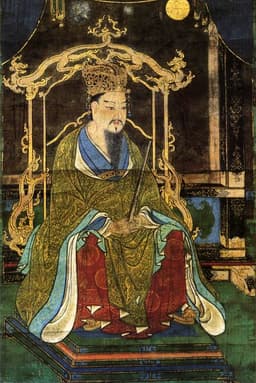
Emperor Kammu
Emperor · Medieval
64.9Total

Julius Caesar
General · Ancient
82.8Total
Basic Information
Born
737
-100
Died
806
-44
Era
Medieval
Ancient
Nationality
Japan
Roman Republic
Occupation
Emperor
General
Civilization
Eastern
Western
Score Comparison
Military (10%)
21.2
88.0
Political (20%)
72.0
78.0
Influence (20%)
82.0
85.0
Legacy (20%)
68.0
82.0
Leadership (15%)
72.0
80.0
Strategy (15%)
36.8
85.0
TOTAL
64.9
82.8
Emperor Kammu — Complete Timeline
789 AD
Campaign against the EmishiWar◆ Major
Kammu launched a major military campaign to subdue the Emishi people in northern Honshu. The campaign was initially unsuccessful, with a defeat at the Battle of Koromo River, but later efforts under Sakanoue no Tamuramaro achieved victory.
Military CampaignEmishiExpansion
Impact: national
794 AD
Moved the capital to Heian-kyoPolitical Action
Emperor Kammu moved the imperial capital from Nara to Heian-kyo (modern Kyoto). This relocation was intended to escape the influence of powerful Buddhist monasteries in Nara and marked the beginning of the Heian period.
Capital MoveHeian PeriodJapan
Impact: nationalconstructive
800 AD
Patronage of Buddhist templesCultural
Kammu commissioned the construction of several Buddhist temples in Heian-kyo, including To-ji and Sai-ji. These temples were intended to protect the new capital and promote Buddhism as a state religion.
BuddhismArchitectureReligion
Impact: nationalconstructive
Julius Caesar — Complete Timeline
58 BC
Gallic WarsWar◆ Major
Caesar, as proconsul of Gaul, launched a series of campaigns that conquered all of Gaul (modern France, Belgium, and parts of Switzerland). He fought numerous battles, including against the Helvetii, the Belgae, and the Gallic chieftain Vercingetorix. The wars brought immense wealth and a loyal army to Caesar.
Gallic WarsConquestRoman Expansion
Impact: regional
49 BC
Crossing the RubiconPolitical Action◆ Major
Caesar led Legio XIII across the Rubicon River into Italy, defying the Roman Senate's order to disband his army. This act triggered a civil war against Pompey and the Optimates, ultimately leading to Caesar's dictatorship and the end of the Roman Republic.
Roman Civil WarEnd of RepublicPower Struggle
Impact: global
48 BC
Battle of PharsalusWar◆ Major
Caesar's outnumbered army defeated the larger forces of Pompey the Great at Pharsalus in Greece. Caesar's tactical use of a reserve line to counter Pompey's cavalry charge proved decisive. Pompey fled to Egypt, where he was assassinated, leaving Caesar as the undisputed master of the Roman world.
Roman Civil WarBattleDecisive Victory
Impact: regional
44 BC
Appointment as Dictator for LifePolitical Action◆ Major
The Roman Senate appointed Caesar dictator perpetuo (dictator for life), granting him unprecedented personal power. This move concentrated military, legislative, and judicial authority in one person, effectively ending the Roman Republic's traditional system of checks and balances and alarming many senators.
DictatorshipEnd of RepublicPower Consolidation
Impact: regionaldestructive
Assassination on the Ides of MarchPolitical Action◆ Major
A group of Roman senators, led by Marcus Junius Brutus and Gaius Cassius Longinus, stabbed Caesar to death at a meeting of the Senate in the Theatre of Pompey. The assassination was intended to restore the Republic, but instead triggered another civil war that led to the rise of the Roman Empire.
AssassinationRoman PoliticsEnd of Republic
Impact: globaldestructive
Expert Analysis
emperor-kammu-vs-julius-caesar
# The General and the Emperor: Two Paths to Power, Two Kinds of Legacy
On a cold January morning in 49 BCE, Julius Caesar stood at the banks of the Rubicon River in northern Italy, contemplating an act that would shatter centuries of Roman tradition. By crossing that shallow stream with his legions, he would ignite a civil war and seal his own destiny. Nearly nine centuries later and half a world away, Emperor Kammu of Japan faced a different kind of crossing—not of a river, but of an entire political culture. In 794, he made the calculated decision to abandon the old capital of Nara, with its suffocating Buddhist monasteries and entrenched aristocratic factions, and build a new imperial city at Heian-kyo, the future Kyoto. Both men sought to reshape their worlds. One succeeded so spectacularly that his name became synonymous with imperial ambition; the other succeeded so quietly that most Western readers have never heard of him.
Origins
Julius Caesar was born into the chaos of the late Roman Republic, a world of civil wars, slave revolts, and senatorial corruption. His family, the Julii, claimed descent from the goddess Venus, but they were politically marginal. Young Caesar watched his uncle Gaius Marius fight bloody street battles against Sulla, and he learned early that in Rome, power belonged to those who could command armies and buy allegiances. He was a patrician by birth but a populist by necessity, fluent in the language of both the Forum and the battlefield.
Emperor Kammu was born in 737, the son of Emperor Konin, but his path was no less precarious. The Japanese imperial court was a web of rival clans—the Fujiwara, the Soga, the Nakatomi—each maneuvering for influence through marriages, Buddhist patronage, and control of the throne itself. Kammu was not the eldest son, and his ascent required patience, diplomacy, and a ruthless willingness to break with tradition. Where Caesar grew up amid the clang of swords, Kammu grew up amid the whisper of courtiers.
Rise to Power
Caesar’s rise was a masterclass in strategic ambition. He borrowed fortunes to fund lavish games, bought off tribunes, and forged the First Triumvirate with Pompey and Crassus—two men more powerful than himself. His appointment as governor of Gaul in 58 BCE gave him the one thing the Republic valued above all: a war. Over eight years, he conquered what is now France and Belgium, crossed the Rhine into Germany, and landed in Britain. The Gallic Wars made him rich, famous, and beloved by his legions. When the Senate ordered him to disband his army, he refused. The Rubicon was crossed. Within four years, he was dictator for life.
Kammu’s rise was quieter but no less determined. He became emperor in 781, inheriting a court dominated by the powerful Buddhist clergy of Nara. The old capital had become a city of temples and intrigue, and the monks wielded influence that rivaled the throne. Kammu moved decisively. In 789, he launched a major military campaign against the Emishi, the indigenous people of northern Honshu who had resisted Yamato rule for generations. The campaign was initially unsuccessful—the Emishi fought fiercely in their forested mountains—but Kammu persisted, and the threat of imperial expansion began to reshape Japan’s northern frontier.
Leadership & Governance
Caesar governed as he conquered: with speed, ruthlessness, and a show of generosity. He reformed the calendar (giving us the Julian calendar), granted citizenship to Gauls, and packed the Senate with his supporters. He was a military genius who led from the front, often fighting alongside his men, and a political pragmatist who pardoned his enemies—until he didn’t. His strategy was personal: loyalty to Caesar, not to Rome. His reforms were brilliant but fragile, because they depended on one man.
Kammu governed through institutions. He moved the capital to Heian-kyo in 794, a carefully planned city modeled on Chinese principles of geomancy and bureaucracy. The move was a political masterstroke: it freed the imperial court from Buddhist influence and placed the emperor at the center of a new, secular administration. Kammu also patronized Buddhist temples like To-ji and Sai-ji, but on his terms—as imperial foundations, not independent power bases. His military campaigns against the Emishi continued, but he relied on generals and governors rather than personal command. Where Caesar was a storm, Kammu was a tide.
Triumph & Tragedy
Caesar’s greatest triumph was his own survival: he defeated Pompey, crushed the Senate’s armies in Spain, Africa, and Egypt, and returned to Rome as absolute master of the Mediterranean world. But the tragedy was built into the triumph. His dictatorship alienated the very aristocracy he needed to govern. On the Ides of March, 44 BCE, a conspiracy of senators—many of them former allies—stabbed him to death in the Senate chamber. He fell at the foot of a statue of Pompey, his greatest rival.
Kammu’s triumph was more subtle. He died in 806, having reigned for 25 years, and left behind a capital that would endure for over a millennium. Heian-kyo became the heart of Japanese civilization—the world of *The Tale of Genji*, of court poetry, of a refined aesthetic that shaped Japan’s cultural identity. His tragedy was that he could not fully subdue the Emishi; the northern frontier remained a contested zone for generations. But he did something Caesar could not: he built a system that outlasted him.
Character & Destiny
Caesar was driven by an insatiable hunger for glory. He wrote his own commentaries, minted coins with his image, and accepted divine honors. He believed his destiny was to rule, and he was right—but only for a moment. His personality, brilliant and arrogant, created both his rise and his fall. He could not imagine a world in which he was not the center.
Kammu was driven by a different impulse: the preservation of the imperial institution. He was cautious, patient, and willing to compromise. He moved the capital not for personal glory but to secure the throne’s independence. His personality was suited to a world of ritual and hierarchy, where power flowed through channels, not storms. He understood that an emperor who rules for decades must think in centuries.
Legacy
Caesar’s legacy is the Roman Empire. His adopted heir Octavian became Augustus, the first emperor, and the Republic never returned. Caesar’s name became a title: *Kaiser*, *Tsar*. He is remembered as the man who destroyed the Republic and built an empire, a figure of endless fascination and controversy. His military campaigns are studied in war colleges; his assassination is one of history’s great dramas.
Kammu’s legacy is Heian-kyo—Kyoto—a city that remained Japan’s imperial capital until 1868. He is remembered as a wise administrator and a cultural patron, but his name is not a household word outside Japan. His political score of 65.7 and influence of 65.3 reflect a ruler who worked within the system, not one who shattered it. Yet his choices shaped Japanese civilization for a thousand years.
Conclusion
Two men, two worlds. Caesar crossed a river and changed history in a decade. Kammu moved a capital and changed history over centuries. The general’s story is a tragedy of ambition; the emperor’s story is a quiet triumph of endurance. Both were leaders of genius, but they answered different questions. Caesar asked: *How can one man master the world?* Kammu asked: *How can one man build a world that lasts?* The answers, and the legacies, could not be more different.
Rankings
🥇
Julius CaesarLeader
Mil: 88.0Pol: 78.0Inf: 85.0
82.8
🥈
Emperor Kammu
Mil: 21.2Pol: 72.0Inf: 82.0
64.9
+17.9 behind
How This Comparison Works
Algorithm
Each figure is scored on 6 dimensions (0—100 scale) based on structured historical data: Military (10%), Political (20%), Influence (20%), Legacy (20%), Leadership (15%), Strategy (15%). The weighted total produces the final ranking.
Data Sources
Scores are computed from structured sub-indicators in the database. Scale factors adjust for era (Ancient ×0.85, Modern ×1.0) and civilization size (Eastern ×1.05, Other ×0.80) to account for differences in population and military scale.
Maximum 3 Figures
Comparisons are limited to 2—3 figures to ensure readability and statistical meaningfulness.
Error Margins
±5 points per dimension — Sub-scores are derived from historical records with inherent uncertainty. Two figures within 5 points on a dimension should be considered roughly equivalent in that area.
Total Score Accuracy
±3 points overall — The weighted combination of 6 dimensions produces a total score with approximately ±3 points of uncertainty. Differences of less than 3 points are not statistically significant— the figures are effectively tied.
Known Limitations
- Historical records are incomplete and uneven across civilizations
- Figures from oral-tradition societies may be underrepresented
- Occupation labels can misclassify multi-role figures
- Scores measure capability and impact, not moral character
- Quantitative scoring is a comparison tool, not absolute truth
Capability Radar
Military (10%) — Battles & Warfare
Battles
10
95
Win Rate
10
92
Expansion
10
97
Political (20%) — Governance & Reform
Reform
75
90
Diplomacy
60
85
Economy
65
82
Influence (20%) — Cultural & Global Reach
Cultural
70
88
Global
60
94
Legacy (20%) — Historical Impact
Historical
75
95
Longevity
75
96
Leadership (15%) — Power & Stability
Tenure
70
75
Stability
60
60
Strategy (15%) — Tactics & Innovation
Strategy
10
94
Tactics
10
96
Reform
10
88
Similar Comparisons
Comments & Discussion
Caesar-Crosser6/17/2026
Comparing Kammu's move to Kyoto with Caesar crossing the Rubicon is like comparing a real estate deal to a revolution. Caesar committed high treason by marching on Rome, knowing it meant civil war and the death of a republic. Kammu relocated a capital to escape Buddhist tax exemptions. One risked everything for supreme power; the other just wanted to get out of a bad lease. Military history respects real gambles, not bureaucratic renovations.
铁血史官6/17/2026
别把桓武天皇和凯撒相提并论。凯撒渡卢比孔河是在赌博他的生命、他的军团和罗马共和国的命运。桓武天皇迁都平安京?他只是厌倦了奈良的和尚。一次是革命性背叛,一次是城市规划调整。从军事角度看,这根本不是同一量级的行为——一个是敢于夺取天下的将军,一个是搬家避风的皇帝。
NumericNarrator6/17/2026
If we're judging by data rather than drama, Kammu actually outperforms Caesar on the metrics that matter for long-term stability. Caesar's rule lasted about 5 years before assassination. Kammu reigned 25 years, moved the capital, and his dynasty held power for nearly 400 years after his death. The Roman Empire collapsed within 500 years. Caesar made headlines; Kammu built foundations. Who had the better strategic plan? The numbers don't lie.
古典学人6/17/2026
凯撒是古典世界的塑造者,桓武天皇只是东亚史中的一个脚注。凯撒的《高卢战记》至今仍被拉丁文学生阅读,他的历法改革沿用了几百年,他的政治暗杀终结了罗马共和国。桓武天皇做了什么?他搬到了京都,镇压了虾夷人。抱歉,但当我们比较影响文明进程的人物时,一个征服高卢、改变罗马、定义西方历史的人,显然超过了迁都的东方统治者。