Loading...
Emperor Taizu of Jin vs Kutlug I Bilge Kagan
Emperor Taizu of Jin leads by 8.0 pts · 2 figures compared
…
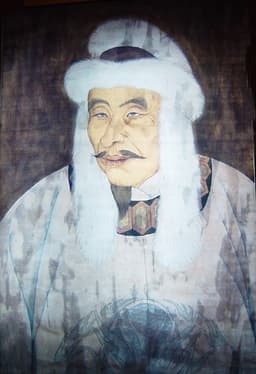
Emperor Taizu of Jin
Emperor · Medieval
63.5Total

Kutlug I Bilge Kagan
Emperor · Medieval
55.5Total
Basic Information
Born
1068
705
Died
1123
747
Era
Medieval
Medieval
Nationality
China
Uyghur Khaganate
Occupation
Emperor
Emperor
Civilization
Eastern
Eastern
Score Comparison
Military (10%)
82.0
72.5
Political (20%)
65.0
68.0
Influence (20%)
55.0
57.2
Legacy (20%)
55.0
49.2
Leadership (15%)
72.0
40.0
Strategy (15%)
72.0
55.0
TOTAL
63.5
55.5
Emperor Taizu of Jin — Complete Timeline
1114 AD
Unification of the Jurchen tribesWar◆ Major
Wanyan Aguda led the Jurchen tribes in a rebellion against the Khitan-led Liao dynasty. He unified the Jurchen clans under his leadership, establishing a confederation that would form the basis of the Jin dynasty.
Jurchen unificationRebellionLiao dynasty
Impact: regionalconstructive
1115 AD
Battle of Hubu RiverWar◆ Major
Aguda's Jin forces defeated a Liao army at the Hubu River. This victory secured Jin control over the Liao's eastern territories and demonstrated the military effectiveness of the Jurchen cavalry against the Khitan.
BattleLiao-Jin WarMilitary victory
Impact: regional
Proclamation of the Jin dynastyPolitical Action◆ Major
Wanyan Aguda declared himself emperor, founding the Jin dynasty. He adopted the Chinese-style reign name Shouguo and established a centralized administration, marking the formal beginning of the Jin state.
Dynasty foundingImperial proclamationJin dynasty
Impact: regionalconstructive
1120 AD
Capture of the Liao Supreme CapitalWar◆ Major
Jin forces under Aguda captured the Liao dynasty's Supreme Capital (Shangjing). This conquest crippled the Liao state and forced the Liao emperor Tianzuo to flee, effectively ending Liao resistance in the region.
Capital captureLiao-Jin WarConquest
Impact: regional
Alliance with the Song dynastyPolitical Action◆ Major
Aguda negotiated the Alliance of the Sea with the Song dynasty, agreeing to jointly attack the Liao dynasty. The Song would receive the Sixteen Prefectures, while Jin would take the rest of Liao territory.
Diplomatic allianceSong-Jin relationsLiao partition
Impact: regional
Kutlug I Bilge Kagan — Complete Timeline
744 AD
Foundation of the Uyghur KhaganatePolitical Action
Kutlug I Bilge Kagan led the Uyghur tribes in overthrowing the Second Turkic Khaganate. He proclaimed himself khagan, establishing the Uyghur Khaganate with its capital at Ordu-Baliq.
FoundationUyghur KhaganateIndependence
Impact: regionalconstructive
745 AD
Alliance with the Tang dynastyPolitical Action◆ Major
Kutlug I Bilge Kagan formed an alliance with the Tang dynasty against the remnants of the Turkic Khaganate. This alliance secured Tang recognition of the Uyghur Khaganate and provided military support.
AllianceTang DynastyDiplomacy
Impact: regionalconstructive
747 AD
Consolidation of Uyghur powerPolitical Action◆ Major
Kutlug I Bilge Kagan consolidated Uyghur control over the former Turkic territories, incorporating tribes such as the Basmyls and Karluks. He established a centralized administration and promoted trade.
ConsolidationAdministrationTrade
Impact: regionalconstructive
Death and successionPolitical Action
Kutlug I Bilge Kagan died in 747, succeeded by his son Bogu Qaghan. His death marked the end of the founding phase of the Uyghur Khaganate, which continued to expand under his successors.
DeathSuccessionLegacy
Impact: regional
Expert Analysis
Origins
Emperor Taizu of Jin, born Wanyan Aguda (1068–1123), was a chieftain of the Wanyan clan among the Jurchen people, semi-nomadic tribes inhabiting the forests and rivers of modern northeastern China. His father, Helibo, had begun unifying Jurchen clans against the Khitan-led Liao dynasty. Aguda inherited a confederation in flux, with internal rivalries and external pressure from the Liao. He was raised in a warrior culture, learning horsemanship and archery from youth, and participated in campaigns against neighboring tribes. His early exposure to Chinese administrative practices came through contact with Liao officials.
Kutlug I Bilge Kagan (died 747), originally named Kutlug, was a member of the Ashina clan, the traditional ruling family of the Turkic Khaganates. He emerged as a leader of the Uyghur tribe, one of several Turkic groups under the declining Second Turkic Khaganate. Little is known of his early life, but he likely served as a military commander under the Turkic khagans. The Uyghurs were a confederation of nine tribes (Toquz Oghuz) who had been subjects of the Turks. Kutlug capitalized on the internal strife within the Turkic Khaganate after the death of Bilge Khagan in 734.
Rise to Power
Aguda's rise began in 1113 when he succeeded his brother as chieftain of the Wanyan clan. He immediately pursued unification of the Jurchen tribes, using a combination of diplomacy and force. In 1114, he led a rebellion against the Liao dynasty, which had exploited Jurchen labor and resources. His first major victory came at the Battle of Ningjiangzhou in 1114, where his outnumbered forces defeated a Liao army. In 1115, he proclaimed himself emperor, founding the Jin dynasty with the reign name Shouguo. Key to his success was the Alliance of the Sea (1120) with the Song dynasty, agreeing to jointly attack the Liao. Aguda's forces captured the Liao Supreme Capital in 1120 and the Western Capital in 1122, effectively ending Liao rule.
Kutlug I Bilge Kagan's rise was more abrupt. In 744, he led a Uyghur revolt against the Turkic Khaganate, which was weakened by succession struggles. He allied with the Tang dynasty, who saw the Uyghurs as a counterweight to the Turks. In 745, his forces defeated the last Turkic khagan, Ozmish Khagan, and Kutlug declared himself khagan of the Uyghur Khaganate. He adopted the title "I Bilge" ("Wise and Brave") and established his capital at Ordu-Baliq in the Orkhon Valley. His alliance with Tang was formalized through marriage to a Tang princess, securing recognition and military support.
Leadership & Governance
Aguda's governance blended Jurchen tribal traditions with Chinese bureaucratic models. He established a dual administration: a "Southern Chancellery" for Chinese subjects and a "Northern Chancellery" for Jurchen and other steppe peoples. He promoted agriculture among the Jurchens, built granaries, and issued a legal code. His leadership was personal; he led troops in battle and maintained loyalty through charisma and rewards. However, his reliance on tribal chiefs created tensions between central authority and local autonomy.
Kutlug I Bilge Kagan's governance was more traditional steppe-based. He organized the Uyghur state around a military-administrative system inherited from the Turks, with a khagan at the top and subordinate tribal leaders. He adopted the Uyghur alphabet from the Sogdians, which became a vehicle for administration and culture. His alliance with Tang brought Chinese influence, but he maintained the nomadic military structure. Unlike Aguda, he did not create a dual administration; the Uyghur Khaganate remained a steppe empire with a strong cavalry core.
Triumph & Tragedy
Aguda's greatest triumph was the destruction of the Liao dynasty, a feat that established the Jin as a major power in East Asia. He conquered Liao territories from the steppe to the borders of Song China. His military score of 82.0 reflects his battlefield successes. His tragedy was his early death in 1123, just as the Jin were poised to expand further. He did not live to see the conquest of the Song capital Kaifeng in 1127, which his successors achieved. His political score of 65.0 indicates that while he founded a dynasty, the institutional foundations were incomplete, leading to later instability.
Kutlug's triumph was the establishment of the Uyghur Khaganate, which dominated the eastern steppe for nearly a century. His alliance with Tang secured recognition and trade advantages. His military score of 72.5 shows competent but not exceptional generalship. His tragedy was the fragility of his creation: after his death in 747, his son Bogu Qaghan faced revolts and eventual decline. The Uyghur Khaganate collapsed in 840 under Kyrgyz attacks. Kutlug's legacy score of 49.2 reflects the short-lived nature of his dynasty.
Character & Destiny
Aguda was decisive and pragmatic. He personally led charges in battle and was known for his strategic acumen, particularly in the use of cavalry and siege warfare. His decision to ally with the Song was a masterstroke that allowed him to focus on the Liao. However, his trust in tribal leaders sometimes backfired, as some defected. His early death prevented him from consolidating the empire, leaving his successors to face internal divisions.
Kutlug was ambitious and opportunistic, seizing the moment when the Turkic Khaganate crumbled. He was willing to subordinate Uyghur sovereignty to Tang suzerainty to gain legitimacy. His leadership score of 40.0 suggests he was less effective in maintaining unity; after his death, the khaganate faced succession crises. He was more a unifier than a conqueror, but his state lacked the institutional depth of the Jin.
Legacy
Aguda's legacy is the Jin dynasty, which ruled northern China until 1234. He established a pattern of Jurchen-Chinese synthesis that influenced later dynasties like the Yuan and Qing. The Jin introduced the Jurchen script and promoted Buddhism. His military campaigns weakened the Liao and set the stage for the Jin-Song wars. His influence score of 55.0 reflects his role as a founder but not a world-historical figure.
Kutlug's legacy is the Uyghur Khaganate, which preserved Turkic culture and fostered the development of the Uyghur script and Manichaeism. The Uyghurs later became cultural intermediaries between China and the Islamic world. However, the khaganate's collapse meant his personal impact was limited. His legacy score of 49.2 is lower than Aguda's, partly because the Uyghur state was shorter-lived.
Conclusion
Emperor Taizu of Jin had greater impact than Kutlug I Bilge Kagan. Aguda's Jin dynasty controlled a larger territory, lasted longer (120 years vs. 96 years for the Uyghur Khaganate), and directly influenced Chinese history through the Jin-Song wars and the eventual Mongol conquest. His military score of 82.0 and total score of 63.5 exceed Kutlug's 72.5 and 55.5. While Kutlug founded a significant steppe empire, his state was more fragile and less transformative. Aguda's unification of the Jurchen and destruction of the Liao reshaped East Asian geopolitics, whereas the Uyghur Khaganate remained a regional power. Therefore, Aguda is the more consequential figure.
Rankings
🥇
Emperor Taizu of JinLeader
Mil: 82.0Pol: 65.0Inf: 55.0
63.5
🥈
Kutlug I Bilge Kagan
Mil: 72.5Pol: 68.0Inf: 57.2
55.5
+8.0 behind
How This Comparison Works
Algorithm
Each figure is scored on 6 dimensions (0—100 scale) based on structured historical data: Military (10%), Political (20%), Influence (20%), Legacy (20%), Leadership (15%), Strategy (15%). The weighted total produces the final ranking.
Data Sources
Scores are computed from structured sub-indicators in the database. Scale factors adjust for era (Ancient ×0.85, Modern ×1.0) and civilization size (Eastern ×1.05, Other ×0.80) to account for differences in population and military scale.
Maximum 3 Figures
Comparisons are limited to 2—3 figures to ensure readability and statistical meaningfulness.
Error Margins
±5 points per dimension — Sub-scores are derived from historical records with inherent uncertainty. Two figures within 5 points on a dimension should be considered roughly equivalent in that area.
Total Score Accuracy
±3 points overall — The weighted combination of 6 dimensions produces a total score with approximately ±3 points of uncertainty. Differences of less than 3 points are not statistically significant— the figures are effectively tied.
Known Limitations
- Historical records are incomplete and uneven across civilizations
- Figures from oral-tradition societies may be underrepresented
- Occupation labels can misclassify multi-role figures
- Scores measure capability and impact, not moral character
- Quantitative scoring is a comparison tool, not absolute truth
Capability Radar
Military (10%) — Battles & Warfare
Battles
85
55
Win Rate
90
60
Expansion
85
65
Political (20%) — Governance & Reform
Reform
75
55
Diplomacy
80
60
Economy
65
50
Influence (20%) — Cultural & Global Reach
Cultural
55
40
Global
50
35
Legacy (20%) — Historical Impact
Historical
70
50
Longevity
60
45
Leadership (15%) — Power & Stability
Tenure
70
60
Stability
60
55
Strategy (15%) — Tactics & Innovation
Strategy
85
55
Tactics
88
50
Reform
75
45
Similar Comparisons
Comments & Discussion
No comments yet. Be the first to share your thoughts!