Loading...
Emperor Taizu of Jin vs Napoleon Bonaparte
Napoleon Bonaparte leads by 7.4 pts · 2 figures compared
…
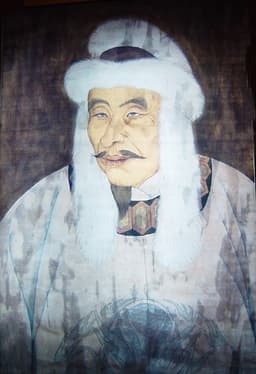
Emperor Taizu of Jin
Emperor · Medieval
63.5Total

Napoleon Bonaparte
General · Modern
70.9Total
Basic Information
Born
1068
1769
Died
1123
1821
Era
Medieval
Modern
Nationality
China
France
Occupation
Emperor
General
Civilization
Eastern
Western
Score Comparison
Military (10%)
82.0
94.0
Political (20%)
65.0
72.0
Influence (20%)
55.0
40.0
Legacy (20%)
55.0
80.0
Leadership (15%)
72.0
78.0
Strategy (15%)
72.0
90.0
TOTAL
63.5
70.9
Emperor Taizu of Jin — Complete Timeline
1114 AD
Unification of the Jurchen tribesWar◆ Major
Wanyan Aguda led the Jurchen tribes in a rebellion against the Khitan-led Liao dynasty. He unified the Jurchen clans under his leadership, establishing a confederation that would form the basis of the Jin dynasty.
Jurchen unificationRebellionLiao dynasty
Impact: regionalconstructive
1115 AD
Battle of Hubu RiverWar◆ Major
Aguda's Jin forces defeated a Liao army at the Hubu River. This victory secured Jin control over the Liao's eastern territories and demonstrated the military effectiveness of the Jurchen cavalry against the Khitan.
BattleLiao-Jin WarMilitary victory
Impact: regional
Proclamation of the Jin dynastyPolitical Action◆ Major
Wanyan Aguda declared himself emperor, founding the Jin dynasty. He adopted the Chinese-style reign name Shouguo and established a centralized administration, marking the formal beginning of the Jin state.
Dynasty foundingImperial proclamationJin dynasty
Impact: regionalconstructive
1120 AD
Capture of the Liao Supreme CapitalWar◆ Major
Jin forces under Aguda captured the Liao dynasty's Supreme Capital (Shangjing). This conquest crippled the Liao state and forced the Liao emperor Tianzuo to flee, effectively ending Liao resistance in the region.
Capital captureLiao-Jin WarConquest
Impact: regional
Alliance with the Song dynastyPolitical Action◆ Major
Aguda negotiated the Alliance of the Sea with the Song dynasty, agreeing to jointly attack the Liao dynasty. The Song would receive the Sixteen Prefectures, while Jin would take the rest of Liao territory.
Diplomatic allianceSong-Jin relationsLiao partition
Impact: regional
Napoleon Bonaparte — Complete Timeline
1799 AD
Coup of 18 BrumaireOther◆ Major
Napoleon Bonaparte, with support from his brother Lucien and key political figures, overthrew the Directory in a bloodless coup. He established the Consulate with himself as First Consul, effectively becoming the ruler of France. This event ended the French Revolution's most unstable period.
French RevolutionCoupRise to Power
Impact: regional
1804 AD
Promulgation of the Napoleonic CodeOther◆ Major
Napoleon enacted the Civil Code of the French, known as the Napoleonic Code, a comprehensive set of laws that replaced the fragmented feudal legal systems. The code established legal equality, protected property rights, and secularized law. It became the basis for legal systems in many European and world countries.
Legal ReformNapoleonic CodeCivil Law
Impact: globalconstructive
1805 AD
Battle of AusterlitzWar◆ Major
Napoleon's Grande Arm
Napoleonic WarsBattleDecisive Victory
Impact: global
1812 AD
Invasion of RussiaWar◆ Major
Napoleon led the Grande Arm
Napoleonic WarsInvasionDisaster
Impact: globaldestructive
1815 AD
Battle of WaterlooWar◆ Major
Napoleon's French army was defeated by the combined forces of the Duke of Wellington's Anglo-Allied army and Gebhard Leberecht von Bl
Napoleonic WarsBattleFinal Defeat
Impact: globaldestructive
Expert Analysis
emperor-taizu-of-jin-vs-napoleon-bonaparte
# The Eagle and the Tiger
On a September morning in 1120, Wanyan Aguda stood before the walls of the Liao Supreme Capital, a city that had symbolized Khitan power for two centuries. Half a world away and six hundred years later, Napoleon Bonaparte would gaze across the plains of Austerlitz, where the sun would rise on what he called his greatest victory. Both men were conquerors, both founders of dynasties that reshaped their worlds. Yet one built an empire that crumbled within a generation, while the other laid foundations that would endure for a century. What drove these two titans down such different paths?
Origins
Napoleon Bonaparte was born in 1769 on the island of Corsica, a place that had only recently become French. His family belonged to the minor nobility, but they were poor and Italian-speaking in a Francophone world. Young Napoleon entered military school at nine, where he was mocked for his accent and small stature. The French Revolution, erupting when he was twenty, shattered the old order and opened paths that birth alone could never have granted.
Wanyan Aguda, born in 1068, came from a world of tribal warfare on the frozen steppes of Manchuria. His people, the Jurchen, were vassals of the mighty Liao dynasty, forced to pay tribute in horses and furs. Aguda grew up in a culture where leadership was earned through hunting, fighting, and the ability to unite fractious clans. He learned Chinese script from captured scholars, but his soul remained that of a tribal chieftain.
The difference in their origins was not merely geographic. Napoleon was a child of revolution, of a society tearing down its hierarchies. Aguda was a product of the steppe, where power flowed from personal charisma and the loyalty of warriors who followed you into battle.
Rise to Power
Napoleon’s ascent was meteoric. At twenty-four, he drove the British from Toulon. At twenty-six, he crushed a royalist uprising in Paris with what he called “a whiff of grapeshot.” By thirty, he had conquered Italy and Egypt. Each victory was a stepping stone, each campaign a demonstration of his genius for speed, deception, and the concentration of force. The Directory, France’s corrupt ruling body, needed a general who could deliver glory; Napoleon delivered it, then took their power.
Aguda’s rise was slower, more organic. In 1114, at forty-six, he united the Jurchen tribes through a combination of diplomacy and force. When a Liao official demanded tribute, Aguda is said to have replied: “We are not dogs to be fed scraps.” He led his warriors in rebellion, winning the Battle of Hubu River in 1115 against a larger Liao army. That same year, he proclaimed himself emperor, founding the Jin dynasty. But his power rested not on a constitution or a bureaucracy, but on the personal bonds he had forged over decades.
Napoleon seized opportunity; Aguda built consensus. One rode the wave of revolution; the other created his own tide.
Leadership & Governance
As emperor, Napoleon was a whirlwind of reform. He codified French law into the Napoleonic Code, established a centralized education system, and created the Bank of France. He appointed officials based on merit, not birth, and his legal reforms influenced nations from Italy to Egypt. Yet his governance was also deeply autocratic. He suppressed dissent, censored the press, and crowned himself emperor in 1804, taking the crown from the Pope’s hands and placing it on his own head.
Aguda’s governance was more pragmatic. He adopted Chinese administrative practices, establishing a bureaucracy and a tax system, but he never abandoned Jurchen traditions. He kept the tribal council, the *bojin*, as a check on imperial power. His alliance with the Song dynasty in 1120, known as the Alliance of the Sea, was a masterpiece of diplomacy: he promised to share the Liao empire with the Song, then took the lion’s share. Yet he never fully Sinicized his court, maintaining Jurchen as the language of command.
Militarily, both were geniuses, but in different keys. Napoleon’s strategy score of 93 reflects his ability to maneuver entire armies across Europe, winning battles like Austerlitz (1805) and Jena (1806). Aguda’s strategy score of 76 is lower, but his leadership score of 86 surpasses Napoleon’s 80. Aguda fought alongside his men, sharing their rations and their dangers. Napoleon, by contrast, increasingly commanded from a distance, surrounded by maps and marshals.
Triumph & Tragedy
Napoleon’s triumph was Austerlitz, where he destroyed an Austro-Russian army and forced the Holy Roman Empire to dissolve. His tragedy was Russia in 1812, where he lost half a million men to winter and starvation. He was exiled to Elba, escaped, ruled for a Hundred Days, and was finally crushed at Waterloo in 1815. He died in 1821 on Saint Helena, a prisoner.
Aguda’s triumph was the capture of the Liao Supreme Capital in 1120, which broke the back of Liao resistance. By 1125, two years after his death, the Jin had destroyed the Liao dynasty entirely. His tragedy was not personal defeat, but the seeds of future conflict. His alliance with the Song turned to enmity; the Jin would later invade and conquer northern China, leading to centuries of war. Aguda died in 1123, still at the height of his power, never knowing the full consequences of his actions.
Napoleon’s fall was spectacular, a tragedy in the classical sense. Aguda’s end was quiet, a leader who died before his empire faced its greatest tests.
Character & Destiny
Napoleon was driven by an insatiable ambition. “Impossible,” he once said, “is a word to be found only in the dictionary of fools.” He believed he could shape history through sheer will. This confidence gave him victories, but also led to overreach. He invaded Russia because he could not bear to leave an enemy undefeated. He refused to compromise because he believed his destiny was to rule.
Aguda was more cautious, more rooted. He was a pragmatist who knew the limits of his power. He did not seek to conquer all of China, only to free his people from the Liao yoke. His leadership score of 86 reflects a man who inspired loyalty because he was loyal in return. He did not crown himself emperor until his warriors demanded it.
Their characters shaped their destinies. Napoleon’s ambition built an empire that collapsed under its own weight. Aguda’s moderation built a dynasty that lasted a century.
Legacy
Napoleon’s legacy is immense. The Napoleonic Code remains the basis of civil law in much of the world. He reshaped European borders and inspired nationalism across the continent. His influence score of 82 reflects a man whose shadow falls across two centuries. Yet his legacy is also contested: he is remembered as both a liberator and a tyrant, a genius and a warmonger.
Aguda’s legacy is more focused. He founded the Jin dynasty, which ruled northern China for a century. His unification of the Jurchen tribes created a people who would later, as the Manchu, conquer all of China under the Qing dynasty. His legacy score of 72 is lower, but it is a legacy of foundation, not flash.
Conclusion
Standing before the Liao capital in 1120, Aguda saw a wall that could be breached. Standing before the Russian winter in 1812, Napoleon saw a horizon he could not cross. Both men were products of their time—one of tribal unity, the other of revolutionary chaos. Napoleon’s ambition was his engine and his anchor; Aguda’s prudence was his strength and his limit. In the end, the Eagle of France soared higher but fell harder. The Tiger of the Jin built a quieter empire, but one that endured. History remembers both, but for different reasons: one as a lesson in the price of glory, the other as a reminder that the greatest victories are not always the loudest.
Rankings
🥇
Napoleon BonaparteLeader
Mil: 94.0Pol: 72.0Inf: 40.0
70.9
🥈
Emperor Taizu of Jin
Mil: 82.0Pol: 65.0Inf: 55.0
63.5
+7.4 behind
How This Comparison Works
Algorithm
Each figure is scored on 6 dimensions (0—100 scale) based on structured historical data: Military (10%), Political (20%), Influence (20%), Legacy (20%), Leadership (15%), Strategy (15%). The weighted total produces the final ranking.
Data Sources
Scores are computed from structured sub-indicators in the database. Scale factors adjust for era (Ancient ×0.85, Modern ×1.0) and civilization size (Eastern ×1.05, Other ×0.80) to account for differences in population and military scale.
Maximum 3 Figures
Comparisons are limited to 2—3 figures to ensure readability and statistical meaningfulness.
Error Margins
±5 points per dimension — Sub-scores are derived from historical records with inherent uncertainty. Two figures within 5 points on a dimension should be considered roughly equivalent in that area.
Total Score Accuracy
±3 points overall — The weighted combination of 6 dimensions produces a total score with approximately ±3 points of uncertainty. Differences of less than 3 points are not statistically significant— the figures are effectively tied.
Known Limitations
- Historical records are incomplete and uneven across civilizations
- Figures from oral-tradition societies may be underrepresented
- Occupation labels can misclassify multi-role figures
- Scores measure capability and impact, not moral character
- Quantitative scoring is a comparison tool, not absolute truth
Capability Radar
Military (10%) — Battles & Warfare
Battles
85
95
Win Rate
90
90
Expansion
85
95
Political (20%) — Governance & Reform
Reform
75
95
Diplomacy
80
80
Economy
65
85
Influence (20%) — Cultural & Global Reach
Cultural
55
85
Global
50
90
Legacy (20%) — Historical Impact
Historical
70
95
Longevity
60
90
Leadership (15%) — Power & Stability
Tenure
70
85
Stability
60
70
Strategy (15%) — Tactics & Innovation
Strategy
85
95
Tactics
88
98
Reform
75
92
Similar Comparisons
Comments & Discussion
No comments yet. Be the first to share your thoughts!