Loading...
Empress Jingu vs Julius Caesar
Julius Caesar leads by 39.1 pts · 2 figures compared
…
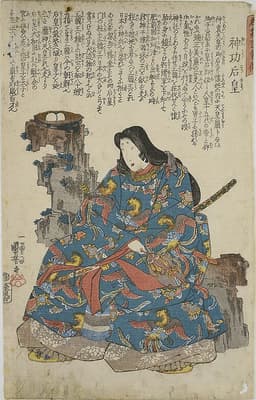
Empress Jingu
Emperor · Ancient
43.7Total

Julius Caesar
General · Ancient
82.8Total
Basic Information
Born
169
-100
Died
269
-44
Era
Ancient
Ancient
Nationality
Japan
Roman Republic
Occupation
Emperor
General
Civilization
Eastern
Western
Score Comparison
Military (10%)
55.0
88.0
Political (20%)
33.6
78.0
Influence (20%)
51.8
85.0
Legacy (20%)
44.2
82.0
Leadership (15%)
33.6
80.0
Strategy (15%)
41.0
85.0
TOTAL
43.7
82.8
Empress Jingu — Complete Timeline
200 AD
Conquest of the Three Korean KingdomsWar◆ Major
According to the Nihon Shoki, Empress Jingu led a naval expedition to the Korean peninsula and conquered the kingdoms of Silla, Baekje, and Goguryeo. This legendary campaign is said to have established Japanese dominance in Korea for several centuries, though archaeological evidence is lacking.
Korean CampaignLegendary ConquestYamato
Impact: regional
210 AD
Returned from Korea with TributePolitical Action
After her legendary conquest, Empress Jingu is said to have returned to Japan with tribute from the Korean kingdoms, including gold, silver, and textiles. This event is recorded as a triumph that enriched the Yamato court and solidified her reputation as a warrior ruler.
TributeDiplomacyWealth
Impact: nationalconstructive
Regency for Emperor OjinPolitical Action
Empress Jingu is said to have served as regent for her son, Emperor Ojin, after her husband's death. Her regency is credited with maintaining stability and continuing the expansion of Yamato influence, though the historical accuracy of her rule is disputed.
RegencySuccessionYamato
Impact: nationalconstructive
Julius Caesar — Complete Timeline
58 BC
Gallic WarsWar◆ Major
Caesar, as proconsul of Gaul, launched a series of campaigns that conquered all of Gaul (modern France, Belgium, and parts of Switzerland). He fought numerous battles, including against the Helvetii, the Belgae, and the Gallic chieftain Vercingetorix. The wars brought immense wealth and a loyal army to Caesar.
Gallic WarsConquestRoman Expansion
Impact: regional
49 BC
Crossing the RubiconPolitical Action◆ Major
Caesar led Legio XIII across the Rubicon River into Italy, defying the Roman Senate's order to disband his army. This act triggered a civil war against Pompey and the Optimates, ultimately leading to Caesar's dictatorship and the end of the Roman Republic.
Roman Civil WarEnd of RepublicPower Struggle
Impact: global
48 BC
Battle of PharsalusWar◆ Major
Caesar's outnumbered army defeated the larger forces of Pompey the Great at Pharsalus in Greece. Caesar's tactical use of a reserve line to counter Pompey's cavalry charge proved decisive. Pompey fled to Egypt, where he was assassinated, leaving Caesar as the undisputed master of the Roman world.
Roman Civil WarBattleDecisive Victory
Impact: regional
44 BC
Appointment as Dictator for LifePolitical Action◆ Major
The Roman Senate appointed Caesar dictator perpetuo (dictator for life), granting him unprecedented personal power. This move concentrated military, legislative, and judicial authority in one person, effectively ending the Roman Republic's traditional system of checks and balances and alarming many senators.
DictatorshipEnd of RepublicPower Consolidation
Impact: regionaldestructive
Assassination on the Ides of MarchPolitical Action◆ Major
A group of Roman senators, led by Marcus Junius Brutus and Gaius Cassius Longinus, stabbed Caesar to death at a meeting of the Senate in the Theatre of Pompey. The assassination was intended to restore the Republic, but instead triggered another civil war that led to the rise of the Roman Empire.
AssassinationRoman PoliticsEnd of Republic
Impact: globaldestructive
Expert Analysis
empress-jingu-vs-julius-caesar
# The Crossing and the Conqueror: Two Paths to Power
On a winter morning in 49 BCE, Julius Caesar stood at the banks of the Rubicon River in northern Italy. The law was clear: no general could bring his army across this boundary into the Roman homeland. To do so was treason, punishable by death. Caesar paused, then gave the order. "The die is cast," he reportedly said, and marched his legions into history. Nearly two centuries earlier and half a world away, a Japanese empress named Jingu is said to have stood on a ship's prow, gazing at the Korean coastline. According to the *Nihon Shoki*, she led a fleet across the sea, conquered three kingdoms, and returned with tribute—all while pregnant with the future emperor. One story is fact, the other legend. Yet both figures reveal how ambition, timing, and sheer will can reshape the world—or the stories we tell about it.
Origins
Julius Caesar was born into the chaos of the late Roman Republic, a world of civil wars, debt crises, and aristocratic competition. His family, the Julii, claimed descent from the goddess Venus, but they were politically marginal. Caesar grew up in a Rome where the old senatorial order was cracking under the weight of empire. His father died when he was sixteen, and Caesar soon found himself on the wrong side of the dictator Sulla's purges. He fled, served in the army in Asia Minor, and learned early that survival required cunning and risk.
Empress Jingu, by contrast, emerged from a Japan still forming its identity—a collection of clans and chieftains under the Yamato court. The historical record is thin, but legend paints her as the wife of Emperor Chuai, a ruler who died while campaigning against local rebels. Jingu was thrust into power not by choice but by circumstance. Her world was one of ritual, shamanic authority, and tribal warfare, where a woman could rule only if she channeled divine will. The difference in their origins is stark: Caesar fought for a place in a sophisticated state; Jingu inherited a role in a mythic one.
Rise to Power
Caesar's ascent was a masterclass in calculated ambition. He climbed the Roman political ladder—quaestor, aedile, praetor, consul—using alliances, bribes, and military glory. His conquest of Gaul (58–50 BCE) was a brutal, decade-long campaign that made him fabulously wealthy and gave him a loyal army. He wrote his own propaganda in the *Commentaries*, turning battles into bestsellers. When the Senate ordered him to disband his forces, he knew his enemies wanted him dead. The Rubicon was his gamble for survival and supremacy.
Jingu's rise is shrouded in the supernatural. After her husband's death, she is said to have been possessed by gods who commanded her to invade Korea. She led a fleet in 200 CE, conquered the Three Korean Kingdoms—Silla, Baekje, and Goguryeo—and returned home with tribute and hostages. Then, rather than seize the throne, she served as regent for her son, Emperor Ojin, from around 210 CE. Her power came not from political maneuvering but from divine mandate and maternal duty. Where Caesar broke laws, Jingu followed prophecy.
Leadership & Governance
Caesar ruled with a blend of military genius and political ruthlessness. He reformed the calendar, granted citizenship to provincials, and redistributed land to veterans. His strategy was always offensive: he believed that the best defense was overwhelming attack. At the Battle of Alesia (52 BCE), he besieged a Gallic army while simultaneously building defenses against a relief force—a feat of engineering and nerve. His political reforms aimed to centralize power and break the senatorial oligarchy, but he never finished the job. He was a brilliant tactician but a poor consolidator, trusting too much in his own charisma.
Jingu's leadership is harder to assess. Her military score is low—32.9—suggesting that the "conquest" was more symbolic than bloody. She likely led raids or negotiated tributary relationships rather than waging full-scale war. Her political score (51.8) reflects a regency that maintained stability and allowed her son to inherit peacefully. In an era when Japanese rulers derived authority from ritual and lineage, Jingu's strength was in preserving the Yamato line, not in transforming institutions. She governed through tradition; Caesar governed through disruption.
Triumph & Tragedy
Caesar's greatest triumph was his dictatorship. He was named dictator for life in 44 BCE, the first Roman to hold that title permanently. He had crushed his rivals—Pompey, Cato, the senatorial conservatives—and stood at the peak of the ancient world. But his tragedy came swiftly. On the Ides of March, 44 BCE, a group of senators stabbed him twenty-three times. He died at the foot of a statue of Pompey, his old enemy. His murder plunged Rome into another civil war, and his adopted heir, Octavian, would eventually destroy the Republic Caesar had tried to save.
Jingu's triumph was her return from Korea with tribute, a feat that cemented Yamato prestige for generations. Her tragedy is that we cannot be sure it happened. Modern historians doubt the conquest; Korean records mention no such invasion. Her story may be a later invention to legitimize Japanese claims over the peninsula. Unlike Caesar, whose death is documented by multiple sources, Jingu's entire life exists in a single eighth-century chronicle. Her tragedy is the silence of history.
Character & Destiny
Caesar was driven by an insatiable need for glory. He once said, "It is better to be first in a little village than second in Rome." He was arrogant, generous to his soldiers, and contemptuous of his rivals. His personality—bold, brilliant, reckless—led him to break the Republic, and it also led to his death. He refused bodyguards, ignored warnings, and walked into the Senate on that fatal day. He believed his luck would never run out.
Jingu's character is a projection. She is portrayed as pious, determined, and self-sacrificing—the ideal mother-ruler. Her destiny was to serve as a vessel for divine will and a bridge between generations. Where Caesar shaped his own fate through action, Jingu's fate was shaped by the needs of a dynasty that wanted a heroic ancestor.
Legacy
Caesar's legacy is enormous. His name became a title—Kaiser, Tsar, Caesar—and his reforms outlived him. The Roman Empire, which he inadvertently created, lasted for centuries. His writings are still read. He is remembered as a genius and a tyrant, a man who changed the world and died for it.
Jingu's legacy is more modest but enduring. She was the first empress in Japanese mythology, and her story was used for centuries to justify imperial authority. Her son, Emperor Ojin, was later deified as Hachiman, the god of war. Her name appears in official histories, and she is still worshipped at shrines. But she remains a legend, not a person—a symbol of what a ruler should be, not what one was.
Conclusion
Caesar and Jingu never met. They lived in different worlds, separated by oceans and centuries. Yet both faced the same fundamental question: how does a leader seize power and leave a mark? Caesar answered with action, ambition, and blood. Jingu answered with faith, duty, and myth. One created history; the other was created by it. In the end, the die is cast for all rulers, but some throw it themselves, while others watch it fall.
Rankings
🥇
Julius CaesarLeader
Mil: 88.0Pol: 78.0Inf: 85.0
82.8
🥈
Empress Jingu
Mil: 55.0Pol: 33.6Inf: 51.8
43.7
+39.1 behind
How This Comparison Works
Algorithm
Each figure is scored on 6 dimensions (0—100 scale) based on structured historical data: Military (10%), Political (20%), Influence (20%), Legacy (20%), Leadership (15%), Strategy (15%). The weighted total produces the final ranking.
Data Sources
Scores are computed from structured sub-indicators in the database. Scale factors adjust for era (Ancient ×0.85, Modern ×1.0) and civilization size (Eastern ×1.05, Other ×0.80) to account for differences in population and military scale.
Maximum 3 Figures
Comparisons are limited to 2—3 figures to ensure readability and statistical meaningfulness.
Error Margins
±5 points per dimension — Sub-scores are derived from historical records with inherent uncertainty. Two figures within 5 points on a dimension should be considered roughly equivalent in that area.
Total Score Accuracy
±3 points overall — The weighted combination of 6 dimensions produces a total score with approximately ±3 points of uncertainty. Differences of less than 3 points are not statistically significant— the figures are effectively tied.
Known Limitations
- Historical records are incomplete and uneven across civilizations
- Figures from oral-tradition societies may be underrepresented
- Occupation labels can misclassify multi-role figures
- Scores measure capability and impact, not moral character
- Quantitative scoring is a comparison tool, not absolute truth
Capability Radar
Military (10%) — Battles & Warfare
Battles
20
95
Win Rate
25
92
Expansion
30
97
Political (20%) — Governance & Reform
Reform
5
90
Diplomacy
15
85
Economy
5
82
Influence (20%) — Cultural & Global Reach
Cultural
30
88
Global
20
94
Legacy (20%) — Historical Impact
Historical
35
95
Longevity
40
96
Leadership (15%) — Power & Stability
Tenure
20
75
Stability
10
60
Strategy (15%) — Tactics & Innovation
Strategy
15
94
Tactics
15
96
Reform
5
88
Similar Comparisons
Comments & Discussion
Kōryū-Senpai6/17/2026
Calling Jingu a "conqueror" is like calling your uncle's fishing story a naval campaign. The Nihon Shoki was written 400 years after she supposedly lived—that's like using a 19th-century dime novel as a source on George Washington. Her entire invasion of Korea is a myth to legitimize Yamato expansion. Caesar crossed the Rubicon; Jingu crossed a scribe's imagination. If she existed, she was likely a regent who got a legendary makeover.
Rubicon-Or-Bust6/17/2026
Is anyone else tired of this false equivalence? Caesar's crossing is a verified political bomb—we have Cicero's letters, coins minted to commemorate it, and multiple contemporary accounts. Jingu's "conquest" relies on a single nationalist chronicle and zero archaeological evidence from Korea. It's like comparing the moon landing to a story about a rabbit on the moon. One changed history; the other just changed bedtime stories.
潮汐史官6/17/2026
拿神功皇后对比凯撒?这简直是拿《封神演义》对比《三国志》。日本书纪里说她怀孕三年不生,打完仗回来才生——这医学上就不可能。凯撒的卢比孔河渡河是确凿的事件,有法律文件、军事记录可查。神功皇后那套"三韩征伐"纯粹是7世纪日本的宣传,用来证明对朝鲜有历史主权。别把民族神话和历史事实混为一谈。
战狂凯撒6/17/2026
凯撒才配叫征服者,神功皇后顶多算个神话版吉祥物。看看凯撒的战绩:8年高卢战争征服800座城市、100万人口;神功皇后呢?连她到底存不存在都成问题。日本书纪说她带兵渡海,韩国方面的史料里一个字都没提。我要是编故事,也编个怀孕女皇征服外国的戏码,多浪漫啊。但浪漫归浪漫,历史归历史。
Chronicler50306/17/2026
Both of you "skeptics" are missing the point. Jingu's story is a foundational myth that shaped Japanese imperial identity for 1,500 years—the ritual of the Three Sacred Treasures, the regency model, even the Chrysanthemum Throne's claim to divine lineage. Caesar crossed one river; Jingu, as a woman, crossed every social boundary of her era. Her legend may be unverifiable, but its cultural power is undeniable. Myth isn't fake history; it's history's engine.