Loading...
Eon of Aksum vs Julius Caesar
Julius Caesar leads by 43.7 pts · 2 figures compared
…
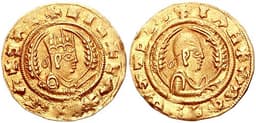
Eon of Aksum
Emperor · Ancient
39.1Total

Julius Caesar
General · Ancient
82.8Total
Basic Information
Born
390
-100
Died
410
-44
Era
Ancient
Ancient
Nationality
Ethiopia
Roman Republic
Occupation
Emperor
General
Civilization
Other
Western
Score Comparison
Military (10%)
25.9
88.0
Political (20%)
29.3
78.0
Influence (20%)
45.5
85.0
Legacy (20%)
35.0
82.0
Leadership (15%)
55.3
80.0
Strategy (15%)
36.8
85.0
TOTAL
39.1
82.8
Eon of Aksum — Complete Timeline
395 AD
Issued gold coins with royal portraitCultural
Eon of Aksum minted gold coins featuring his crowned portrait, continuing the tradition of royal coinage. These coins were used in long-distance trade and demonstrated Aksumite sovereignty.
CoinageRoyal PortraitureTrade
Impact: regional
400 AD
Maintained diplomatic relations with ByzantiumPolitical Action
Eon likely maintained contact with the Byzantine Empire, as suggested by the style of his coinage. This relationship helped secure Aksum's position in the Red Sea trade network.
DiplomacyByzantine EmpireTrade
Impact: regional
Julius Caesar — Complete Timeline
58 BC
Gallic WarsWar◆ Major
Caesar, as proconsul of Gaul, launched a series of campaigns that conquered all of Gaul (modern France, Belgium, and parts of Switzerland). He fought numerous battles, including against the Helvetii, the Belgae, and the Gallic chieftain Vercingetorix. The wars brought immense wealth and a loyal army to Caesar.
Gallic WarsConquestRoman Expansion
Impact: regional
49 BC
Crossing the RubiconPolitical Action◆ Major
Caesar led Legio XIII across the Rubicon River into Italy, defying the Roman Senate's order to disband his army. This act triggered a civil war against Pompey and the Optimates, ultimately leading to Caesar's dictatorship and the end of the Roman Republic.
Roman Civil WarEnd of RepublicPower Struggle
Impact: global
48 BC
Battle of PharsalusWar◆ Major
Caesar's outnumbered army defeated the larger forces of Pompey the Great at Pharsalus in Greece. Caesar's tactical use of a reserve line to counter Pompey's cavalry charge proved decisive. Pompey fled to Egypt, where he was assassinated, leaving Caesar as the undisputed master of the Roman world.
Roman Civil WarBattleDecisive Victory
Impact: regional
44 BC
Appointment as Dictator for LifePolitical Action◆ Major
The Roman Senate appointed Caesar dictator perpetuo (dictator for life), granting him unprecedented personal power. This move concentrated military, legislative, and judicial authority in one person, effectively ending the Roman Republic's traditional system of checks and balances and alarming many senators.
DictatorshipEnd of RepublicPower Consolidation
Impact: regionaldestructive
Assassination on the Ides of MarchPolitical Action◆ Major
A group of Roman senators, led by Marcus Junius Brutus and Gaius Cassius Longinus, stabbed Caesar to death at a meeting of the Senate in the Theatre of Pompey. The assassination was intended to restore the Republic, but instead triggered another civil war that led to the rise of the Roman Empire.
AssassinationRoman PoliticsEnd of Republic
Impact: globaldestructive
Expert Analysis
eon-of-aksum-vs-julius-caesar
# The Emperor and the General: Eon of Aksum and Julius Caesar
In the year 395, somewhere in the highlands of what is now Ethiopia, a king named Eon ordered his mint to strike gold coins bearing his crowned portrait. Across the Mediterranean, in a Roman world still reeling from civil wars, Julius Caesar had been dead for nearly four and a half centuries. The coins Eon issued are small, precious, and nearly all that remains of his reign. Caesar, by contrast, left behind a world transformed—a Republic turned Empire, a calendar reformed, and a name that would become synonymous with absolute power. How could two rulers, both ancient, both men of authority, leave such different marks on history? The answer lies not merely in their actions, but in the worlds they inherited and the choices they made within them.
Origins
Julius Caesar was born into the Roman aristocracy in 100 BCE, a time when the Republic was tearing itself apart. His family, the Julii, claimed descent from the goddess Venus, but they were not among the wealthiest or most powerful. Caesar grew up in the shadow of political violence—the Social Wars, the civil strife between Marius and Sulla. His father died when he was sixteen, and he narrowly escaped Sulla’s proscriptions by fleeing Rome. He was a patrician by birth, but a survivor by necessity.
Eon of Aksum, by contrast, ruled a kingdom that had flourished for centuries. Aksum, in modern-day Ethiopia and Eritrea, was a trading empire that connected the Roman world to India and Africa. Its kings had long issued coinage—silver, bronze, and gold—as symbols of sovereignty and economic power. Eon’s exact origins are lost, but his reign, around 390 to 410, came during a period of relative stability. Aksum was Christian, allied with Byzantium, and rich from trade. Eon inherited a throne that required no conquest to secure, only the maintenance of what already existed.
Rise to Power
Caesar’s rise was a masterclass in ambition. He climbed the Roman political ladder—quaestor, aedile, praetor—each step funded by borrowed money and alliances with men like Crassus and Pompey. His military command in Gaul, beginning in 58 BCE, was his true springboard. Over eight years, he conquered a vast territory, built a loyal army, and amassed wealth that made him a threat to the Senate. When ordered to disband his forces, he crossed the Rubicon River in 49 BCE, an act of war that launched a civil war. He emerged as dictator, then dictator for life.
Eon’s path to power is almost invisible. He appears in history only through his coins, which bear his name and portrait in the style of Byzantine emperors. There is no record of a coup, a war, or a dramatic crossing. He likely inherited the throne peacefully, as Aksumite kings usually did. His rise was not a story of struggle but of continuity. The most dramatic event of his reign, as far as we know, was the minting of gold coins in 395—a routine act of royal display.
Leadership & Governance
Caesar governed as a revolutionary. As dictator, he reformed the calendar, introduced the Julian calendar that would serve Europe for sixteen centuries. He granted citizenship to Gauls, expanded the Senate with his supporters, and launched ambitious public works. He centralized power in his own hands, bypassing the traditional aristocratic bodies. His military genius was undeniable—his siege of Alesia in 52 BCE remains a textbook example of engineering and strategy. But his political wisdom was flawed: he pardoned his enemies, only to be stabbed by them.
Eon’s governance is known only through inference. His coins suggest a stable kingdom, integrated into the Byzantine sphere. The style of his coinage imitates Constantinople, indicating diplomatic ties—likely maintained around 400, as the historical record hints. He did not need to conquer or reform; Aksum was already a prosperous Christian kingdom with a functioning bureaucracy. His leadership was conservative, preserving what existed rather than remaking it.
Triumph & Tragedy
Caesar’s greatest triumph was the conquest of Gaul, which doubled Rome’s territory and made him the most powerful man in the Republic. His most devastating failure was his assassination on the Ides of March in 44 BCE, when senators he had pardoned stabbed him to death. He died believing he could control the forces he had unleashed, but his murder plunged Rome into another civil war. In his final moments, according to tradition, he pulled his toga over his face—a gesture of dignity in the face of betrayal.
Eon’s triumphs and tragedies are lost. He issued coins, and then he died. There is no record of a great battle, a rebellion, or a dramatic end. His tragedy may be that he ruled during a period of quiet decline. After his reign, Aksum’s power slowly waned, its trade routes disrupted by the rise of Islam. Eon’s gold coins would become artifacts, dug up centuries later by archaeologists, their king a name without a story.
Character & Destiny
Caesar’s character was audacity itself. He took risks that would have destroyed lesser men—borrowing fortunes, defying the Senate, marching on Rome. His confidence bordered on arrogance, and his clemency toward enemies was both a strength and a fatal weakness. He believed in his own destiny, and history proved him right, though not in the way he expected. His name became a title: Kaiser, Tsar, Caesar.
Eon’s character is unknowable. He was likely a traditionalist, content to rule within the framework his ancestors built. He did not seek to expand Aksum’s borders or challenge Rome. His destiny was to be forgotten, preserved only by the coins he minted. In a sense, he succeeded: his reign was stable, his kingdom at peace. But stability leaves few stories.
Legacy
Caesar’s legacy is immeasurable. He ended the Roman Republic and set the stage for the Empire, which lasted another five centuries in the West and a thousand more in the East. His writings, especially his *Commentaries on the Gallic War*, remain classics of military literature. His name is a byword for ambition and power, studied by generals and politicians for two millennia.
Eon’s legacy is a handful of gold coins, housed in museums. They are invaluable to historians, who use them to date Aksumite kings and trace trade networks. But outside of academic circles, Eon is unknown. His legacy is not a transformed world but a preserved moment—a king, a crown, a coin.
Conclusion
Standing at the edge of history, we see Caesar as a tide that reshaped the shoreline, Eon as a ripple that vanished into the deep. Both were kings, both ruled, both died. But Caesar’s world was one of violent change, where ambition could topple republics and build empires. Eon’s world was one of quiet continuity, where a king’s greatest act was to mint a coin that said, “I was here.” The difference is not in their worth as men, but in the currents of their time. Caesar rode a storm; Eon sailed a calm sea. History remembers the storm.
Rankings
🥇
Julius CaesarLeader
Mil: 88.0Pol: 78.0Inf: 85.0
82.8
🥈
Eon of Aksum
Mil: 25.9Pol: 29.3Inf: 45.5
39.1
+43.7 behind
How This Comparison Works
Algorithm
Each figure is scored on 6 dimensions (0—100 scale) based on structured historical data: Military (10%), Political (20%), Influence (20%), Legacy (20%), Leadership (15%), Strategy (15%). The weighted total produces the final ranking.
Data Sources
Scores are computed from structured sub-indicators in the database. Scale factors adjust for era (Ancient ×0.85, Modern ×1.0) and civilization size (Eastern ×1.05, Other ×0.80) to account for differences in population and military scale.
Maximum 3 Figures
Comparisons are limited to 2—3 figures to ensure readability and statistical meaningfulness.
Error Margins
±5 points per dimension — Sub-scores are derived from historical records with inherent uncertainty. Two figures within 5 points on a dimension should be considered roughly equivalent in that area.
Total Score Accuracy
±3 points overall — The weighted combination of 6 dimensions produces a total score with approximately ±3 points of uncertainty. Differences of less than 3 points are not statistically significant— the figures are effectively tied.
Known Limitations
- Historical records are incomplete and uneven across civilizations
- Figures from oral-tradition societies may be underrepresented
- Occupation labels can misclassify multi-role figures
- Scores measure capability and impact, not moral character
- Quantitative scoring is a comparison tool, not absolute truth
Capability Radar
Military (10%) — Battles & Warfare
Battles
10
95
Win Rate
10
92
Expansion
10
97
Political (20%) — Governance & Reform
Reform
20
90
Diplomacy
20
85
Economy
30
82
Influence (20%) — Cultural & Global Reach
Cultural
20
88
Global
10
94
Legacy (20%) — Historical Impact
Historical
20
95
Longevity
10
96
Leadership (15%) — Power & Stability
Tenure
40
75
Stability
30
60
Strategy (15%) — Tactics & Innovation
Strategy
10
94
Tactics
10
96
Reform
10
88
Similar Comparisons
Comments & Discussion
**MarshalMetrics**6/17/2026
Sure, Caesar's conquests were impressive, but let's not conflate body count with lasting impact. The man died with no clear succession plan, sparking another century of civil war. Eon's gold coins tell a quieter story: a stable, transcontinental trade empire that outlived Rome's western half. Coins don't lie about economic depth—Caesar left a blood-soaked Senate, Eon left a functioning mint. Give me the tax collector king over the glory-hound general any day.
**克娄巴特拉的算盘**6/17/2026
拿阿克苏姆的埃翁跟凯撒比?这就像把一只旱地乌龟放到地中海鲨鱼池里。凯撒用高卢战争欠下的债买通了罗马,而埃翁大王?他留下的金币上甚至无法清楚刻出自己的眼睛。史料里连一场像样的战役记录都没有,却来碰瓷《高卢战记》的作者?如果阿克苏姆真那么强,怎么隔壁波斯人都懒得提他半句?历史不是谁活得久谁赢,是看谁搅动了世界的血管。
**ClassicalCounter**6/17/2026
Caesar's calendar reform alone trumps Eon's entire material legacy. The Julian calendar governed Europe for 1,600 years and directly shaped our modern system. Eon's gold staters are beautiful—I've seen them at the British Museum—but they reflect participation in an existing Mediterranean trade network, not innovation. Caesar didn't just use the system; he rewired it. When your name becomes a title for emperors, that's influence measured in centuries, not geography.
**红海考古迷**6/17/2026
你们这些罗马粉丝总喜欢拿战争与政治说事,却忽略了一个事实:埃翁统治时的阿克苏姆是当时全球四大力量之一,与波斯、罗马和印度平起平坐。他的金币在从亚历山大港到斯里兰卡的港口流通。凯撒至死没见过印度洋一口水,而阿克苏姆的商人已经在用本地文字跟孔雀王朝的后裔做生意了。等凯撒把他那套宪政危机搞定,东非高原的象牙和香料早已铺满半个旧世界。
**Revisionist_Rome**6/17/2026
The comparison is fundamentally flawed because it imposes a Western-centric metric of "impact." Caesar's "genius" was largely self-mythologized propaganda—he wrote his own press releases in the third person. Eon, with no surviving literary tradition, left us a material culture that speaks to sustainable statecraft. One man built a cult of personality that collapsed within a generation; the other's kingdom lasted seven centuries. Who's the better ruler? Ask the people who didn't get assassinated