Loading...
Epaminondas vs Hannibal Barca
Epaminondas leads by 3.8 pts · 2 figures compared
…

Epaminondas
General · Ancient
61.0Total
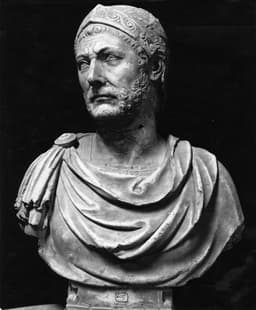
Hannibal Barca
General · Ancient
57.2Total
Basic Information
Born
-418
-247
Died
-362
-183
Era
Ancient
Ancient
Nationality
Greece
Carthage
Occupation
General
General
Civilization
Western
Middle Eastern
Score Comparison
Military (10%)
65.0
92.0
Political (20%)
68.0
35.0
Influence (20%)
55.0
55.0
Legacy (20%)
55.0
40.0
Leadership (15%)
57.6
68.0
Strategy (15%)
81.9
88.0
TOTAL
61.0
57.2
Epaminondas — Complete Timeline
371 BC
Battle of LeuctraWar
Epaminondas led the Theban army to defeat the Spartans at Leuctra using innovative tactics, including an echelon formation with a deep left flank. The victory shattered Spartan military dominance and ended their hegemony over Greece.
Greek WarfareSpartan HegemonyMilitary Innovation
Impact: regional
370 BC
First Invasion of the PeloponneseWar◆ Major
Epaminondas led a Theban army into the Peloponnese, invading Spartan territory for the first time in centuries. He liberated Messenia from Spartan control and founded the city of Messene, permanently weakening Sparta's economy and military.
SpartaMesseniaGreek Politics
Impact: regional
368 BC
Foundation of MegalopolisPolitical Action◆ Major
Epaminondas founded the city of Megalopolis as the capital of the Arcadian League. The city served as a political counterweight to Sparta and a center for anti-Spartan forces in the Peloponnese.
Urban FoundationArcadian LeagueAnti-Spartan
Impact: regionalconstructive
362 BC
Battle of MantineaWar
Epaminondas led the Theban army against a coalition of Sparta, Athens, and other Greek states at Mantinea. The Thebans won the battle, but Epaminondas was killed. His death ended Theban hegemony and left Greece in a power vacuum.
BattleDeathGreek Hegemony
Impact: regionaltragic
Hannibal Barca — Complete Timeline
219 BC
Siege of SaguntumWar◆ Major
Hannibal besieged and captured Saguntum, a Roman ally in Spain. This act violated a treaty with Rome and directly triggered the Second Punic War. The eight-month siege demonstrated Hannibal's determination and military skill, but also his willingness to provoke conflict.
SiegeProvocationWar Start
Impact: regionaldestructive
218 BC
Crossing of the AlpsWar
Hannibal led a Carthaginian army, including war elephants, from Spain across the Alps into Italy. The journey was arduous, with significant losses from terrain, weather, and attacks by mountain tribes. This strategic maneuver surprised the Romans and brought the war to their homeland.
Military CampaignAlpsStrategy
Impact: global
216 BC
Battle of CannaeWar
Hannibal's outnumbered army encircled and annihilated a larger Roman force at Cannae in southern Italy. The Romans suffered up to 70,000 casualties in one day. This battle is considered a masterpiece of tactical encirclement and remains studied in military academies.
BattleTacticsRoman Defeat
Impact: globaldestructive
202 BC
Battle of ZamaWar
Hannibal was defeated by Scipio Africanus at Zama in North Africa. Scipio's tactics neutralized Hannibal's elephants and cavalry, leading to a decisive Roman victory. This battle ended the Second Punic War and forced Carthage to accept harsh peace terms.
BattleDefeatEnd of War
Impact: globaltragic
183 BC
Exile and DeathPolitical Action◆ Major
After the war, Hannibal became a politician in Carthage, but Roman pressure forced him into exile. He fled to the Seleucid court, then to Bithynia. When the Romans demanded his extradition, he committed suicide by poison, ending his life as a fugitive.
ExileSuicideRoman Pursuit
Impact: regionaltragic
Expert Analysis
Origins
Epaminondas was born around 418 BCE in Thebes, Greece, into a noble but impoverished family. His father, Polymnis, ensured he received a thorough education in philosophy, music, and physical training. He studied under the Pythagorean philosopher Lysis of Tarentum, which deeply influenced his strategic thinking. In contrast, Hannibal Barca was born in 247 BCE in Carthage, into the prominent Barcid family. His father, Hamilcar Barca, was a leading general in the First Punic War. Hannibal was raised in a military environment, swearing eternal enmity against Rome at a young age. He received rigorous training in warfare and administration, preparing him for command.
Rise to Power
Epaminondas rose to prominence in Thebes during a period of Spartan hegemony. In 379 BCE, he participated in the democratic revolution that expelled the Spartan-backed oligarchy. He became a key political and military leader, serving as a Boeotarch (one of the chief magistrates) multiple times. His decisive moment came in 371 BCE at the Battle of Leuctra, where he defeated the Spartan army using a revolutionary tactic: concentrating his best troops on the left wing in a deep column, rather than the traditional evenly-spaced phalanx. This victory broke Spartan military dominance and established Theban hegemony.
Hannibal's rise began in Spain, where he succeeded his brother-in-law Hasdrubal as commander in 221 BCE. He quickly consolidated Carthaginian control over the Iberian Peninsula. In 219 BCE, he besieged and captured Saguntum, a Roman ally, triggering the Second Punic War. His audacious crossing of the Alps in 218 BCE with a multi-ethnic army, including war elephants, brought him into Italy, where he won a series of stunning victories. The Battle of Cannae in 216 BCE, where he annihilated a Roman army of up to 80,000 men, remains a classic example of tactical encirclement.
Leadership & Governance
Epaminondas was known for his democratic and collaborative leadership. He promoted the Boeotian League as a federal state, strengthening Thebes' political influence. He also founded Megalopolis as a counterweight to Sparta and liberated Messenia, creating a buffer state. His governance focused on building alliances and spreading democratic ideals. In contrast, Hannibal was a charismatic autocrat who commanded unwavering loyalty from his multi-ethnic troops. He relied on personal authority and tactical brilliance rather than institutional reforms. Politically, Hannibal scored 35.0, reflecting his limited success in Carthaginian politics after the war. Epaminondas scored 68.0 in political impact, demonstrating his effectiveness as a statesman.
Triumph & Tragedy
Epaminondas' greatest triumph was the Battle of Leuctra (371 BCE), where his innovative tactics shattered Spartan invincibility. He also invaded the Peloponnese, liberating Messenia and reducing Sparta to a secondary power. However, his final battle, the Battle of Mantinea (362 BCE), was a mixed outcome: the Thebans won, but Epaminondas was killed in the fighting. His death led to the rapid decline of Theban hegemony, as no successor could match his leadership. Hannibal's greatest triumph was Cannae, a masterpiece of tactical encirclement that caused immense Roman casualties. Yet his failure to march on Rome immediately after Cannae is often criticized. His ultimate tragedy was defeat at Zama (202 BCE) by Scipio Africanus, leading to Carthage's humiliation. He later fled into exile and died by suicide in 183 BCE to avoid capture.
Character & Destiny
Epaminondas was described as modest, philosophical, and incorruptible. His character shaped his destiny: his selfless dedication to Thebes and willingness to die for his city led to his heroic death. Historians note his strategic creativity—scoring 81.9 in strategy—and his ability to inspire loyalty. Hannibal, by contrast, was cunning, ruthless, and relentless. His strategic score of 88.0 reflects his tactical genius, but his political naivety (political score 35.0) undermined his long-term success. His character—driven by a personal vendetta against Rome—ultimately led to his downfall, as he could not secure lasting support from Carthage or its allies.
Legacy
Epaminondas' legacy is profound but often overlooked. His tactics at Leuctra directly influenced later military thinkers, including Philip II of Macedon, who adopted the deep phalanx. He reshaped the Greek political landscape by ending Spartan dominance and promoting federalism. However, his influence score of 55.0 reflects his limited long-term impact outside military history. Hannibal's legacy is more widespread: his crossing of the Alps and Cannae are studied in military academies worldwide. His score of 40.0 in legacy might seem low, but it is due to his ultimate failure to defeat Rome. Nevertheless, his strategic innovations and the fear he instilled in Rome have ensured his enduring fame.
Conclusion
While both were exceptional generals, Epaminondas had a greater impact on the course of history. His victory at Leuctra permanently altered the Greek balance of power, weakening Sparta and enabling the rise of Macedon. Hannibal's victories, though brilliant, did not achieve their strategic goal of breaking Rome. Epaminondas' political and military achievements—scoring a total of 61.0 compared to Hannibal's 57.2—demonstrate his more comprehensive influence. Epaminondas not only won battles but also built a lasting political structure through the Boeotian League and the liberation of Messenia. Hannibal, despite his tactical superiority, failed to secure Carthage's future. Therefore, Epaminondas emerges as the more impactful figure in terms of altering the historical trajectory of the ancient world.
Rankings
🥇
EpaminondasLeader
Mil: 65.0Pol: 68.0Inf: 55.0
61.0
🥈
Hannibal Barca
Mil: 92.0Pol: 35.0Inf: 55.0
57.2
+3.8 behind
How This Comparison Works
Algorithm
Each figure is scored on 6 dimensions (0—100 scale) based on structured historical data: Military (10%), Political (20%), Influence (20%), Legacy (20%), Leadership (15%), Strategy (15%). The weighted total produces the final ranking.
Data Sources
Scores are computed from structured sub-indicators in the database. Scale factors adjust for era (Ancient ×0.85, Modern ×1.0) and civilization size (Eastern ×1.05, Other ×0.80) to account for differences in population and military scale.
Maximum 3 Figures
Comparisons are limited to 2—3 figures to ensure readability and statistical meaningfulness.
Error Margins
±5 points per dimension — Sub-scores are derived from historical records with inherent uncertainty. Two figures within 5 points on a dimension should be considered roughly equivalent in that area.
Total Score Accuracy
±3 points overall — The weighted combination of 6 dimensions produces a total score with approximately ±3 points of uncertainty. Differences of less than 3 points are not statistically significant— the figures are effectively tied.
Known Limitations
- Historical records are incomplete and uneven across civilizations
- Figures from oral-tradition societies may be underrepresented
- Occupation labels can misclassify multi-role figures
- Scores measure capability and impact, not moral character
- Quantitative scoring is a comparison tool, not absolute truth
Capability Radar
Military (10%) — Battles & Warfare
Battles
75
95
Win Rate
85
92
Expansion
60
85
Political (20%) — Governance & Reform
Reform
70
30
Diplomacy
75
60
Economy
50
35
Influence (20%) — Cultural & Global Reach
Cultural
65
85
Global
60
85
Legacy (20%) — Historical Impact
Historical
80
95
Longevity
70
90
Leadership (15%) — Power & Stability
Tenure
55
40
Stability
45
25
Strategy (15%) — Tactics & Innovation
Strategy
90
95
Tactics
95
99
Reform
85
70
Similar Comparisons
Comments & Discussion
No comments yet. Be the first to share your thoughts!