Loading...
Hannibal Barca vs Napoleon Bonaparte
Napoleon Bonaparte leads by 13.7 pts · 2 figures compared
…
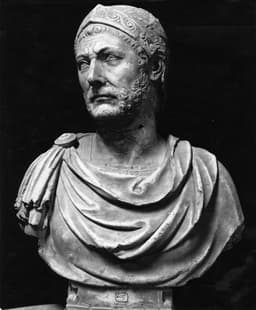
Hannibal Barca
General · Ancient
57.2Total

Napoleon Bonaparte
General · Modern
70.9Total
Basic Information
Born
-247
1769
Died
-183
1821
Era
Ancient
Modern
Nationality
Carthage
France
Occupation
General
General
Civilization
Middle Eastern
Western
Score Comparison
Military (10%)
92.0
94.0
Political (20%)
35.0
72.0
Influence (20%)
55.0
40.0
Legacy (20%)
40.0
80.0
Leadership (15%)
68.0
78.0
Strategy (15%)
88.0
90.0
TOTAL
57.2
70.9
Hannibal Barca — Complete Timeline
219 BC
Siege of SaguntumWar◆ Major
Hannibal besieged and captured Saguntum, a Roman ally in Spain. This act violated a treaty with Rome and directly triggered the Second Punic War. The eight-month siege demonstrated Hannibal's determination and military skill, but also his willingness to provoke conflict.
SiegeProvocationWar Start
Impact: regionaldestructive
218 BC
Crossing of the AlpsWar
Hannibal led a Carthaginian army, including war elephants, from Spain across the Alps into Italy. The journey was arduous, with significant losses from terrain, weather, and attacks by mountain tribes. This strategic maneuver surprised the Romans and brought the war to their homeland.
Military CampaignAlpsStrategy
Impact: global
216 BC
Battle of CannaeWar
Hannibal's outnumbered army encircled and annihilated a larger Roman force at Cannae in southern Italy. The Romans suffered up to 70,000 casualties in one day. This battle is considered a masterpiece of tactical encirclement and remains studied in military academies.
BattleTacticsRoman Defeat
Impact: globaldestructive
202 BC
Battle of ZamaWar
Hannibal was defeated by Scipio Africanus at Zama in North Africa. Scipio's tactics neutralized Hannibal's elephants and cavalry, leading to a decisive Roman victory. This battle ended the Second Punic War and forced Carthage to accept harsh peace terms.
BattleDefeatEnd of War
Impact: globaltragic
183 BC
Exile and DeathPolitical Action◆ Major
After the war, Hannibal became a politician in Carthage, but Roman pressure forced him into exile. He fled to the Seleucid court, then to Bithynia. When the Romans demanded his extradition, he committed suicide by poison, ending his life as a fugitive.
ExileSuicideRoman Pursuit
Impact: regionaltragic
Napoleon Bonaparte — Complete Timeline
1799 AD
Coup of 18 BrumaireOther◆ Major
Napoleon Bonaparte, with support from his brother Lucien and key political figures, overthrew the Directory in a bloodless coup. He established the Consulate with himself as First Consul, effectively becoming the ruler of France. This event ended the French Revolution's most unstable period.
French RevolutionCoupRise to Power
Impact: regional
1804 AD
Promulgation of the Napoleonic CodeOther◆ Major
Napoleon enacted the Civil Code of the French, known as the Napoleonic Code, a comprehensive set of laws that replaced the fragmented feudal legal systems. The code established legal equality, protected property rights, and secularized law. It became the basis for legal systems in many European and world countries.
Legal ReformNapoleonic CodeCivil Law
Impact: globalconstructive
1805 AD
Battle of AusterlitzWar◆ Major
Napoleon's Grande Arm
Napoleonic WarsBattleDecisive Victory
Impact: global
1812 AD
Invasion of RussiaWar◆ Major
Napoleon led the Grande Arm
Napoleonic WarsInvasionDisaster
Impact: globaldestructive
1815 AD
Battle of WaterlooWar◆ Major
Napoleon's French army was defeated by the combined forces of the Duke of Wellington's Anglo-Allied army and Gebhard Leberecht von Bl
Napoleonic WarsBattleFinal Defeat
Impact: globaldestructive
Expert Analysis
hannibal-barca-vs-napoleon-bonaparte
# The Lonely Peaks of Genius
On a September morning in 216 BCE, a Carthaginian army of some 50,000 men stood on a dusty plain near the town of Cannae in southern Italy. Across from them, nearly 80,000 Romans formed up in a dense, massive block—a formation designed to crush any opposition by sheer weight. What followed was not a battle but a butchery. By sunset, the Roman Republic had lost perhaps 50,000 to 70,000 men, the single worst military disaster in its long history. The victor was a man named Hannibal Barca, a general from the North African city of Carthage, who had marched an army, including war elephants, over the Alps into the heart of enemy territory. Yet for all his brilliance, Hannibal would never conquer Rome.
Nearly two thousand years later, another general faced a similar challenge. In 1805, Napoleon Bonaparte, the Emperor of the French, stood on a hill near Austerlitz in Moravia, watching a combined Russian and Austrian army maneuver into a trap he had laid. When the sun rose on December 2, it illuminated a battlefield that would become a legend. Napoleon’s 73,000 men destroyed an allied force of 85,000, killing or capturing over a third of them. Unlike Hannibal, Napoleon would go on to dominate Europe for a decade, redrawing its borders and its laws. The question that haunts history is simple: why?
Origins
Hannibal was born in 247 BCE into a warrior aristocracy of Carthage, a Phoenician trading empire that had already fought one brutal war with Rome. His father, Hamilcar Barca, was a general who had fought the Romans in Sicily and who instilled in his son a burning hatred for the Republic. According to the Roman historian Livy, Hamilcar made the young Hannibal swear an oath of eternal enmity against Rome. Hannibal’s world was one of maritime commerce, mercenary armies, and a senate that could never quite decide whether to support its generals or watch them fail.
Napoleon, born in 1769 on the island of Corsica, came from a very different place. Corsica had just been conquered by France, and his family were minor nobles of Italian origin. He was not a child of an ancient empire but of the Enlightenment, a young man who devoured books on military science, philosophy, and the history of conquerors like Alexander and Caesar. His world was one of revolutionary ferment, where old hierarchies were crumbling and a determined man could rise on talent alone.
Rise to Power
Hannibal’s path to command was direct: he inherited it. At age 26, after his father and brother-in-law had died, the Carthaginian army in Spain acclaimed him as its leader. His authority came from the loyalty of soldiers who had fought for his family for years. He had no need to persuade a parliament or win an election. His first great act was the siege of Saguntum in 219 BCE, a Roman ally in Spain. By capturing it, he deliberately provoked war with Rome—a war he intended to carry into Italy itself.
Napoleon’s rise was anything but inherited. He was a young artillery officer during the French Revolution, a time of chaos and opportunity. In 1795, he saved the revolutionary government from a royalist uprising in Paris, and by 1796, at age 26, he was given command of the French army in Italy. He won stunning victories against the Austrians, then launched an expedition to Egypt in 1798. But his true moment came in 1799, when he seized power in a coup d’état, becoming First Consul of France. He did not inherit an army; he created one, and a state to go with it.
Leadership & Governance
As generals, both men were near-perfect. Hannibal’s masterpiece was Cannae in 216 BCE, where he used a crescent-shaped formation to draw the Roman center forward, then enveloped their flanks with his African veterans. It was a battle of annihilation, a feat rarely achieved in ancient warfare. Napoleon’s masterpiece was Austerlitz in 1805, where he deliberately weakened his right flank to lure the allies into attacking, then struck their center with overwhelming force. Both men understood that war was not about winning battles but about destroying the enemy’s will to fight.
But here the paths diverge. Hannibal was a military genius but a political failure. He won battle after battle in Italy for fifteen years, but he could never persuade Rome’s Italian allies to defect in large numbers. He lacked the siege equipment to take Rome itself, and the Carthaginian senate sent him little reinforcement. He was fighting a war of attrition he could not win. Napoleon, by contrast, was a political genius of the first order. He created the Napoleonic Code, a legal system that standardized French law and spread across Europe. He reformed education, centralized the government, and built a network of alliances through marriage and diplomacy. He did not just conquer; he organized.
Triumph & Tragedy
Hannibal’s greatest triumph was also his greatest tragedy. After Cannae, he had Rome on its knees. Yet he could not finish the war. The Romans, led by Fabius Maximus’s strategy of avoiding battle, simply waited him out. When a Roman army under Scipio Africanus invaded Carthage itself, Hannibal was recalled to Africa. At the Battle of Zama in 202 BCE, Scipio used a new formation—manipular lines with gaps—to neutralize Hannibal’s elephants and defeat him. Hannibal escaped alive, but Carthage was forced to surrender. He spent his last years in exile, fleeing from Roman agents, and died by his own hand in 183 BCE.
Napoleon’s tragedy came later. After conquering most of Europe, he invaded Russia in 1812 with over 600,000 men. The Russians refused to fight a decisive battle, retreating and burning the countryside. Napoleon reached Moscow, but found it abandoned and burning. Forced to retreat in the Russian winter, his Grande Armée was destroyed. By 1814, the allies had invaded France, and Napoleon was forced to abdicate. He returned in 1815 for a final, desperate campaign, only to be defeated at Waterloo by the Duke of Wellington and Gebhard von Blücher. He died in exile on the island of St. Helena in 1821.
Character & Destiny
Hannibal was a man of iron will and tactical genius, but he was also a man of his time. He saw war as a duel between generals, not as a project of state-building. He never tried to create a political system that could sustain his conquests. When he lost, he accepted it as fate.
Napoleon was a man of boundless ambition and cold calculation. He saw war as an instrument of policy, and policy as an instrument of power. He built institutions that outlasted him. But his ambition was also his flaw. He could not stop. He invaded Russia not because he had to, but because he could not bear to leave an enemy undefeated. His character drove him to the heights, then over the edge.
Legacy
Hannibal left behind a legend. Every military academy still studies Cannae. His name became a byword for strategic genius. But he left no lasting institutions, no code, no empire. Carthage was destroyed by Rome in 146 BCE, and Hannibal’s memory lived on only as a warning to Rome’s enemies—and as a lesson for future generals.
Napoleon left behind a transformed Europe. The Napoleonic Code remains the basis of civil law in many countries. He redrew the map of Germany and Italy, setting the stage for their unification. He spread the ideals of the French Revolution—equality before the law, secular government, meritocracy—across the continent. Even his enemies adopted his reforms. He is remembered not just as a general but as a founder.
Conclusion
What separates these two titans is not their military brilliance, which was nearly equal. It is their understanding of power beyond the battlefield. Hannibal could destroy an army but could not build a state. Napoleon could do both. One fought for revenge, the other for empire. One died in exile, forgotten by his city; the other died in exile, but his name became an era. The lesson of their lives is that military genius alone is not enough. To change the world, a general must also be a statesman. And that is a far rarer gift than any victory.
Rankings
🥇
Napoleon BonaparteLeader
Mil: 94.0Pol: 72.0Inf: 40.0
70.9
🥈
Hannibal Barca
Mil: 92.0Pol: 35.0Inf: 55.0
57.2
+13.7 behind
How This Comparison Works
Algorithm
Each figure is scored on 6 dimensions (0—100 scale) based on structured historical data: Military (10%), Political (20%), Influence (20%), Legacy (20%), Leadership (15%), Strategy (15%). The weighted total produces the final ranking.
Data Sources
Scores are computed from structured sub-indicators in the database. Scale factors adjust for era (Ancient ×0.85, Modern ×1.0) and civilization size (Eastern ×1.05, Other ×0.80) to account for differences in population and military scale.
Maximum 3 Figures
Comparisons are limited to 2—3 figures to ensure readability and statistical meaningfulness.
Error Margins
±5 points per dimension — Sub-scores are derived from historical records with inherent uncertainty. Two figures within 5 points on a dimension should be considered roughly equivalent in that area.
Total Score Accuracy
±3 points overall — The weighted combination of 6 dimensions produces a total score with approximately ±3 points of uncertainty. Differences of less than 3 points are not statistically significant— the figures are effectively tied.
Known Limitations
- Historical records are incomplete and uneven across civilizations
- Figures from oral-tradition societies may be underrepresented
- Occupation labels can misclassify multi-role figures
- Scores measure capability and impact, not moral character
- Quantitative scoring is a comparison tool, not absolute truth
Capability Radar
Military (10%) — Battles & Warfare
Battles
95
95
Win Rate
92
90
Expansion
85
95
Political (20%) — Governance & Reform
Reform
30
95
Diplomacy
60
80
Economy
35
85
Influence (20%) — Cultural & Global Reach
Cultural
85
85
Global
85
90
Legacy (20%) — Historical Impact
Historical
95
95
Longevity
90
90
Leadership (15%) — Power & Stability
Tenure
40
85
Stability
25
70
Strategy (15%) — Tactics & Innovation
Strategy
95
95
Tactics
99
98
Reform
70
92
Similar Comparisons
Comments & Discussion
No comments yet. Be the first to share your thoughts!